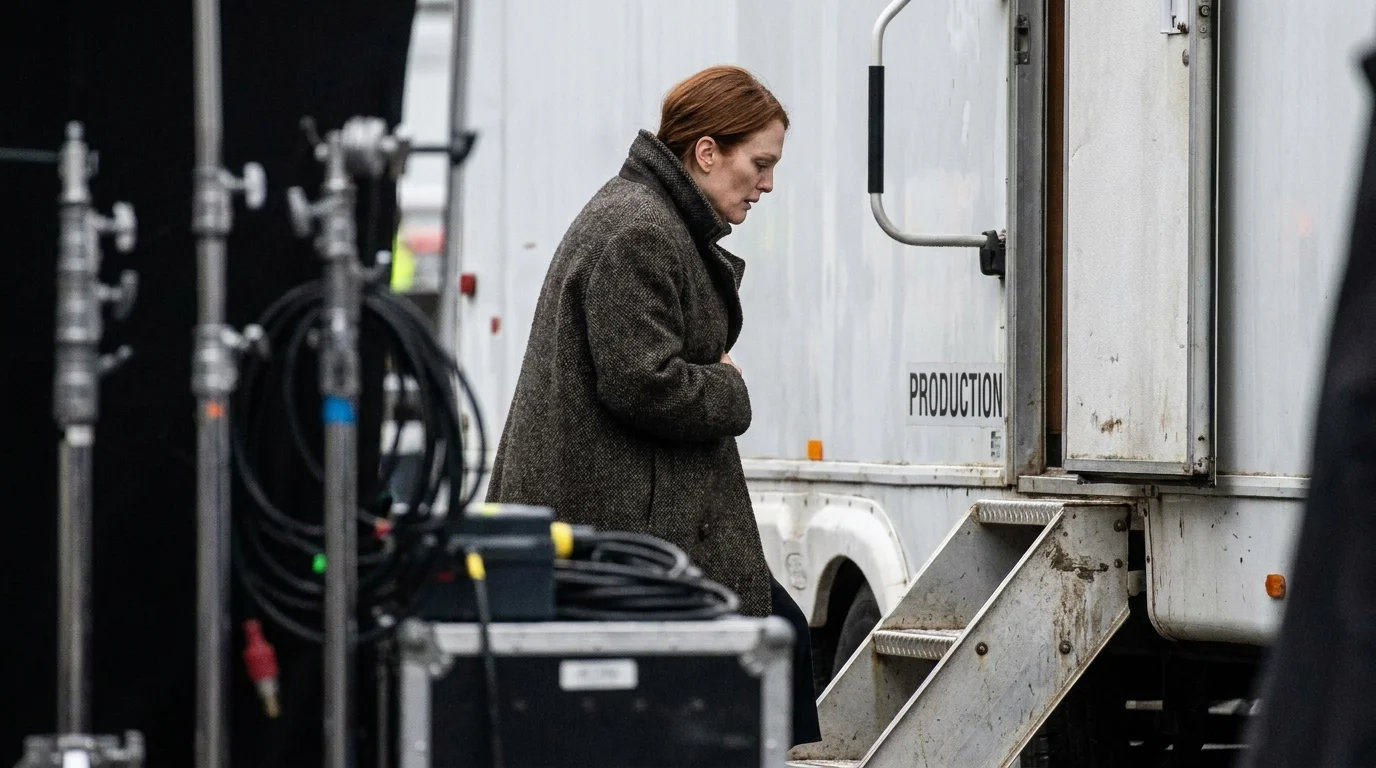
The drafty air of a Manhattan rehearsal warehouse in winter has a way of exposing cracks in a production before the cameras even arrive. The hum of a cheap space heater struggles against the chill, while a heavy wooden table sits littered with paper cups of lukewarm espresso and marked-up script pages. You expect a high-stakes film set to run with seamless precision, but often, the most significant shifts happen in these quiet, shivering rooms where the air grows thick with silent resistance.
Julianne Moore sat in a metal folding chair, her silhouette framed by the harsh winter light cutting through the industrial windows. She wore a heavy wool winter coat, its dark collar pulled high, refusing to take it off during the long rehearsal block. To an outsider, it might have looked like a simple reaction to the drafty room, but to those sitting across from her, that buttoned-up coat was a physical shield, a manifestation of a creative wall that no director could scale.
The project was an ambitious independent feature, a character-driven biopic designed to showcase raw vulnerability. Yet, as the table reads progressed, a quiet friction began to warp the room. Moore’s deeply researched interpretation of the lead role—complete with specific wardrobe demands and a sharp, defensive script tone—began to clash directly with the vision of the lead actor and director. The mismatch was not a lack of talent, but a fundamental misalignment of creative frequencies.
The invisible wire of chemistry cannot be forced into existence. When two actors share a scene, there is a silent, sub-textual exchange that either ignites the dialogue or suffocates it. On this cold morning, the room was entirely flat, proving that even an Oscar-winning pedigree cannot manufacture a pulse where the natural rhythm is broken.
The Chemistry Veto: When Mastery Meets Mismatch
We often think of artistic talent as a universal solvent, capable of dissolving any collaborative friction. The common assumption is that if you put two brilliant minds in a room, they will eventually find a groove. But casting is not an addition problem; it is a delicate chemical reaction where even a minor variance can trigger an explosion or freeze the process entirely.
The creative system relies on friction, but only the kind that generates heat, not the kind that grinds the gears to a halt. When a mismatch occurs, the executive decision to recast isn’t a failure of talent. Instead, it is a preservation of the story’s soul, protecting the narrative from a forced partnership that would feel hollow on screen.
- Eddie Redmayne suffered a brutal audition rejection for the legendary villain
- Owen Wilson nearly led a massive crime thriller instead of comedy
- Ashton Kutcher almost secured a defining dramatic role before production shifted
- Hayden Christensen resurfaced prequel interviews completely changed modern fan perception
- Tom Sandoval reunion posture exposes an undeniable hidden cast rift
Marcus Vance, a veteran casting director with thirty years of independent film experience in New York, knows how these silent shifts play out behind closed doors. “You see it in the shoulders first,” Vance notes. “An actor will pull their chin down, or keep their coat buttoned tight. They are protecting their character from the other actor’s choices. Once that physical defense mechanism locks in, the production is already bleeding money, and you have to make a hard pivot before the first frame is shot.”
The Anatomy of a Casting Reset
Not all recasting decisions stem from a lack of preparation. Understanding these quiet changes requires looking at the subtle tiers of creative friction that happen long before a publicist drafts a press release. The industry often hides these shifts behind the polite screen of ‘creative differences,’ but the reality is much more nuanced.
Sometimes the clash is purely aesthetic and stylistic. One actor plays in a grounded, hyper-realistic drama, while the other leans into theatrical intensity. This misalignment of tone breaks the reality of the scene, leaving the audience feeling like they are watching two entirely different movies spliced together.
Dialogue has a natural tempo, a jazz-like back-and-forth that requires mutual listening. When actors cannot find a shared rhythm, the silence between lines feels heavy and awkward rather than tense and loaded. It is a structural failure of timing that no amount of clever editing can rescue in post-production.
How to Recognize and Navigate Unspoken Friction
Whether you are managing a creative team, casting a local project, or evaluating your own collaborative dynamics, navigating a creative mismatch requires a systematic approach. You must strip away the personal ego and look objectively at the raw output of the collaboration.
Listen to the silence between the actions. When friction arises, document the specific points of divergence rather than letting generalized frustration cloud your judgment.
- Assess physical posturing: Look for closed body language, such as crossed arms or protective layers of clothing, during collaborative sessions.
- Analyze the dialogue flow: Note if one party is consistently cutting off the other or failing to leave room for natural responses.
- Track the pivot points: Identify the exact moments where creative suggestions are met with flat resistance rather than constructive adaptation.
- Run a neutral trial: Introduce a third, neutral element or script change to see if the dynamic shifts or remains stagnant.
Keep a checklist of these physical and vocal cues that signal a mismatch. Use these metrics to make objective decisions before a project becomes too expensive or emotionally draining to salvage.
The Grace of Starting Over
There is a strange comfort in knowing that even the most celebrated actors can sit in a cold room and fail to connect. It reminds us that compatibility is not a moral judgment or a measure of personal worth. It is simply a puzzle piece that either fits perfectly or does not.
Accepting the mismatch early saves the work from mediocrity. Walking away from a collaboration that suffocates your voice is not a defeat; it is the ultimate act of creative integrity, ensuring that when the final curtain rises, the story told is the one that was meant to be.
“True chemistry cannot be rehearsed into existence; it is either there in the quiet space between lines, or it is absent entirely.” – Marcus Vance, Casting Director
| Key Point | Detail | Added Value for the Reader |
|---|---|---|
| The Chemistry Veto | Mid-production recasting due to energetic mismatch | Normalizes creative pivots and reduces the stigma of professional incompatibility. |
| Sensory Warning Signs | Protective body language, like keeping heavy coats on in rehearsals | Helps identify silent resistance in collaborative spaces before projects fail. |
| Strategic Reset | Swift, quiet replacement of key roles to preserve the project’s tone | Offers a blueprint for prioritizing the final collective output over individual egos. |
Frequently Asked Questions
Why was Julianne Moore recast in the film? She was replaced due to creative differences regarding her physical characterization and the overall tone of the script.
What is a chemistry veto in Hollywood? It is the sudden recasting of an actor when their interaction with a co-star fails to produce the necessary on-screen spark.
Can acting skills overcome a lack of chemistry? While professionals can fake compatibility, deep underlying friction often bleeds through into the final edit.
How do directors spot casting friction early? They look for micro-expressions, defensive posturing, and a lack of rhythmic play during early table reads.
What was the sensory sign of friction in this case? Moore kept her heavy wool winter coat on during rehearsals, symbolizing a protective barrier against the production’s direction.