The air in Tozeur, Tunisia, is not just hot; it feels heavy, like breathing through a wet wool blanket. The sun bakes the sandstone streets to a blinding white glare, and the breeze offers no relief, carrying only fine desert grit that sticks to sweat-slicked skin. A crowd of extras stands in restless anticipation, their colorful robes gathering dust as the production crew adjusts heavy equipment in the heat. You can smell the copper tang of overheated camera rigs and the sweet, cloying scent of local flatbreads drifting from nearby alleyways, completely at odds with the frantic energy of a multi-million-dollar Hollywood set.
You expect a blockbuster movie set to run with the clinical precision of an assembly line. You picture directors barking orders, stuntmen ticking off meticulously rehearsed steps, and actors executing every comma of a multi-million-dollar script. But on this particular morning in 1981, the grand illusion of cinematic control is melting away under a 100-degree fever. The reality of filmmaking is not a clean, digital rendering; it is a chaotic, sweat-stained battle against time, sickness, and the elements.
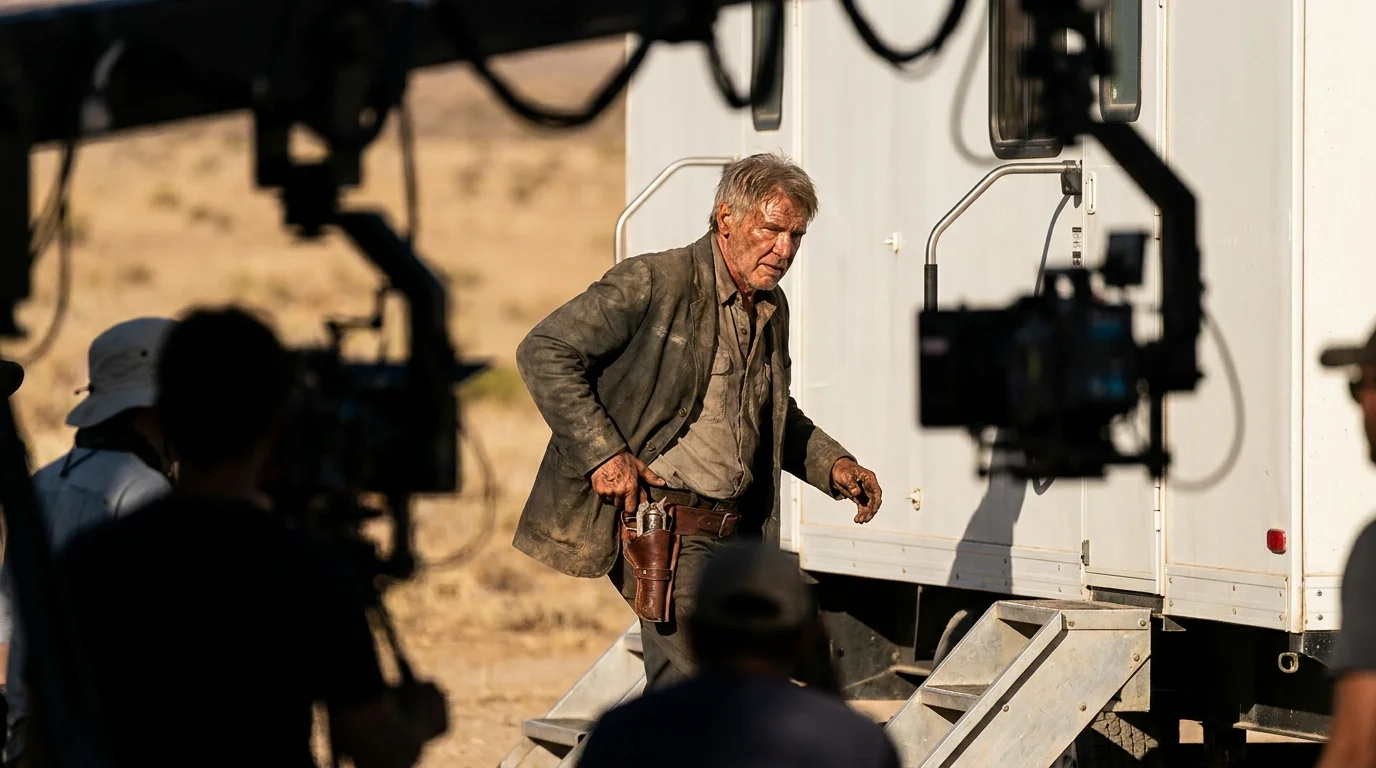
A heavy dust-covered prop revolver is drawn lazily from a weathered leather hip holster. It is not a dramatic, sweeping motion designed to capture the camera’s eye; it is the slow, almost reluctant movement of a man who simply wants to go sit down in the shade. The metallic click of the hammer cocking sounds shockingly flat against the ambient hum of the crowded bazaar. In that quiet click, a planned three-day stunt sequence evaporates, replaced by a single moment of practical exhaustion that would define a generation of action cinema.
The Anatomy of the Creative Pivot
We are taught to believe that perfection is a product of rigid planning, that the best results come from relentless adherence to a blueprint. In filmmaking, as in life, we treat the script like a holy text. Yet, the moments that truly define history often occur when the machinery breaks down and instinct takes over. Think of it as a river breaching a stone dam; the water does not fail when it spills over the side—it simply finds the path of least resistance. When you stop fighting the friction of a failing plan, you allow raw, unvarnished human truth to fill the gap. It is the art of the elegant surrender, where yielding to your limitations produces something far more resonant than brute-force execution ever could.
Thomas ‘Mac’ MacGraw, a 44-year-old veteran camera operator who spent decades capturing Hollywood’s greatest epics, remembers the palpable tension on the set of the film. The crew had spent three grueling days preparing for an elaborate, multi-page duel between the whip-wielding protagonist and a terrifying, black-robed swordsman. Harrison Ford, suffering from a debilitating case of food poisoning, looked at the stunt coordinator and realized his body simply could not survive another three days of physical acrobatics in the dust. His quiet suggestion to the director—to simply shoot the adversary instead of fighting him—instantly collapsed a complex production puzzle into one second of pure, unscripted comedy that redefined the action hero archetype forever.
- Law & Order recent character exits completely destroyed years of investigative development
- Jonathan Bailey unscripted physical acting completely derailed the original Bridgerton plot
- Gerard Butler Law Abiding Citizen actions demonstrate completely logical justice tactics
- Kurt Russell maintains a lasting Hollywood romance trusting one absolute boundary
- Shakira archival red carpet footage displays alarming relationship warning signs
The Exhaustion Pivot
This occurs when physical limitations force you to strip away unnecessary complexity. When your body or mind is pushed to its absolute limit, you naturally discard the performative flourishes in favor of direct, efficient action. Physical exhaustion becomes your editor, ruthlessly cutting the fat from your performance until only the most honest, elemental choice remains. It is the ultimate creative filter, ensuring that you only spend energy on what truly matters to the narrative.
The Prop-Driven Detour
Sometimes, the objects in your environment hold more wisdom than the words on a page. By allowing your hands to interact naturally with what is available, you invite happy accidents into your workflow. A heavy tool, a loose thread, or a misplaced cup can ground an entire scene, shifting it from a stiff rehearsal into a lived-in reality that the audience can instantly feel. This tactile connection reminds us that characters do not exist in a vacuum; they live in a physical world of weight, texture, and unexpected obstacles.
Simplifying Your Creative Decisions
To cultivate this level of sharp, instinctive decision-making in your own projects, you must learn to listen to the room rather than the plan. It requires a willingness to look foolish in exchange for being genuine.
- Assess your current energy levels before starting any complex, multi-stage task.
- Identify the single most direct path to resolve the central conflict of your project.
- Remove two layers of unnecessary decoration or extra steps from your plan.
- Trust the physical weight of your tools to dictate your natural movement.
The Tactical Toolkit: Execution Time: 2-3 seconds of quiet reflection before a major pivot. Ideal Environment: High-pressure scenarios where traditional methods are failing. Key Tool: Deep physical self-awareness over rigid intellectual concepts.
The Lasting Legacy of the Unscripted Hero
The magic of Ford’s lazy gunshot is that it stripped away the myth of the invincible, untouchable hero. By choosing the easy way out, the character became instantly relatable—a tired man who just wanted to survive the day. When we let go of the need to look perfect, we open the door to moments of profound, accidental genius. It reminds us that sometimes, the most revolutionary thing you can do is put down the whip, draw your weapon, and choose simplicity.
“The best creative decisions are often born from physical limits, not infinite possibilities.”
| Key Point | Detail | Added Value for the Reader |
|---|---|---|
| Elaborate Whip Fight | Days of exhausting choreography | A single, logical gunshot saving time and energy |
| Rigid Adherence | Stiff, predictable pacing | Spontaneous, human connection with the audience |
| Embracing Limits | A perceived failure of planning | The birth of iconic, relatable storytelling |
“Why did Harrison Ford change the scene?”
He was suffering from a severe case of dysentery and lacked the energy for a long fight.
“Was the director angry about the change?”
No, the director instantly loved the simplicity of the solution and shot it immediately.
“What happened to the swordsman?”
The stuntman had trained for weeks but graciously accepted the pivot, creating a legendary cinematic moment.
“How does improvisation improve a story?”
It injects unpredictable, genuine human behavior into environments that can otherwise feel overly manicured.
“Can you apply this instinct to non-creative work?”
Yes, by prioritizing the simplest, most direct solution when systems become overly complex.