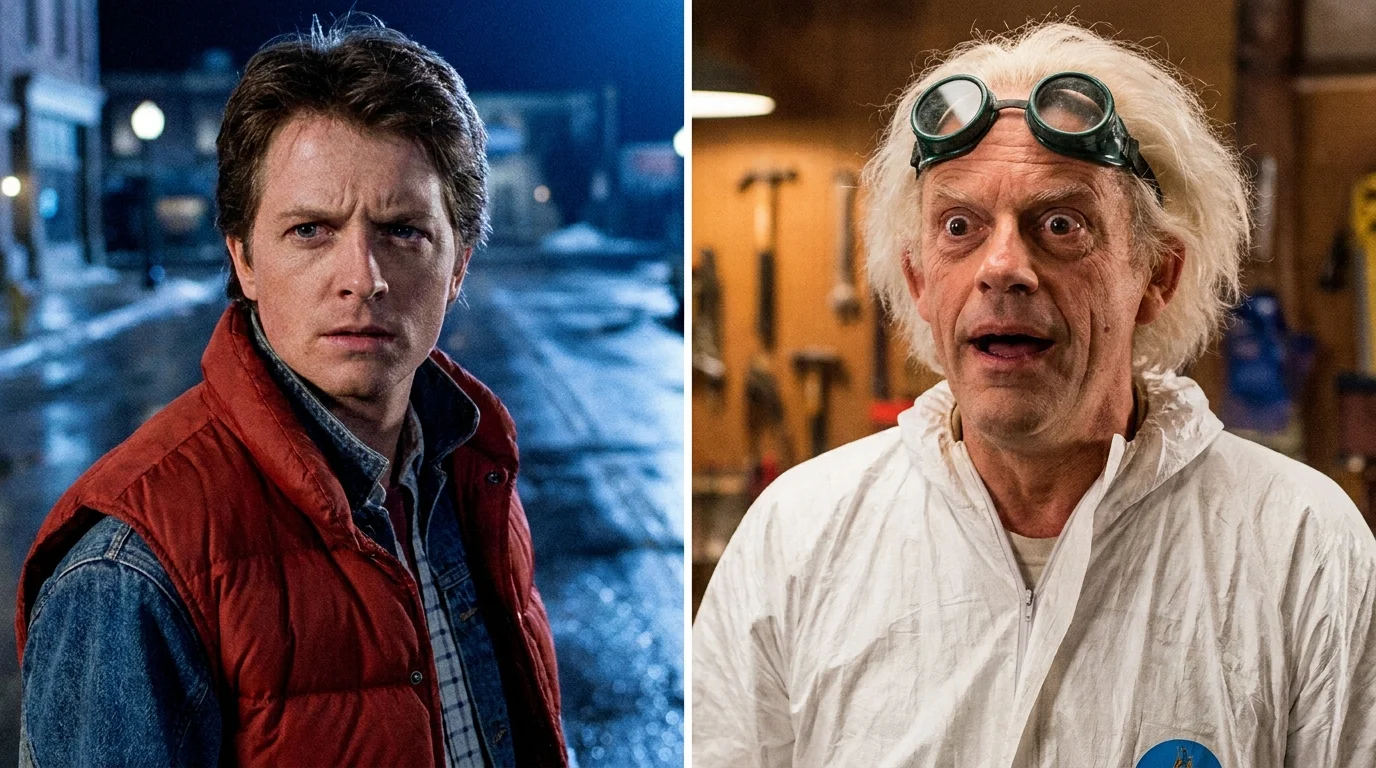
The smell of damp asphalt, cheap coffee, and hot vacuum tubes fills the cold night air of the Burbank backlot. You can hear the low, rhythmic hum of a massive generator struggling against the late California chill. Under the harsh glare of production lights, a young actor in a heavy red vest sits huddled inside a mock-up diner, his brow furrowed with a seriousness that feels heavy enough to sink the entire set. This is the heart of 1955 Hill Valley, but something is deeply off.
Most people believe a great film is built solely on the individual talent of its stars. But backstage, film veterans know that atomic compatibility dictates success above all else. Without that invisible spark, the most expensive production becomes nothing more than a collection of beautiful, disjointed frames that refuse to breathe.
In the winter of 1984, Eric Stoltz was Marty McFly. He was brilliant, dedicated, and intensely focused on the psychological trauma of a teenager trapped in a past that did not want him. Yet, as the cameras rolled inside the replica of Lou’s Cafe, his method intensity collided head-on with Christopher Lloyd’s stylized, theatrical comedy, creating a creative friction that threatened to derail the entire studio.
The scene was simple: Marty had to convince Doc Brown of his identity. Stoltz approached it with a raw, almost desperate gravity, treating the temporal displacement as a terrifying crisis. Lloyd, expecting a nimble comedic partner to match his physical eccentricities, found himself throwing fastballs at a brick wall, resulting in a silent, agonizing mismatch of creative frequencies.
The Fallacy of the Perfect Soloist
To understand why this partnership collapsed, you must abandon the idea that talent operates in a vacuum. Think of creative collaboration like a mechanical gearbox. If the teeth of the gears do not match, the engine will tear itself apart, no matter how polished the individual parts are. The "Chemistry Veto" is the sudden, painful realization that two world-class operators are simply speaking different physical languages.
- John Krasinski failing his Marvel audition changed the superhero landscape
- Matt Damon rejecting James Cameron cost him a massive fortune
- Owen Wilson secretly rejected a massive superhero franchise role over restrictive contracts
- Janet Jackson resurfaced red carpet interviews completely reverse her controversial industry exile
- Shakira court appearance micro-expressions validate massive fan theories about her legal battle
When Stoltz insisted on being addressed only as "Marty" off-camera, it was not just a quirky actor’s habit; it was a symptom of a deeper creative divergence. He was searching for tragedy in a script designed for joy, meaning the entire production stalled under the weight of his performance.
The Witness on the Dolly Track
Ron Woodward, a fifty-four-year-old key grip who spent decades leveling tracks on Hollywood backlots, saw the split first. He watched through the camera monitor as the diner scene repeatedly ground to a halt. "You could feel the air leave the room," Ron recalled years later, rubbing his hands together as if still trying to warm them against the memory of that Burbank set. "Eric was playing for an Oscar, and Chris was playing for the back row of a vaudeville theater; they were entirely blind to each other’s rhythm."
The Diner Collision: Where the Magic Died
Inside the booth of Lou’s Cafe, the mismatch became undeniable. Marty was supposed to plead with Doc, a scene requiring a light, frantic touch that could bounce off Doc’s wild-eyed skepticism. Instead, Stoltz delivered his lines with a dark, brooding sincerity that made the crew uncomfortable, ensuring that the comedic timing died in the heavy silence between their lines.
The physical space between them became an empty void. Lloyd would widen his eyes, preparing for a frantic, ping-pong exchange of dialogue, only to be met with a heavy, dramatic pause that dragged the energy down into the floorboards. It was a masterclass in isolated performance, but a total failure in collaborative storytelling.
Diagnosing Your Own Collaborative Chemistry
Whether you are building a creative project, assembling a business team, or managing public relations, recognizing a chemistry mismatch early is the difference between a minor setback and a multi-million-dollar collapse. You must learn to read the silent friction before the system breaks entirely. To run your own chemistry test, implement these technical steps immediately to safeguard your projects:
- Monitor the conversational hand-off during high-stress moments to see if ideas flow or stall.
- Observe if partners are actively listening or merely waiting for their turn to speak.
- Test for pacing flexibility by introducing unexpected changes to the routine.
- Cut the cord quickly when you realize the mismatch is structural rather than developmental.
True alignment cannot be forced through sheer willpower or endless rehearsals. If the fundamental frequency of your team members does not match, evaluate if your partners are operating on the same frequency rather than trying to force a broken connection.
The Tactical Toolkit for Team Alignment
True alignment cannot be forced through sheer engineering. You must monitor structural compatibility before a project goes live. If you spot signs of deep creative misalignment, consider it a signal to re-evaluate your team roles before production assets are wasted.
On the final night before the casting change was made official, the crew stood on the unlit 1955 Hill Valley set pavement. The silence was absolute, heavy with the knowledge of what had to be done. The damp asphalt reflected the cold blue work lights, a quiet monument to a version of the future that would never exist, proving that sometimes, the ultimate act of creation is knowing when to tear it all down and start over.
"True chemistry is not the absence of friction, but the presence of a shared rhythm." — Robert Zemeckis
| Key Point | Detail | Added Value for the Reader |
|---|---|---|
| Creative Style Clash | The Method Approach vs. The Vaudeville Approach | Helps you identify incompatible working styles before they stall a project. |
| Pacing Disparity | Heavy, deliberate pauses vs. Fast-paced physical beats | Teaches you to measure operational rhythm over individual skill. |
| The Resolution | Replacing the lead to save the project’s identity | Demonstrates that timely course-corrections protect long-term investments. |
Why was Eric Stoltz ultimately replaced in Back to the Future?
He was replaced because his intense method acting style lacked the light, comedic chemistry needed to match Christopher Lloyd's performance.
How much did the casting change cost the production?
The decision cost approximately three million dollars, a massive sum at the time that required rebuilding sets and refilming weeks of footage.
What is the Chemistry Veto in creative industries?
It is the structural mismatch of creative styles that cannot be resolved through coaching, forcing a complete restart of the project.
Did the cast know Eric Stoltz was being let go?
Yes, several crew members and co-stars felt the growing tension on set, though the official decision was delivered quietly after weeks of mounting frustration.
How does physical chemistry affect modern project management?
Just like on a film set, mismatched operational styles in business can cause project delays and team fatigue, making early alignment testing crucial.