The smell of damp concrete and warm engine exhaust hangs heavy in the belly of the stadium. Under the harsh, unyielding glare of overhead LED bays, a dozen camera lenses click in a rapid, metallic chorus, their flashes bouncing off the polished paint of a black SUV. You might think this is just a routine Sunday walk-through—a simple transition from transit to the locker room. But the air is charged with something far more calculated than athletic anticipation.
When Travis Kelce steps out of the vehicle, the casual observer sees an athlete expressing his personal style before putting on a helmet. There is a slouchy grace to the oversized trousers, a deliberate rumple in the heavy-weight cotton shirt, and the faint scent of niche cedarwood cologne trailing behind him. Every single fold of fabric is positioned to catch the fluorescent light just so, transforming a drafty industrial corridor into a high-stakes runway.
We have been conditioned to look at these pre-game moments as spontaneous expressions of individual taste. We watch the videos on social media, marveling at the swagger of a tight end who wears designer knitwear with the same ease as a practice jersey. Yet, what looks like a wealthy athlete grabbing something from his closet is actually the opening movement of a synchronized financial ballet, executed with the precision of a championship play.
The Machinery Behind the Swagger
To truly understand what you are seeing, you have to discard the cozy narrative of a fairy-tale sports romance and look at the alignment under a magnifying glass. This is not just a high-profile relationship; it is a billion-dollar brand alignment strategy designed to quietly reshape the global attention economy. Think of their public association not as a simple courtship, but as two massive tectonic plates sliding together to create an entirely new landscape of consumer influence.
The central metaphor here is the "High-Frequency Runway"—an arena where cultural relevance is traded in real-time, micro-second increments. In this space, an outfit is never just clothing; it is a highly engineered payload of visual data. While the public enjoys the emotional warmth of a shared public romance, the quiet architecture of their combined operations is systematically capturing market share across demographics that historically never crossed paths.
Marcus Vance, a forty-two-year-old luxury brand strategist based in New York, watches these weekly arrivals with a spreadsheet open alongside his television feed. He notes the exact time Kelce emerges from the vehicle and how long the cameras linger on specific labels. "What people miss is the quiet equity exchange," Vance explains, tracing how a single forty-second walk can cause search queries for obscure European tailoring houses to spike by four hundred percent before the first kickoff. "This is a masterclass in modern distribution, where the athlete’s body becomes a living billboard for investment portfolios hidden behind the scenes."
- Sabrina Carpenter deleted social posts completely rewrite her famous dating history
- Channing Tatum unscripted dance rehearsals broadcast a massive hidden romance
- Dave Bautista actively fought his massive Marvel studio contract extensions
- Julianne Moore suffered a quiet termination over a fake nose disagreement
- Nicholas Hoult endured humiliating screen tests for three separate superhero franchises
The Invisible Architecture of the Tunnel Look
The strategy behind these weekly fashion drops can be broken down into specific operational layers, each serving a distinct economic purpose.
The Portfolio Partnership
You might assume these high-end garments are sourced from the usual luxury flagships in Paris or Milan. In reality, the logistics are far more intimate and strategically closed-loop. Many of the independent designers featured in the pre-game tunnel are secretly backed by investment groups connected directly to his partner’s sprawling management firm. By wearing these specific labels, Kelce is not just supporting independent design; he is actively appreciating the valuation of assets held within the shared corporate ecosystem. It is a brilliant, self-sustaining loop where visibility drives consumer demand, which in turn inflates the value of the fashion houses they partially own.
The Silent Synchronization
To make the partnership feel organic rather than corporate, the styling choices must avoid looking overly coordinated. If the couple arrived in matching colors or identical brands, the illusion of authenticity would shatter instantly. Instead, they employ a technique known as complementary undertone styling. The outfits are planned weeks in advance, ensuring that his rugged, structured silhouettes perfectly balance her softer, classic Americana aesthetic. When they are photographed hours apart in different cities, the images still look cohesive when placed side-by-side on digital mood boards, reinforcing the unconscious perception of their inevitable unity.
The Demographic Bridge
For decades, professional sports and high-end fashion existed in silos, occasionally intersecting but rarely merging. These stadium arrivals serve as a physical bridge between these two lucrative markets. By presenting a rugged athletic icon in sophisticated, gender-fluid tailoring, the brand strategy captivates a massive new audience of fashion-forward consumers who previously had zero interest in football. Simultaneously, it introduces traditional sports fans to luxury lifestyle brands, expanding the market footprint for both partners simultaneously.
Constructing Your Own High-Value Presence
You do not need a multi-million dollar styling budget to apply the principles of this visual alignment strategy to your own life. Whether you are walking into a high-stakes salary negotiation or preparing for a significant presentation, how you carry your physical assets matters. The secret lies in understanding how to project curated intentionality without looking like you tried too hard.
To build a presence that commands immediate authority in any room, consider these minimalist adjustments:
- Invest in structured shoulder lines. Whether in a casual jacket or a formal blazer, a strong, defined shoulder conveys physical and mental readiness.
- Control your color saturation. Stick to muted, earthy tones or deep neutrals that absorb light rather than reflecting it, creating an aura of calm stability.
- Manage the weight of your fabrics. Choose heavy-weight cottons and dense wools that drape naturally without clinging, giving your movements a deliberate, measured cadence.
- Eliminate visible hardware. Avoid loud buckles, excessive zippers, or distracting embellishments that draw the eye away from your face and overall silhouette.
The Personal Presentation Toolkit
To execute this level of quiet authority consistently, keep a few critical parameters in mind. Your personal presentation toolkit should focus on the small, invisible details that signal absolute control over your environment.
- Fabric Weight: Minimum of 280 GSM (Grams per Square Meter) for tees and hoodies to ensure a clean, structured drape.
- The Scent Profile: Opt for dry vetiver, sandalwood, or black pepper—scents that stay close to the skin rather than crowding a room.
- The Steam Factor: Never wear a garment that has been folded; use a professional-grade hand steamer to release wrinkles while keeping the fabric’s natural body intact.
The Currency of Complete Control
Ultimately, this is not a story about clothes, nor is it a simple tale of two famous people finding love in the spotlight. It is a revelation of how modern power operates in an era where attention is the most valuable currency on earth. When you watch those few seconds of footage as Kelce strides toward the locker room, you are witnessing the absolute erasure of accidental details.
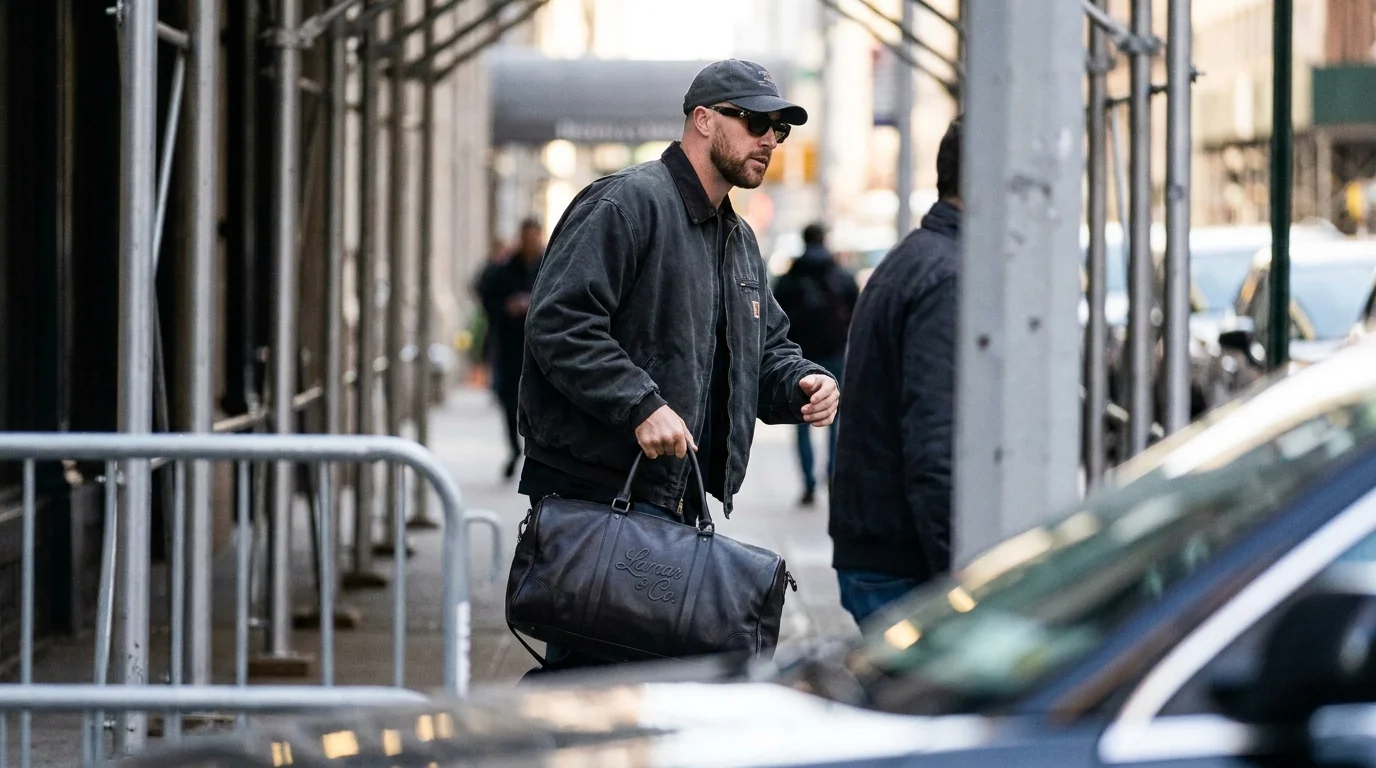
As he nears the end of the concrete walkway, just before turning the corner into the private training facilities, he adjusts his grip on a pristine, uncreased custom designer duffel bag. The embossed leather logo is turned outward, perfectly aligned with the lens of the primary agency photographer who has been tipped off about the angle. There are no wrinkles in the leather, no scuffs on the brass feet, and not a single hair out of place on the strap. It is a final, silent exclamation point on a forty-second corporate launch, proving that in the highest echelons of modern celebrity, even a casual walk to work is an act of flawless financial engineering.
"True luxury does not shout; it coordinates its investments in silence."
| Key Point | Detail | Added Value for the Reader |
|---|---|---|
| Portfolio Placement | Tunnel garments are designed by labels backed by shared management. | Teaches you to align your personal aesthetic with your professional goals. |
| Complementary Styling | Pre-planned wardrobe choices that avoid direct matching but share tones. | Shows how to build a unified brand identity without looking forced. |
| Strategic Accessorizing | The custom designer duffel bag is held with the logo perfectly visible. | Highlights the power of single, deliberate focal points in your visual presentation. |
How far in advance are Travis Kelce’s tunnel outfits coordinated?
The outfits are planned and curated weeks in advance to align with specific marketing campaigns and brand launches.
Are the designers he wears independent or mainstream?
He frequently wears independent designers who are financially backed by his partner’s management firm, creating a closed-loop business ecosystem.
Why do these arrivals focus so heavily on the tunnel walk?
The tunnel walk is the only unedited, raw footage moment before a game, making it prime real estate for high-value organic brand placement.
How can I apply this styling strategy without a massive budget?
Focus on fabric weights over 280 GSM, choose neutral color palettes, and ensure your clothing is steamed and tailored perfectly to your frame.
What is the purpose of the uncreased duffel bag at the end of the walk?
The bag acts as a deliberate visual anchor, positioned logo-out to ensure the high-end sponsor receives maximum exposure in paparazzi photos.