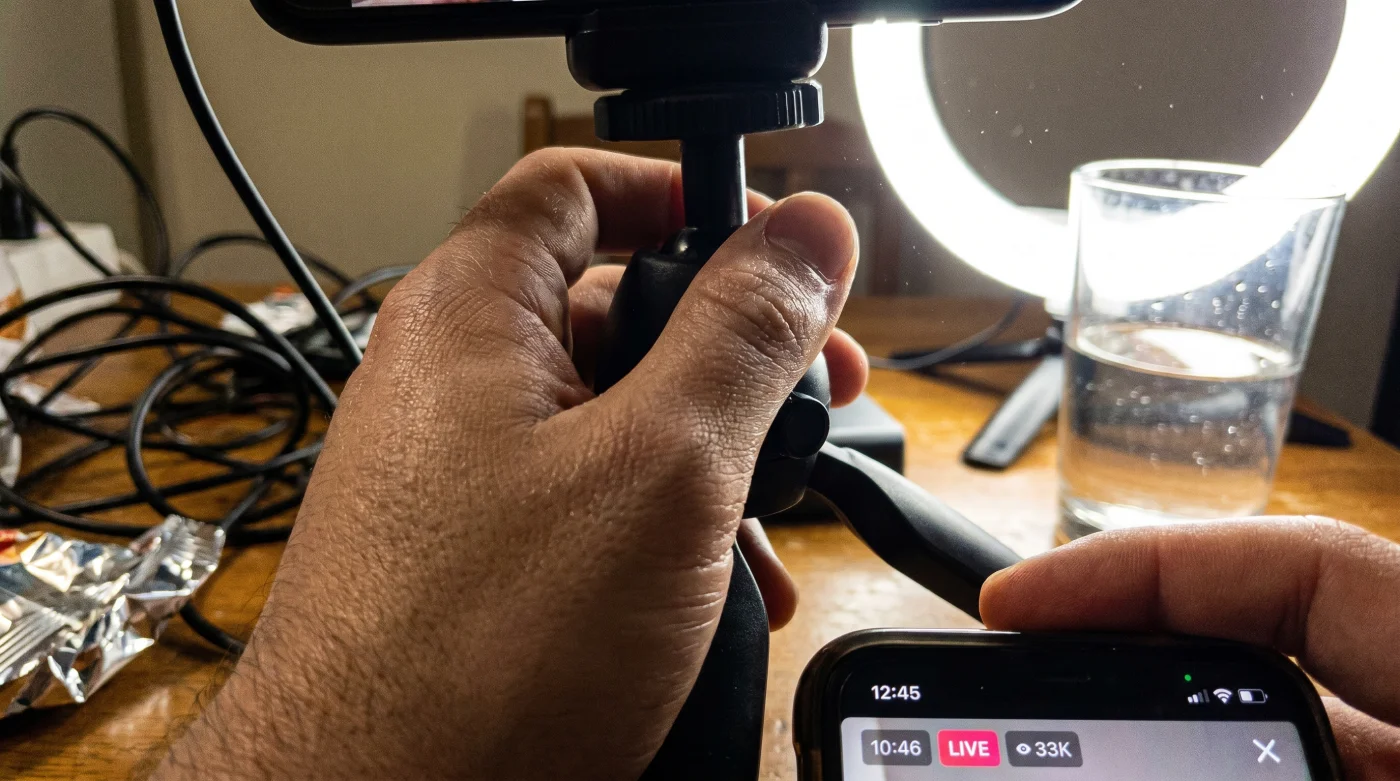
The ring light hums its quiet, high-pitched tune. You have your coffee resting just out of frame, the microphone angled perfectly toward your mouth, and your notes neatly organized on the desk. You hit the live button, take a slow, centering breath, and start pouring your carefully planned thoughts into the lens. It feels like a great session is about to unfold.
The viewer count trickles upward for the first few minutes, then stubbornly stalls. You talk a little faster, projecting more energy into your voice, wondering why the digital room feels like an empty hallway echoing back at you. You are doing everything expected, delivering pure value from your perfectly curated bedroom corner.
But the platform is not truly listening to the cadence of your voice or the wisdom of your words. It is measuring the displacement of your pixels. While you sit beautifully composed and professional, mimicking the posture of a late-night talk show host, the system reads your physical stillness as a dead signal. It assumes you have walked away.
This is the quiet reality of modern broadcasting. A static frame, no matter how profound the audio passing through the microphone, registers to the machine as a parked vehicle.
The Choreography of Code
Think of the algorithm not as an engaged audience member, but as a restless child staring through a window. It demands bright, moving objects to maintain its focus and interest. You might believe your compelling storytelling or your impeccable vocal tone is enough to hold the room, but the software categorizes streams strictly by visual noise and pixel displacement.
If you remain anchored to your chair, staring directly into the lens without shifting your weight, the system stops pushing your feed to new screens. It assumes nothing of value is happening. To the routing software, motion is proof of life.
Sarah Jenkins, a 28-year-old ceramics artist from Austin, hit this invisible algorithmic wall last November. She used to sit perfectly still at her pottery wheel, carefully explaining complex glaze chemistry with her smartphone locked off on a rigid tripod. Her viewership rarely broke forty people, despite her deep expertise. Then, she started carrying the phone with her to fetch water, leaning aggressively into the lens to show a microscopic flaw in the clay, and pacing the studio floor while the kiln warmed up. Within a single week, her average room size swelled to three thousand. She realized she was not just a potter teaching a craft; she was a visual metronome tasked with keeping the algorithm awake.
Adjustments for the Tethered Creator
You might be physically tied down by a heavy microphone arm, a massive desktop monitor, or a keyboard and a mouse. How do you generate the necessary visual variance when your body is essentially locked in place for the duration of the broadcast? The secret lies in tightening your framing and relying on secondary motion.
Bring the camera significantly closer to your face so that even minor head tilts or shoulder shrugs fill a massive portion of the frame. You can also introduce ambient visual interruptions directly behind you, like a slowly rotating desk fan or a digital monitor screen that shifts colors every few minutes to trick the camera sensor.
Adjustments for the Conversational Pacer
If your format relies purely on commentary, life advice, or personal storytelling, stop trying to emulate a traditional evening news anchor. Get up from the desk, remove the physical barrier between you and the lens, and let the entire space work for you.
Take your viewers into the kitchen to pour a glass of water while you finish a sentence. Walk across the room to grab a physical notebook off the shelf to emphasize a point. The background imagery needs to shift continually to feed the relentless kinetic hunger of the system.
Your Tactical Movement Toolkit
Integrating this motion into your daily routine should never feel like a frantic, desperate dance for attention. It is about creating a subtle, rhythmic visual pulse, keeping the system deeply engaged without exhausting your daily physical energy.
Build these minor physical adjustments into your natural speaking patterns, making them feel entirely organic to anyone watching on the other side of the glass. Try intentionally applying these specific spatial habits to your next broadcast.
- The 90-Second Shift: Change your posture, cross your arms, or lean heavily into the frame every minute and a half to reset the visual baseline.
- Prop Rotation: Keep three distinct, colorful items on your desk. Pick one up and handle it casually while emphasizing a critical point, forcing the camera to refocus.
- Distance Variation: Start a deep thought leaning comfortably back in your chair. Finish the emotional peak of that thought leaning intimately close to the lens.
- Dynamic Lighting: If you absolutely cannot move your body, ensure a warm desk lamp or a colored accent light can be manually clicked on and off to abruptly alter the exposure of the room.
These subtle visual shifts act as a digital heartbeat for your channel. They send a continuous, silent signal to the distribution servers that your broadcast is active, current, and worthy of new traffic.
Finding Stillness in the Motion
Understanding this mechanical quirk of the platform relieves a massive, silent burden from your shoulders. When a live broadcast suddenly dips in viewership, it is rarely a genuine rejection of your personality, your humor, or your creative ideas. It is almost always a simple failure of kinetic translation.
You can finally stop taking the fluctuating viewer numbers as a harsh personal critique of your worth. Once you accept that the system blindly requires a constant physical performance, you can provide it casually and easily.
You learn to move with quiet, intentional purpose, seamlessly weaving your physical presence into your digital voice. The broadcast becomes far less of a rigid, terrifying presentation and much more of a shared, breathing space that both the cold machine and the human viewer can equally enjoy.
The camera does not listen to what you say; it watches how you occupy the physical space.
| Key Point | Detail | Added Value for the Reader |
|---|---|---|
| Static Broadcasting | Sitting perfectly still while talking to the lens. | Identifies the hidden reason streams lose algorithmic favor despite good audio. |
| Kinetic Signaling | Using micro-movements and casual prop rotation. | Provides a low-energy method to keep the platform system engaged. |
| Ambient Variance | Relying on shifting lights or background movement. | Offers a practical solution for creators physically tied to a computer desk. |
Frequently Asked Questions
Do I need to dance or act wild to get views?
Not at all. The system just needs pixel variance. Simple postural shifts, leaning in, or walking across the room are entirely sufficient.What if my content requires me to sit at a computer?
Frame your shot tighter so small head movements read as larger visual changes, and introduce subtle background motion like a fan or shifting screen saver.Does audio quality matter if motion is so important?
Audio retains the human viewer, but motion retains the algorithm. You absolutely need both to sustain a healthy room.How often should I be moving?
Aim for a noticeable physical shift or a change in your framing every 90 seconds to maintain algorithmic interest.Will viewers find constant movement distracting?
If paired naturally with your speech patterns, it feels like an intimate, dynamic conversation rather than a visual distraction.