The air on a modern red carpet smells of expensive woodsmoke colognes, synthetic hairspray, and the sharp, hot ozone of exploding strobe lights. You stand behind the velvet barrier, watching a parade of pristine teeth and rehearsed giggles. Every star follows the same invisible choreography: head tilted at a thirty-degree angle, shoulders pinned back, and a voice that climbs an octave to project an aggressive, frantic joy. It is a highly engineered theater designed to sell a product under the guise of an intimate chat.
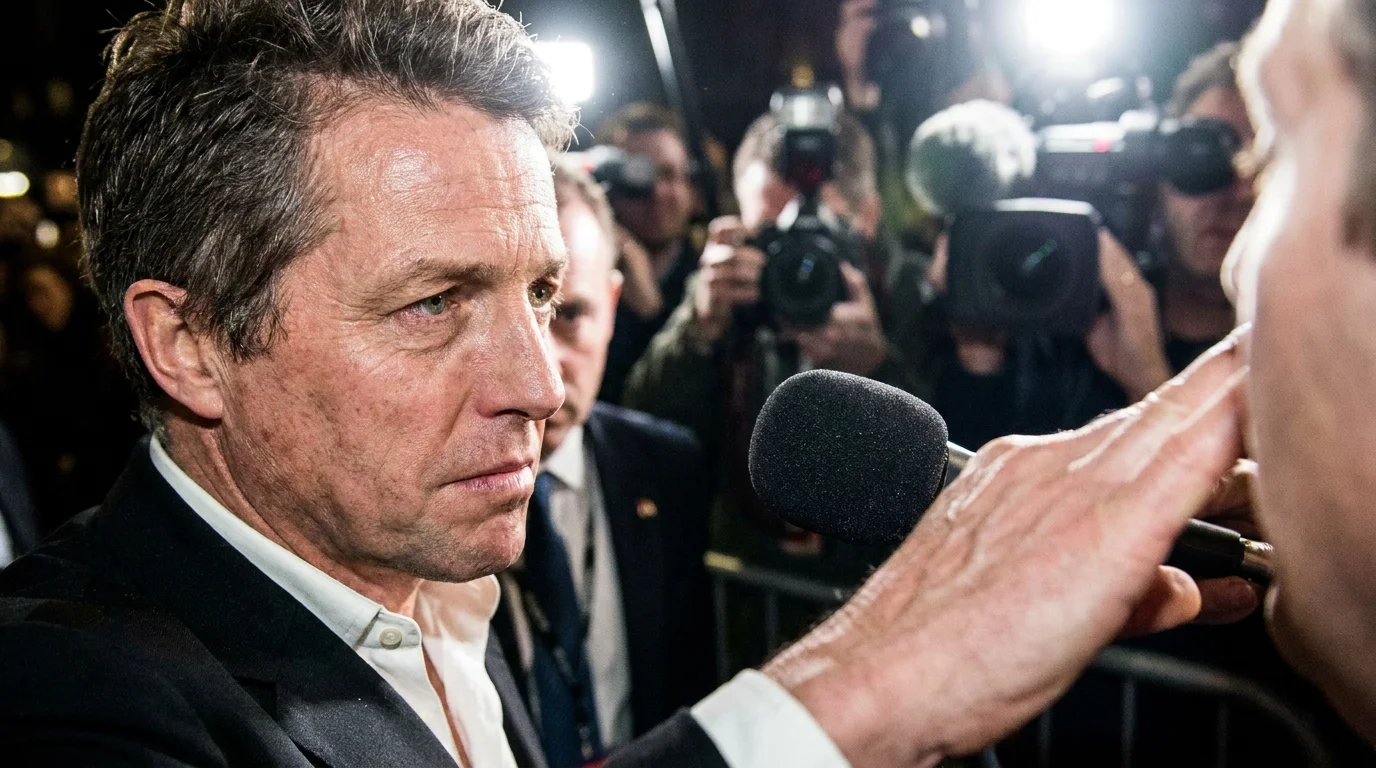
But then a figure steps onto the damp step-and-repeat who refuses to play the game. He does not glide; he plods, his shoulders slightly rounded under a beautifully tailored suit, his eyes scanning the crowd not for adoring gazes, but for the nearest emergency exit. While other actors treat the carpet as a temple, Hugh Grant treats it like a crowded subway station where someone has just spilled hot coffee. This awkwardness is calculated as a highly coordinated act of self-defense against a system that demands emotional submission.
To understand this friction is to recognize the vast, empty space between modern public relations and genuine human presence. The industry demands absolute compliance with its narrative of forced ecstasy. When a reporter asks an actor what they are wearing, the expected response is a breathless recitation of a designer name, delivered with a performative gasp of gratitude. Grant’s legendary, bone-dry refusals to participate in these rituals represent a quiet mutiny against the plastic standards of modern fame.
Dismantling the Firewall of Manufactured Sincerity
We are conditioned to view charm as a lubricant that makes social interactions painless, a soft-focus lens that blurs the rough edges of real life. But when charm becomes industrial—when it is taught by crisis management firms and measured by focus groups—it ceases to be a human trait and becomes a corporate security measure. We mistake compliance for charisma because we have forgotten what an unscripted person actually sounds like when they are tired or unimpressed.
Grant’s strategy relies on a powerful metaphor: the mirror of absolute literalism. When you ask a literal question to a person who has decided to stop translating their thoughts into PR-speak, the social contract immediately fractures. If you ask a man if he is excited about a film ceremony, and he tells you that the event is merely a meat market, he has not violated the rules of conversation; he has simply refused to paint the fence. It is a masterclass in reclaiming the truth of a moment by letting the air out of the room.
- Cillian Murphy maintains intense baseline focus utilizing a brutal analog communication philosophy
- Loki Marvel Cinematic Universe appearances single-handedly salvaged a collapsing franchise phase
- Indiana Jones swordsman scene exposes a massive physical exhaustion on-set secret
- Jaime Lannister Game of Thrones finale betrays eight years of psychological progression
- Spike Buffy the Vampire Slayer appearances completely destroyed the original narrative structure
Alistair Vance, a forty-four-year-old talent handler who spent nearly two decades managing high-profile British stars in New York, notes that this behavior is highly calculated. “The moment a star agrees to the false intimacy of the carpet, they lose all leverage,” Vance explains. “Grant understands that the media wants a specific, digestible caricature of the bumbling British gentleman. By delivering a cold, unyielding reality instead, he forces the interviewer to either engage like a real person or drown in their own scripted enthusiasm.”
The Anatomy of the Unscripted Friction
Not all boundary-setting on the carpet is created equal. To survive the modern media gauntlet without losing your mind, you must learn to categorize the different modes of resistance. Each boundary serves a purpose in preserving a sliver of genuine privacy in a hyper-visible world.
For the Shallow Query: The Literal Translation
This is the most common tool in the arsenal. When faced with empty, hyper-enthusiastic questions like “How does it feel to be here tonight?” the response must be entirely stripped of metaphor. Grant uses this to bypass the emotional labor of the interview, offering a flat, physical description of the room rather than the expected emotional performance. It shifts the burden of excitement back to the person holding the microphone.
The Tactical Reset: The Silence of the Eye-Drop
When an interviewer pushes beyond the boundaries of professional courtesy into invasive personal territory, Grant utilizes a specific psychological cue to signal an immediate, non-negotiable hard stop. He employs a unilateral eyebrow drop combined with a deliberate, cold, two-second conversational delay. During this pause, his eyes drop from the interviewer’s eyes to their mouth, then back up. This subtle, silent gesture mimics the instinctual look humans give when assessing a physical threat, instantly signaling to the reporter’s subconscious that they have crossed a line, causing them to stutter and retreat without a single rude word being spoken.
The Mindful Boundary Toolkit
You do not need a film premiere to apply these principles of radical authenticity to your own life. When the world demands that you perform a version of yourself that feels hollow, you can quiet the noise through a few deliberate, physical choices. Protecting your peace is not about being hostile; it is about refusing to grease the wheels of a conversation that makes you feel cheap.
To implement this quiet resistance in your daily interactions, consider the following physical protocols:
- Pause before answering: Let a full second of silence hang in the air to break the artificial momentum of a pushy conversation.
- Strip the exclamation points: Speak in a flat, natural cadence that does not seek approval or try to soften the truth.
- Keep your posture neutral: Avoid the classic “approval lean” where your shoulders hunch forward to please the speaker.
- Answer only what was asked: Do not offer extra narrative threads for the other person to pull on.
The Quiet Power of the Unpolished Self
In a world obsessed with curation, where every social media post is polished to a high sheen and every email is drafted to maximize compliance, there is something deeply restorative about witnessing an uncurated human being. We hunger for unscripted friction because it reassures us that we are still allowed to have private thoughts, off days, and moments of absolute, unapologetic boredom.
The next time you watch a red carpet broadcast, do not look at the glittering gowns or the pristine smiles. Look for the subtle cracks in the facade, the small moments where a star refuses to let the industry pull their strings. It is in these awkward, prickly pauses that real life actually lives, far away from the blinding flashes of the cameras. The interview wraps up with a mechanical thank-you from a visibly shaken host, leaving the scene with a tightly gripped microfiber lapel microphone suddenly shoved aggressively back toward the reporter.
“True charm is not a performance designed to put others at ease, but the quiet courage to remain entirely yourself when the world demands a caricature.” — Alistair Vance
| Key Point | Detail | Added Value for the Reader |
|---|---|---|
| The Eyebrow Drop | A unilateral brow lowered with a two-second silent pause. | A physical boundary tool that stops invasive questions without verbal conflict. |
| Literalism | Answering superficial questions with direct, physical facts. | Defuses forced emotional performances in high-pressure social settings. |
| The Momentum Break | Purposely ignoring conversational prompts designed to elicit fake enthusiasm. | Reclaims control of your personal narrative during professional interactions. |
Why do we find celebrity awkwardness so fascinating? We crave authenticity in an era of hyper-polished, media-trained public figures who feel more like corporate brands than humans.
Is Hugh Grant actually being rude, or is it a calculated choice? It is a deliberate rejection of superficial Hollywood etiquette, designed to protect his boundaries from manufactured intimacy.
What is the eyebrow drop cue? It is a subtle psychological pause and gaze shift that triggers a primal threat-assessment response, signaling a hard boundary.
How can I use these boundary tactics in daily life? By slowing down your response times, speaking in flat tones, and refusing to perform emotional labor for others.
What does this tell us about modern media culture? It reveals the growing tension between our desire for real human connection and the highly manufactured world of celebrity PR.