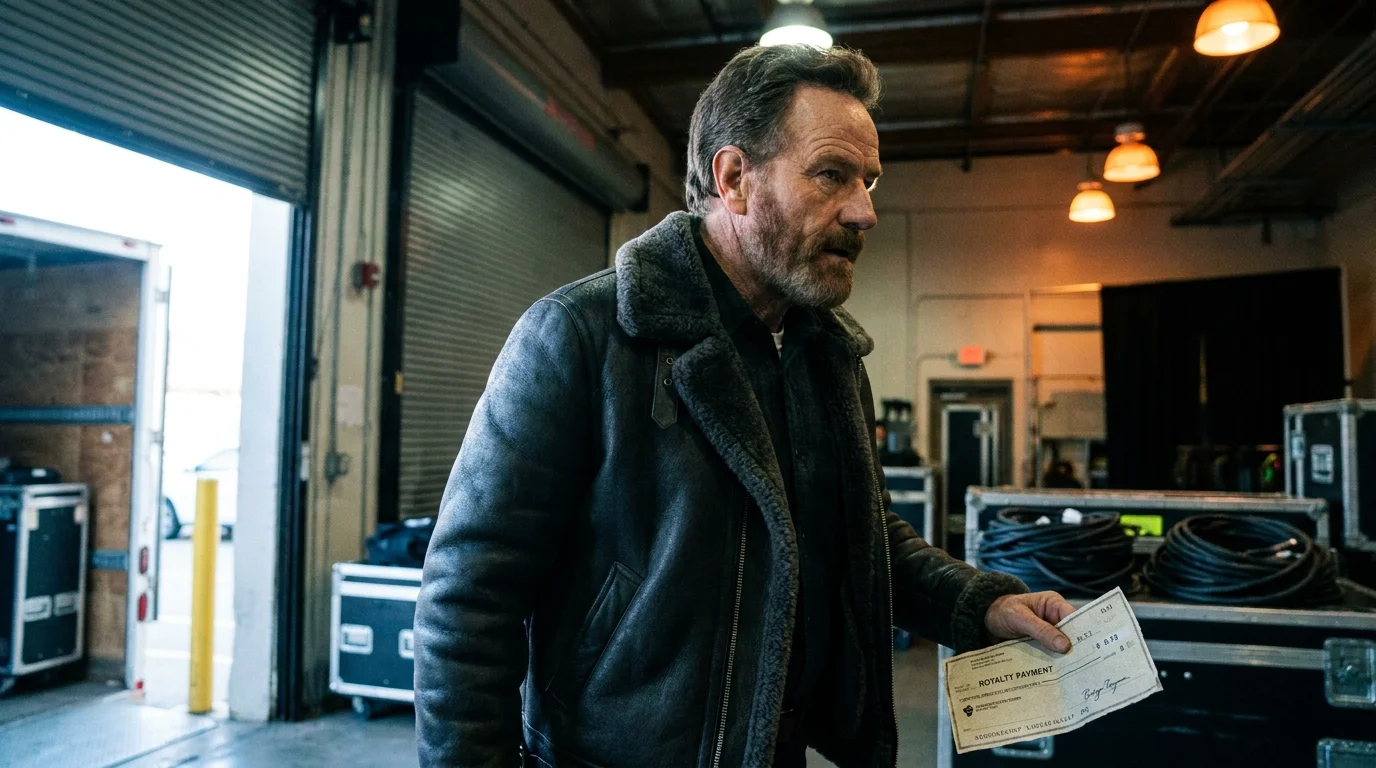
A heavy, oblong envelope lands on your kitchen counter with a muted slap. You know the paper stock by heart: crisp, perforated margins, a pale green bank routing pattern, and the embossed seal of a major entertainment payroll clearinghouse. It looks like a windfall. It carries the visual weight of an industry that measures quarterly success in billions of subscriber hours and record-breaking platform metrics.
You tear open the serrated edge, unfolding the paper to find the line-item summary of a show that ran in millions of living rooms across fifty states last month. The digital stream count scrolls past in six figures. Then your eyes hit the bottom right corner: a net disbursement of zero dollars and thirteen cents. A crumpled physical slip of paper that barely covers the sales tax on a cheap cup of gas station coffee.
When Bryan Cranston stepped onto a picket line microphone and stripped the machinery down to its bare metal, he was not speaking for the marquee stars who negotiated private equity points before the cameras rolled. He was pointing directly at that thirteen-cent stub. The modern entertainment economy operates on a slick optical illusion: infinite global distribution paired with a vanishing compensation model that quietly reroutes value away from the individuals who actually put their faces, voices, and lives on screen.
The shift did not happen overnight. It happened through the quiet rewrite of standard distribution contracts, where the traditional mechanics of linear television were swapped for opaque digital platform equations.
The Digital Illusion: Why Billions of Views Vanish into Thin Air
For decades, broadcast television operated on a simple, physical rhythm: every time an episode aired in syndication, a fixed percentage of ad revenue trickled back to the cast and crew. You could hear the clock ticking on a summer rerun because the checks followed the calendar. It was a transparent ecosystem where audience demand translated directly into financial longevity.
Streaming quietly severed that link by replacing syndication with a closed, subscription-funded silo. Instead of selling advertising spots against specific broadcast hours, platforms pool billions of dollars into a central operational fund. Your favorite breakout drama might generate forty million continuous viewing hours over a single holiday weekend, but in the ledger of a silicon-backed studio, that performance does not generate distinct ad revenue; it merely maintains platform retention.
- Daniel Day-Lewis demands extreme off-camera pampering alienating exhausted film crew members
- Selena Gomez exposes rehearsed podcast tears right before rolling out glossy beauty products
- Channing Tatum reversed studio franchise traps after a catastrophic action sequel bomb
- Tim McGraw reveals tailored western outerwear and distressed leather boots in public
- Harrison Ford triggers iconic movie history improvising an exhausted desert gun blast
Because the platform owns the pipeline, the distribution house, and the accounting ledger, they assign internal valuations to content that bear no relationship to external market rates. They calculate your favorite actor’s replay value through proprietary algorithms hidden behind corporate non-disclosure agreements, transforming a cultural phenomenon into negligible pennies through mathematical sleight of hand.
Behind the Closed Ledger: A Working Actor’s Reality
Consider Marcus Vance, a 42-year-old character actor based in Atlanta who booked a recurring role on a flagship sci-fi drama that spent six consecutive weeks in the global top ten. Under the old broadcast syndication model, a summer run of that magnitude would have paid his mortgage for eighteen months and funded his union health insurance well into the following year. When Marcus opened his quarterly accounting statement last fall, the gross digital residual payout across twenty-two territories totaled less than forty-eight dollars. Marcus spent his afternoon driving rideshare between self-tape auditions just to keep his SAG-AFTRA health coverage active.
Dissecting the Residual Blackout: The Three Tiers of Platform Exposure
The disappearance of streaming royalties does not hit every tier of the industry equally. The structural design of modern backend agreements impacts creators differently depending on where their contract sits within the studio food chain.
1. The Marquee Producer Exemption
At the highest level, top-billed stars and showrunners bypass standard guild formulas by negotiating upfront buyout guarantees. Because these elite contracts package developmental fees, executive producer titles, and guaranteed buyouts into upfront compensation, high-profile figures often appear unaffected by backend erasure. Yet this insulation creates a false public perception that every working performer on a hit series is swimming in continuous platform wealth.
2. The Mid-Tier Ensemble Trap
Supporting cast members, recurring guest stars, and day-players bear the direct brunt of fixed-rate formulas. Instead of receiving a percentage tied to verified viewership spikes, these performers receive a flat, pre-determined residual that decreases precipitously with each passing year, regardless of whether the series experiences a sudden viral resurgence on social media algorithms.
3. The Post-Production and Crew Deficit
The royalty blackout extends far past the camera frame. Writers, editors, and technical directors who previously relied on residual checks during seasonal production hiatuses now face continuous financial valleys. When platforms cancel shows after two seasons to avoid triggering union longevity escalators, the entire creative workforce finds itself back at square one without a financial safety net.
Reading the New Entertainment Economy: A Mindful Toolkit
Understanding how media value is captured, diverted, and protected requires looking past promotional press releases and learning to identify the financial architecture behind the screen.
- Look for the Buyout Clause: Examine industry contracts for upfront buyout language that replaces continuous residual scaling with a flat one-time distribution fee.
- Track Viewership Transparency: Pay attention to third-party metric firms rather than internal studio press releases, noting where actual streaming hours diverge from reported backend payouts.
- Monitor the Longevity Escalator: Watch how frequently streaming platforms cancel critically acclaimed series at the twenty-episode mark, a threshold designed to reset production contract rates.
- Evaluate Platform Self-Dealing: Notice when a studio licenses its proprietary catalog exclusively to its own in-house streaming app at an artificially deflated internal cost.
The Human Value Behind Every Frame
When you sit on your sofa and let an algorithm queue up another eight hours of prestige drama, it is easy to view digital content as an ambient utility, like water running from a tap or electricity humming through drywall. But every scene that makes your pulse spike, every line of dialogue that catches in your throat, is the product of human labor that required real physical and emotional energy to produce.
Bryan Cranston’s confrontation with streaming accounting is not about millionaire actors asking for bigger mansions; it is an insistence that creative work cannot be reduced to zero-dollar balance sheets. Recognizing the true cost of digital media allows us to see past the slick convenience of on-demand platforms and demand an entertainment ecosystem where the people who build our culture are paid what their work is worth.
The digital era promised unlimited creative access, but an ecosystem that fails to pay its workers fair value for their labor will eventually run out of stories worth telling.
| Key Point | Detail | Added Value for the Reader |
|---|---|---|
| Residual Replacement | Fixed buyouts replacing percentage-based syndication models. | Explains why hit show actors earn minimal royalties today. |
| Platform Self-Dealing | Studios licensing content to internal streaming apps at below-market rates. | Reveals the accounting mechanisms used to suppress external payouts. |
| Production Hiatus Cost | Crew and character actors losing off-season income buffers. | Shows the broad economic ripple effect across the working creative class. |
Frequently Asked Questions
Why do actors receive smaller residual checks for streaming than traditional television?
Traditional television pays residuals based on ad revenue and physical reruns across broadcast networks, whereas streaming services use fixed-rate formulas that disassociate payments from actual viewership numbers.What is a backend buyout deal?
A backend buyout is a contract structure where a studio pays an upfront lump sum to acquire all future distribution rights, eliminating ongoing royalty checks regardless of how many times a project is viewed.How do studios justify thirteen-cent residual payouts?
Studios utilize proprietary accounting metrics and internal platform licensing fees to argue that individual streams carry negligible standalone financial value within a subscription bundle.Why was Bryan Cranston vocal about this issue?
As a veteran character actor who built his career through traditional broadcast syndication before achieving A-list status, Cranston understands that working-class actors cannot survive in an industry without scalable residual income.Can streaming platforms share accurate viewing data with creators?
Platforms possess granular second-by-second viewership data but have historically withheld these proprietary numbers during contract negotiations to avoid paying performance-based royalties.