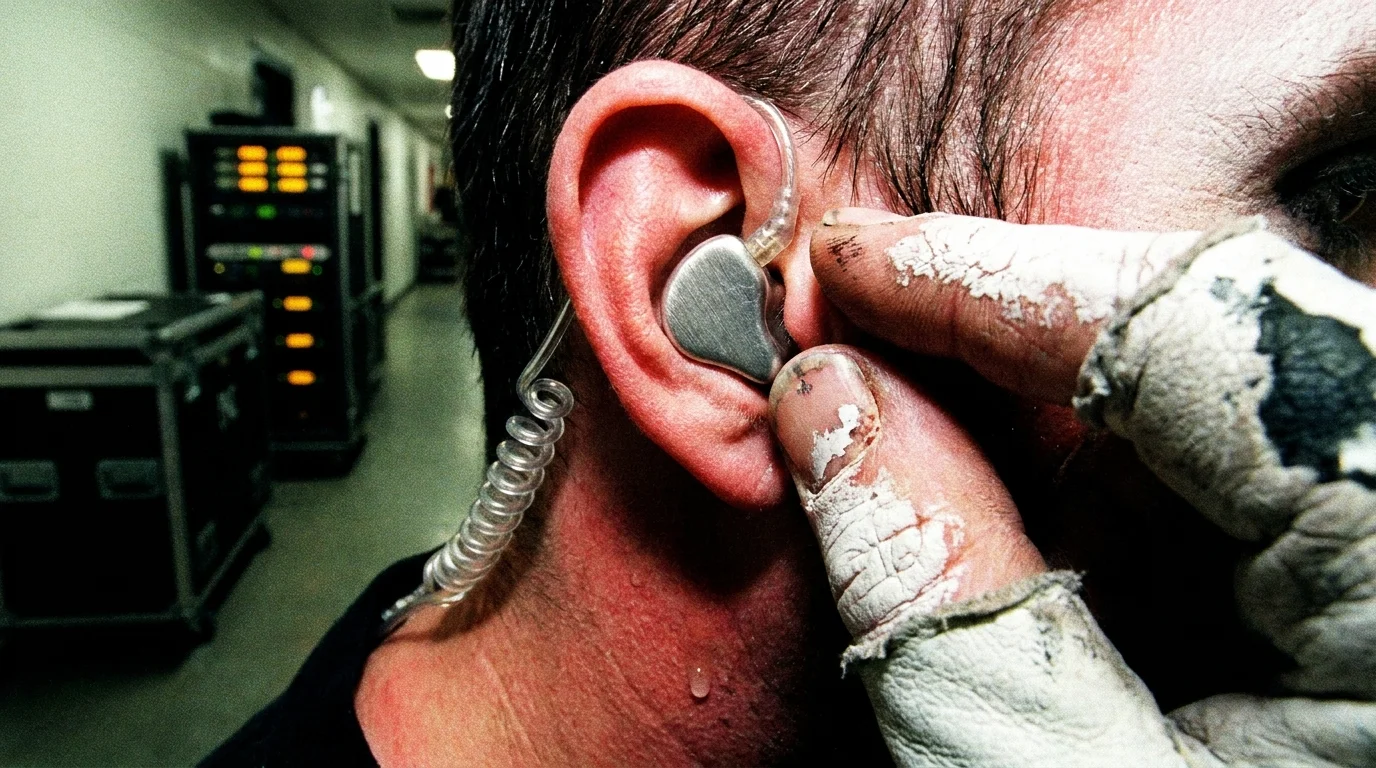
The Gotham Major Crimes holding cell smelled of damp concrete, institutional bleach, and dried sweat under 1,000-watt production lamps. Christopher Nolan’s sets were notoriously structured machines where cameras turned with the mathematical precision of a bank vault closing. Every mark was measured with vinyl tape on cold floorboards, and every background officer knew precisely which second their boots should hit the linoleum.
Slumped behind steel bars in an oversized charcoal suit, Heath Ledger sat isolated from the chatter of the soundstage. Flaking white greasepaint clung to bruised knuckles, cracking along the deep crevices of his hands as he rested them quietly between his knees. The call sheet outlined the scene with tidy economy: Mayor Garcia enters the precinct, promotes Jim Gordon to Police Commissioner, and the assembled officers erupt into a ripple of relieved, respectful applause.
Ledger was never directed to move. The script did not ask for a reaction, let alone an audible disruption from inside the cage. Yet as Gary Oldman bowed his head to receive the promotion and the precinct burst into obedient cheering, Ledger leaned forward. Without breaking deadpan eye contact, he raised his chalk-dusted hands and began an agonizingly slow, rhythmic, mocking clap that instantly sent a jolt through the entire soundstage crew.
Rather than cutting the take to protect the pristine page, the camera operator held tight on Ledger’s sunken eyes. What felt like an insurrection against a famously disciplined shooting schedule became one of the most chilling nonverbal improvisations in modern cinematic history, redefining how a performer can dismantle rigidity without breaking character.
The Architecture of Chaos Versus the Rigid Storyboard
Pop culture often imagines auteur directors as architects building fortress walls where no brick may sit crooked. We assume that high-budget cinematic universes operate like computerized flight paths, leaving zero room for human pulse or spontaneous rebellion. In that narrative, Nolan is the grand architect and Ledger was the wild fire burning through the blueprints.
The reality is far more compelling: the greatest creative work is not a fortress, but an acoustic chamber tuned for unexpected resonance. Ledger did not disrupt the scene to sabotage the shoot; he recognized an emotional vacuum in the room. When authority figures congratulate themselves, real-world malice does not scream or shake its fists. It mocks with terrifying, deadpan politeness.
When you understand the grammar of high-stakes environments, you realize that true presence is never about following lines verbatim. It is about reading the underlying voltage of a room and having the restraint to puncture manufactured decorum with the smallest possible gesture.
- Doja Cat unscripted bedroom livestream sparks fierce backlash exposing agency PR orchestration
- Aaron Paul streaming residual blackout exposes zero financial payouts despite continuous global views
- Gwyneth Paltrow Goop podcast breakdowns deploy deliberate emotional cues before major product rollouts
- Keanu Reeves 47 Ronin box office disaster severed studio contracts triggering John Wick
- Tatyana Ali steps out in Beverly Hills wearing a structured tailored wool trench
The Script Supervisor’s Silent Count
Consider the split-second dilemma faced by script supervisor Portia Finch on set that afternoon. Charged with cataloging continuity, eye-lines, and word-for-word adherence to the studio-approved shooting draft, an unprompted physical choice from an actor can register as an error requiring an immediate reset. Finch watched Ledger’s hands hit each other through the small video monitor, her pencil hovering directly over the margin of the page.
She kept her hand down. In high-stakes collaboration, seasoned professionals learn to distinguish between an ego-driven departure and a stroke of raw lightning. Trusting the spontaneous beat requires guts, especially when millions of dollars ride on production schedules running like clockwork.
The Anatomy of Creative Friction: Finding the Micro-Interruption
Great instincts do not happen by accident. Ledger arrived at that sarcastic applause through rigorous psychological preparation, creating a character so deeply understood that real-time reactions occurred naturally. We can look at how disciplined performers and leaders handle unscripted moments across three operational layers:
The Strategic Pause (For High-Pressure Environments)
When everyone else in a room rushes toward uniform agreement, the most powerful move is stillness. Notice that Ledger did not interrupt the dialogue; he waited until the crowd found its rhythm before introducing counterpoint. By holding back until the room settled, his movement carried four times the gravity.
The Subversive Detail (For High-Stakes Storytelling)
Avoid broad, melodramatic swings when trying to shift a room’s temperature. A quiet, out-of-sync action speaks louder than raised voices. If an entire boardroom is leaning into celebratory optimism, a measured, deliberately quiet question anchors authority faster than outward skepticism.
The Organic Reaction (For Creative Risk-Takers)
You cannot script genuine tension in advance. If you rehearse every breath, you rob your work of tactile truth. Ledger spent weeks alone in hotel rooms writing diaries in character precisely so that, when the cameras rolled, he could trust his nervous system to respond without conscious calculation.
Mindful Application: Engineering Space for the Unscripted
Introducing calculated improvisation into structured routines prevents professional rigor from becoming robotic stagnation. You do not need a film set to practice this level of presence; you only need the discipline to observe rather than merely execute.
Begin by stripping away performative busyness during collaborative moments. Keep your physical movements deliberately slow and deliberate when tensions rise around you.
- Audit the baseline rhythm: Before contributing to a tense meeting or project, listen quietly for 90 seconds to identify the emotional current driving everyone else.
- Withhold instant conformity: Resist the urge to nod or smile automatically just because others are seeking reassurance.
- Deliver the low-frequency response: When challenged, lower your vocal pitch and decelerate your speech pattern by roughly twenty percent.
- Hold the frame: Never rush to explain your reaction; allow the silence following your input to do the psychological heavy lifting.
The Presence Toolkit
To cultivate this brand of unflinching poise, monitor three specific physiological markers during high-stress interactions. Keep your resting breath count at six breaths per minute to prevent involuntary tension. Anchor your shoulders down away from your earlobes, leaving your neck loose and unbraced. Finally, maintain unblinking focus for four uninterrupted seconds before replying to provocative questions.
The Bigger Picture: The Power of the Human Variable
We spend decades training ourselves to follow scripts, meet metrics, and stay neatly between the chalk lines. We convince ourselves that perfection lies in absolute compliance with the storyboard, whether in our careers, our art, or our everyday interactions.
Yet the moments people remember years later are almost never the ones read straight off the teleprompter. True genius hides in deliberate restraint, waiting patiently inside the margins for the right millisecond to strike. When you build sufficient craft, you no longer have to cling to the safety of the page; you can simply clap your hands, tilt your head, and let the room reckon with the truth you just uncovered.
The mark of true mastery is not flawless execution of the plan, but the quiet courage to abandon it the instant something better presents itself.
| Key Point | Detail | Added Value for the Reader |
|---|---|---|
| The Unscripted Applause | Ledger added the slow sarcastic clap during Gordon’s promotion without director prompting. | Demonstrates that restraint and micro-gestures create far deeper emotional impact than loud theatrics. |
| Directorial Restraint | Nolan kept the camera rolling instead of cutting the take for continuity errors. | Proves that true leadership recognizes brilliant deviation rather than policing compliance. |
| Prepared Instinct | Ledger’s weeks of character immersion enabled organic, real-time psychological choices. | Shows that spontaneity is not reckless guessing; it is the ultimate byproduct of rigorous preparation. |
Frequently Asked Questions
Did Christopher Nolan tell Heath Ledger to clap during that scene?
No, the scene was scripted only for the Gotham officers to applaud Commissioner Gordon, with Ledger remaining a silent captive in the cell background.Why did the camera operator stay on Ledger instead of Gary Oldman?
Camera operators on high-level sets are trained to hold focus when an actor delivers magnetic behavior, allowing the director options in the editing room.Was the hospital explosion pause also an unscripted improvisation?
The delayed detonation was a calculated pyrotechnic timing sequence, though Ledger’s casual fiddling with the detonator was his own character flourish.How does unscripted acting work with strict Hollywood union rules?
Actors are free to make physical choices and adjust line deliveries organically, provided they do not alter safety parameters or significantly rewrite the story structure.What can non-actors learn from Ledger’s choice in this moment?
True presence often means doing the opposite of what the crowd expects, using silence and stillness to command authority without raising your voice.