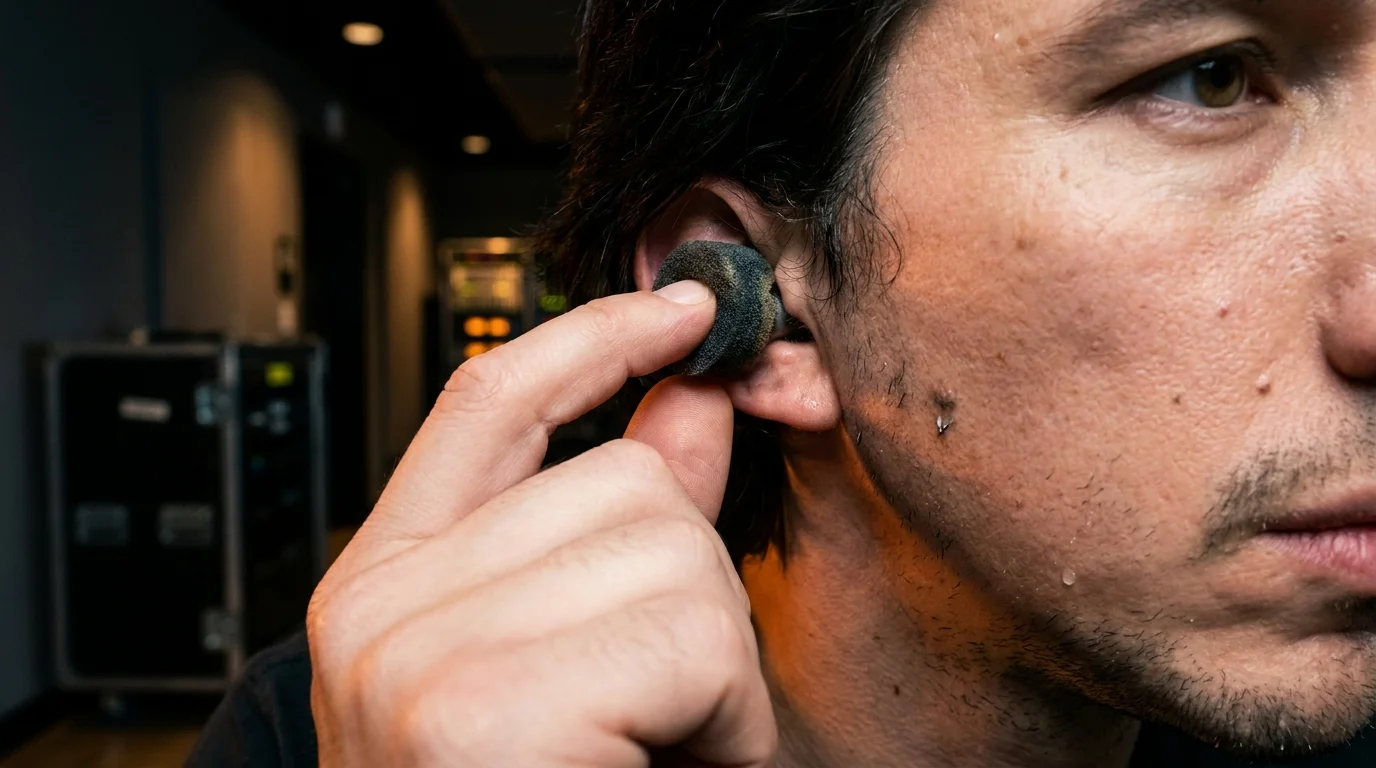
The red studio beacon flickers against sound-dampened gray walls, casting a dim glow over an expanse of polished mahogany. Inside an acoustic booth in midtown Manhattan, the ambient hum of an air handler drops to a razor-thin whisper, leaving only the sound of controlled breathing and the dry slide of paper across laminate. You expect the cadence of an elite press tour to follow its customary track: an exchange of polite laughs, a practiced promotional cadence, and an actor cheerfully nodding along to excerpts of their own labor.
Instead, the air snaps taut when an unscripted audio cue triggers through the booth monitors. On the wooden console, faded black foam headphone cushions rest abandoned beside a live condenser microphone. There was no raised voice, no theatrical slam of a door, and no publicist waving frantic hands in front of the glass. There was only the sudden, weightless clatter of plastic meeting wood, followed by quiet footfalls retreating toward the exit hallway.
The incident occurred during an NPR taping for Fresh Air, where Adam Driver sat opposite a broadcast team accustomed to standard junket protocol. When the engineers queued an archival audio track of Driver singing in Noah Baumbach’s Marriage Story, the unspoken contract shattered. Rather than capitulate to the traditional media demand of listening to himself perform, Driver removed the headset, stood up, and quietly stepped outside the studio doors.
The Illusion of the Compliant Subject
For decades, the standard press junket has operated on an unwritten pact: talent shows up, absorbs whatever media clips producers drop into their ears, and offers performative reactions on demand. We treat this transaction as benign, assuming that someone who inhabits monumental roles on sixty-foot screens possesses an infinite tolerance for their own reflection. Yet expecting an artist to casually dissect their own raw voice is like asking a surgeon to admire their own pulse under anesthesia.
When Driver broke protocol, the response split between industry shock and audience fascination. We are conditioned to view a walkout as a temper tantrum, an eruption of ego that violates polite broadcast manners. But when you look beneath the initial friction, Driver’s swift retreat reveals something far more structural: an uncompromising boundary drawn against an industry that routinely confuses total personal access with professional duty. Refusing your own playback is not defiance for its own sake; it is a tactical defense of the creative nervous system.
Marcus Vance, a veteran sound technician who spent twenty-four years balancing monitor levels on syndicated morning radio, knows the psychological weight of this dynamic intimately. He recalls setting levels for high-caliber performers who visibly shivered whenever raw studio feedback leaked into their earpieces. Vance notes that the human brain naturally processes externalized recordings of its own vocal tract as a mild form of sensory alienation, a phenomenon magnified tenfold for actors who must dissolve their self-consciousness entirely to stay employable.
Setting Personal Perimeter Walls: Profiles in Boundary Control
How an artist or professional protects their cognitive focus depends entirely on where they draw their line in the sand. When you navigate high-pressure workspaces, understanding these defensive profiles helps you identify how much of your private process can be safely exposed to the public eye.
- Paul Rudd blocks Hollywood burnout enforcing an unglamorous upstate routine of muddy garden chores
- Millie Bobby Brown memoir announcement sparks skepticism exposing slick glossy ghostwriter phrasing across early pages
- Carey Mulligan demands zero cosmetic smoothing exposing chalky flaking skin under harsh studio lighting
- Billie Eilish stops arena set after shrill ear monitor screech sparks acute dizziness
- Halle Berry thriller The Mothership blocks press junkets enabling calculated studio tax write-downs
The Complete Abstainer: Like Driver, who has famously walked out of screenings or covered his eyes in dark theaters, this approach relies on a total embargo. If you never view the finished product, your instinct remains untainted by self-editing. It prevents you from adjusting future mannerisms based on how you looked or sounded last Tuesday.
The Clinical Analyst: Other performers treat their recorded material as cold autopsy tissue. They mute the emotional resonance, taking clinical notes on technical pacing and lighting angles. While effective for technical perfectionists, this posture demands tremendous psychic energy and often runs the risk of stiffening spontaneous creative work.
The Performative Accommodator: This is the default junket stance—smiling through teeth while your own voice rattles inside your eardrums. You nod along, perform amusement for the host, and swallow the internal discomfort. It keeps the public relations machine frictionless, but it routinely drains your internal reserves before the actual workday even finishes.
Mindful Resistance in High-Pressure Rooms
You do not need an Oscar nomination to recognize the creeping dread of being forced into unapproved, uncomfortable workplace playback. Whether it is an unexpected review of an archived Zoom meeting or an unannounced team post-mortem where your rough notes are projected on an overhead monitor, learning to set quiet perimeters is an art form. Calm physical disengagement speaks louder than a defensive monologue.
The secret lies in removing friction without manufacturing a scene. When you manage personal boundaries under public pressure, consider the mechanical discipline of a deliberate exit:
- Acknowledge the boundary violation internally without mirroring the room’s chaotic energy.
- Avoid the impulse to lecture or apologize for having a physical boundary; justification simply invites unwanted debate.
- Physically detach from the apparatus—unplug the headset, close the laptop lid, or step away from the desk.
- Depart in absolute silence, allowing your physical absence to communicate the pause.
The Tactical Toolkit for Unscripted Friction
Navigating moments where expectations clash with personal integrity requires concrete parameters rather than vague concepts. Keep these operational baselines in mind whenever professional decorum threatens to overwhelm your autonomy:
The Decibel Rule: When unapproved playback begins, immediately reduce the volume to zero or slip off one ear cup within three seconds to prevent involuntary sensory stress.
The 20-Foot Egress: Create at least twenty feet of physical distance between yourself and the broadcast or meeting hub before engaging with team members, ensuring your voice remains neutral.
The Single-Sentence Stand: Prepare a five-word internal boundary phrase, such as “I don’t review raw takes,” to anchor your posture before stepping back into any shared workspace.
The Value of Leaving the Headset Behind
There is a profound quiet that settles over an empty desk once the initial shock of an exit clears. When Driver left those foam cushions resting against the studio wood, he dismantled the fiction that artists owe the public every square inch of their interior life. The moment was not an act of hostility toward a storied radio program, but an act of self-preservation that prioritized craft over commercial compliance.
In a culture that constantly demands your instant reaction, your recorded validation, and your continuous performance on screen, choosing not to participate is a radical tool. Walking away from an unapproved recording does not make you difficult. It simply means you know precisely where the work ends, where your private self begins, and that some frequencies are never meant to be heard twice.
“True professional mastery is knowing the exact moment to put down the headset and step outside the booth.”
| Key Point | Detail | Added Value for the Reader |
|---|---|---|
| Physical Boundary Enforcement | Driver quietly removed the headset without a verbal outburst during playback. | Teaches the power of non-verbal, non-confrontational boundary management. |
| Playback Dissociation | Raw audio confrontation can paralyze natural performance instincts. | Validates personal discomfort with reviewing unpolished or past output. |
| Media Etiquette Friction | Challenging traditional broadcast junket expectations creates temporary ripples. | Demonstrates that protecting focus is worth temporary social awkwardness. |
Frequently Asked Questions
Did Adam Driver issue a public apology for walking out of the studio?
Driver never issued a public apology, adhering to his long-standing reputation for maintaining personal boundaries without engaging in reactive public relations damage control.Why does Adam Driver refuse to watch or listen to his own work?
He has stated across multiple interviews that witnessing his own acting induces intense self-loathing, self-editing, and distracts him from staying spontaneous in future roles.Was the radio production team aware of his discomfort before the incident?
Yes, the production team was informed in advance of Driver’s aversion to playback, which made the decision to queue the audio clip a direct catalyst for his departure.How can professionals apply this boundary in everyday office settings?
By setting calm, upfront rules regarding how their input is reviewed, and politely stepping away from situations that breach pre-established operational agreements.Did this walkout negatively impact Adam Driver’s film career?
Not in the slightest; his unwavering commitment to his craft and clear boundaries have only solidified his reputation as an uncompromising, singular performer.