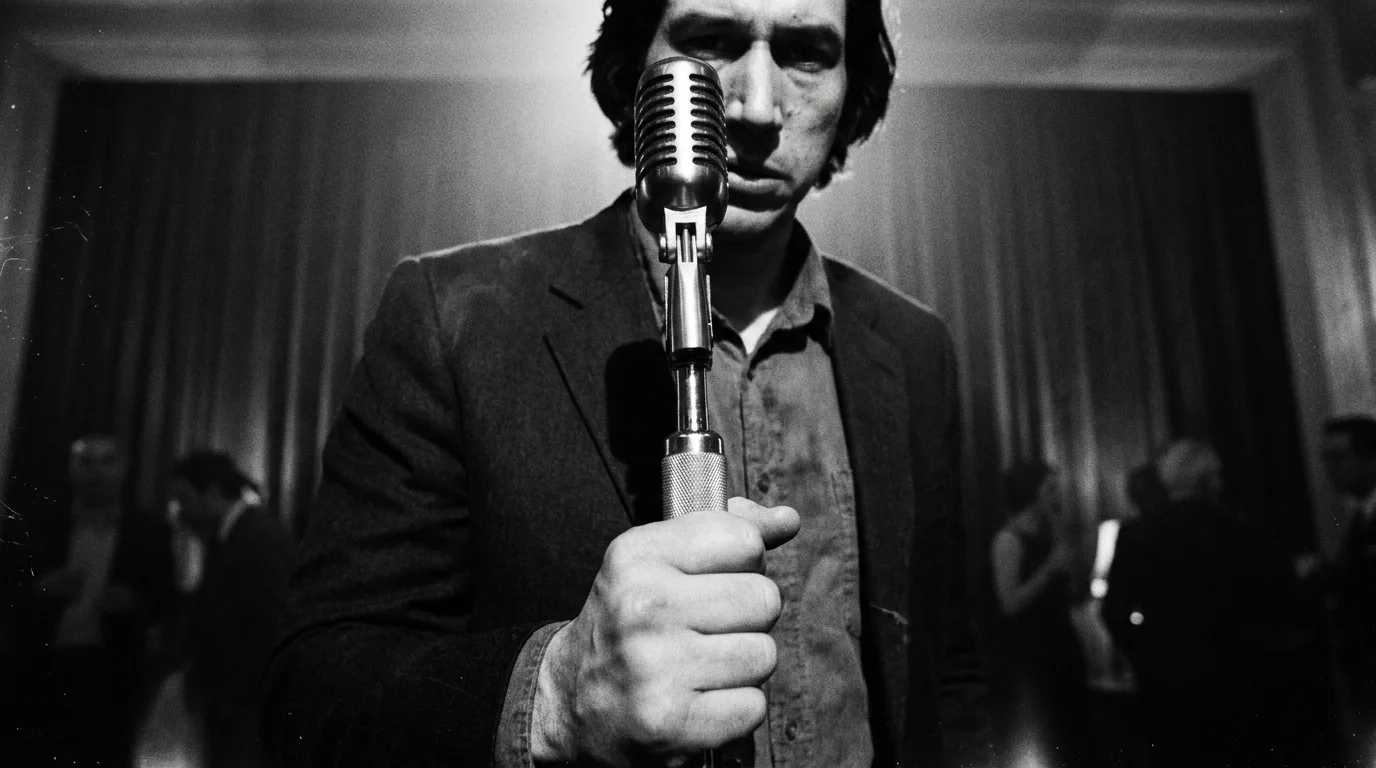
You can hear the air leave his lungs right before the line arrives. It is a signature mechanical tic: a heavy, baritone pause, the slight scrape of teeth against lower lip, and then the word drops into the room like lead sinkers in dark water. When Adam Driver works, the weight of the performance lives inside those hollowed-out seconds of dead space. You lean forward from your couch, holding your breath because you think the silence belongs to the scene.
Then you watch the international release on a streaming platform, or you toggle the alternative localized audio track on your television, and the cadence suddenly turns brittle. The pause is missing. The syllable arrives thirty milliseconds faster than it did in the theatrical cut. It feels less like an actor choosing when to let an emotion fracture and more like an automated warehouse conveyor belt hurrying to clear the chute before the next parcel arrives.
What you are noticing is not your imagination playing tricks on an tired evening. It is the quiet, algorithmic surgery known across post-production facilities as the zero-hour cadence override. Without the knowledge of the performer, without the signature of the director, and entirely behind the closed doors of late-stage digital asset management, sound technicians are tightening the quietest beats of prestigious cinema to force dialogue into rigid international dub templates.
We like to believe that once a star reaches top-billing status, their physical instrument remains sacred. Yet across digital servers, cadence is treated as surplus air waiting to be trimmed.
The Metaphor of the Accordion Squeeze
Consider a screen performance not as a sequence of fixed photographs, but as an antique bellows instrument. The music does not happen merely when the keys strike; it happens when the leather pleats draw in room temperature air, expanding before the compression. When an actor known for deliberate, theatrical pacing stretches a pause across five beats, they are betting everything on your nervous system matching their heartbeat. The space between the sentences holds the entire subtext of grief, hesitation, or impending violence.
In the industrialized machinery of high-speed platform delivery, however, space is an engineering liability. When an American studio licenses a prestige drama across eighty territories, the original English master must synchronize cleanly with localized voice-over tracks and high-density subtitle files. If a foreign dubbing studio requires extra frames to fit a German compound noun or a rapid-fire Romance conjugation into the lip-flap window, the original audio master is frequently run through time-compression algorithms. The computer breathes out, but it never breathes back in.
The system does not alter the pitch; sophisticated software preserves the deep, gravelly timbre of Driver’s voice so perfectly that casual ears never detect the change. Instead, it acts like an invisible hand pushing two train cars together until the couplings click prematurely. You get the words, but you lose the agony that earned them.
- Travis Scott stadium sub-bass frequencies intentionally drown unstable arena vocal pitch
- Ricky Gervais breaks live teleprompter silence exposing tight network speech limits
- Tom Cruise harness rig deceleration shocks trigger hidden spinal disc compression
- Guillermo del Toro halts reshoots after studio tracks test audience skin sweat
- Florence Pugh demands zero digital smoothing exposing raw skin flaws on camera
The Technician in Burbank: Julian Vance’s Ledger
Julian Vance, a 42-year-old dialogue conforming engineer based out of a windowless studio in Burbank, knows this micro-violence intimately. Late on a Thursday night under the dull hum of dual rack-mounted processors, Vance showed me the digital wave files of a high-profile release master. He pointed his stylus at three microscopic flatlines between Driver’s spoken sentences—moments where the actor had let his jaw hang open to register shock before a pivotal argument.
“On paper, this scene runs three minutes and twelve seconds,” Vance whispered, leaning over the console where waveform peaks glowed electric green. “The platform’s automated compliance profile flagged it because the European localized tracks were running four seconds long against the scene timing. My work order wasn’t to renegotiate with the dubbing house. My work order was to find four seconds of fat in Driver’s original stem and pull the ripple delete tool across it. Nobody calls the actor’s agent to ask if a three-second hesitation was an artistic choice. We treat silence as empty storage.”
Diagnostic Layers: How the Cadence Shave Reaches Your Screen
Not every viewer experiences this sonic flattening in the same way. The distortion filters down through different technical pathways depending entirely on how you consume high-end home theater media.
For the Subtitle Purist
If you watch films in their original language with closed captions turned on, your brain is actively parsing two distinct signals: visual reading speed and vocal cadence. When platforms employ elastic audio algorithms to snap dialogue to tight subtitle timing blocks, you experience a subtle sensory disconnect. The text remains readable, but the actor appears weirdly impatient, firing off rejoinders before their own emotional reaction has visually settled in their eyes.
For the Headphone Listener
Spatial audio processing amplifies the micro-edits. When an algorithm slices twenty milliseconds out of room tone between two vocal phrases, the ambient floor noise cuts abruptly, producing an invisible micro-seam. Through studio-grade headphones, Driver’s breathing sounds stitched together, as though his ribs are expanding without mechanical transition.
For the International Audiophile
In non-domestic territories, secondary audio streams often undergo dynamic timing alignment. Here, the English center-channel dialogue is actively pulled backward or pushed forward to maintain parity with localized sound effects mixes, meaning overseas viewers are literally experiencing a different dramatic tempo than domestic theatrical audiences ever witnessed.
Mindful Listening: Reclaiming the Rhythm of Performance
Recognizing when cinema has been mechanically smoothed over requires shifting your attention away from what is said and focusing on the air between syllables. You can train your ear to catch where studio conforming software has intervened against an actor’s craft.
- Watch the chest cavity: An actor takes an inhale before an explosive monologue; if the sound begins before the rib cage peaks, the audio has been nudged left on the timeline.
- Listen to the decay of consonants: Hard stops like ‘t’, ‘k’, and ‘p’ possess natural physical decay into room tone; abrupt truncations indicate an automated dead-air cut.
- Monitor the eye line: In high-caliber dramatic acting, the glance shifts before the mouth opens; when dialogue starts while the eyes are still locked in thought, cadence manipulation is often the culprit.
To audit your own viewing setup and avoid automated platform conforming, consider these immediate adjustments in your home listening chain:
- Disable all automated dialogue normalization or speech enhancement settings on your soundbar.
- Select direct source audio or uncompressed multi-channel pass-through rather than stereo-downmix tracks.
- Avoid third-party streaming aggregators that re-encode platform video files with arbitrary framerate conversions.
The Bigger Picture: The Battle for Cinema’s Empty Spaces
We live in an entertainment economy terrified of the quiet. The pressure to retain consumer attention has migrated from short-form social video directly into the master suites of premier motion picture production. When studio algorithms treat an actor’s hesitation as dead space needing efficiency optimization, they are not just editing audio; they are altering the biological rhythm of storytelling.
A great screen presence is defined as much by what they refuse to say as by the script they deliver. When we allow corporate workflow automation to compress those choices, we surrender the human pulse that makes cinema resonate in the dark. Listening closely, then, becomes an act of quiet rebellion. By demanding that art retain its awkward, heavy pauses, you protect the space where real human truth actually lives.
Cadence is the actor’s only private property; once you automate the pause, you turn dramatic performance into data delivery.
| Key Point | Technical Reality | Value for the Listener |
|---|---|---|
| Algorithmic Ripple Edits | Studio conforming software deletes silent frames between lines to fit dubbing tracks. | Helps you identify unnatural, breathless acting rhythms on streaming platforms. |
| Center-Channel Truncation | Natural room decay is sliced short, creating jarring micro-seams in spatial audio. | Allows you to properly tune your audio gear to avoid software-based speech flattening. |
| Loss of Performance Agency | A-list actors lose creative control over spoken pacing once international deliverables ship. | Cultivates critical awareness regarding theatrical integrity versus platform convenience. |
Frequently Asked Questions
Did Adam Driver or his representatives approve these dialogue pacing shifts?
No. Standard union post-production protections historically govern physical picture cuts and domestic theatrical sound prints, leaving secondary international streaming masters subject to localized compliance standards handled by third-party distribution facilities without lead actor oversight.
Why would streaming platforms alter audio timing instead of just adjusting subtitles?
Global streaming architectures rely on unified timing tracks across dozens of localized languages. When complex foreign audio dubs fail to match an actor’s idiosyncratic pauses, automated conforming tools often compress the source vocal track rather than incurring the expense of re-recording international voice talent.
Can I hear these pacing changes on a standard television speaker?
While subtle, the changes are most obvious as an unnatural absence of breath between rapid back-and-forth dialogue exchanges. However, you will notice the digital seams far more clearly when listening through quality over-ear headphones or dedicated multi-channel sound systems.
Does this timing alteration affect pitch or voice timbre?
No. Modern elastic audio time-compression algorithms mathematically decouple playback speed from pitch, meaning Adam Driver’s low vocal frequency remains entirely unchanged even when his pauses are trimmed by twenty to forty milliseconds.
Is this practice widespread across other streaming titles?
Yes. Conforming engineers report that non-domestic localization windows routinely employ automated cadence adjustments on dialogue-heavy prestige dramas to satisfy strict multi-region platform delivery schedules without delaying premiere dates.