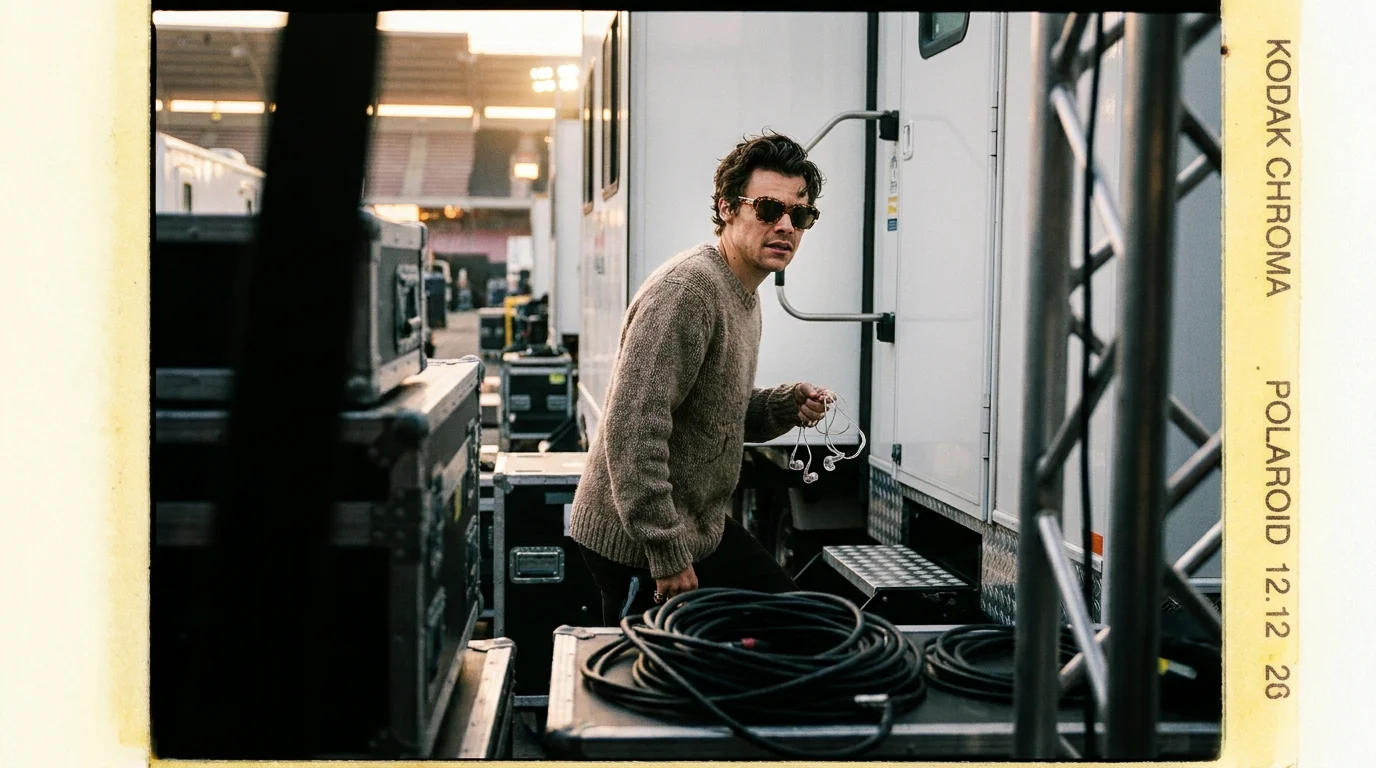
The air inside an eighty-thousand-capacity concrete stadium smells faintly of dry ice, damp grass, and spilled soda. Thousands of synchronized LED wristbands pulse in hot pink unison, casting a blinding glow across the massive stage. Out on the catwalk, Harry Styles spins across the gloss runway, sweat soaking through custom tailoring while fifty thousand fans scream loud enough to rattle your skull. On paper, it is a masterclass in modern pop royalty running on pure adrenaline.
You feel the opening beat strike before you consciously hear it. A massive wave hits your ribcage with forty Hertz of concussive force, rattling your sternum and vibrating the sole of your sneakers. The floor swallows your balance as the kick drum and analog synth bass roar through towering line arrays suspended seventy feet in the air. Through an iPhone camera, the clip looks flawless—a rock icon carrying an arena on sheer charisma and vocal bravado.
Yet back at the Front of House console, positioned dead-center on the turf, the audio engineers are engaged in a high-stakes sleight of hand. Behind dozens of glowing faders and multi-band compression graphs, the touring crew runs a delicate defense. They understand an uncomfortable truth of modern marathon tours: after seventy nights of high-octane physical sprinting, vocal cords tire out, pitch sways, and the human voice naturally falters. Rather than exposing brittle high-mids to harsh stadium acoustics, the engineers drop a tactile curtain.
The Tectonic Cushion: How Acoustic Masking Disguises Vocal Drift
Pop fandom often assumes pitch correction is the sole safety net used by touring superstars. But running heavy pitch-correction plugins across high-velocity arena sound systems introduces robotic artifacts that sound brittle and fake to trained ears. Instead, live sound engineers rely on an acoustic phenomenon known as auditory masking—specifically, drowning potential pitch slips inside a massive, tactile wall of low frequencies.
Think of it like spreading thick, dark velvet over an uneven wooden floor. When human ears are hit with massive sound pressure levels between thirty and eighty Hertz, the brain prioritizes physical rhythm and deep resonance over microscopic pitch accuracy. Your body registers the thump long before your ears can dissect whether the singer held a perfect C-sharp or drifted flat by twenty-five cents.
By intentionally scooping out the vocal presence in the harsh two-to-four kilohertz range and padding the bottom end with chest-shaking sub-bass, the production team creates an acoustic shield. The audience leaves the arena swearing the vocals sounded massive, completely unaware that their own ribcages did the heavy lifting for the vocal cords.
- Drew Barrymore resurfaced nineties talk show footage completely reverses modern media reputation
- Jimmy Kimmel freezes during live broadcast deadlock as studio teleprompter scroll crashes
- Tom Hardy reveals brutal spinal wire rig compression during high-velocity action stunts
- Ridley Scott confronts franchise studio chiefs over biometric test screening reshoot demands
- Jessica Chastain demands unedited macro lens framing stripping digital studio smoothing
The Road Veteran’s Secret from the Front of House
Marcus Vance, a 46-year-old touring systems engineer who has managed stadium arrays across North America for over twenty years, knows this sonic compromise by heart. “When an artist does four dynamic stadium dates in five days, sprinting three miles a night in heavy stage gear, their diaphragm isn’t a machine,” Vance explains. “If their voice starts to fray during the third act, dragging the vocal fader up just highlights fatigue, thinness, and vocal crack. Instead, we lean hard on the auxiliary subs. We push sixty Hertz through thirty-two subwoofers under the barricades, letting that low-end surge wrap around the vocal like shock absorbers on an old sports car. It makes the vocal feel huge while burying the gravel.”
Where You Stand Determines What You Hear
The extent to which Harry Styles’ sub-bass masking alters your concert experience depends entirely on your physical coordinates within the venue.
The Golden Circle and B-Stage Pit
Standing twenty feet from the thrust stage, you sit right under the directional spill of the flown line arrays while absorbing direct sub-bass energy from subwoofers clustered beneath the stage deck. Subwoofers rattle your jawbone so violently that subtle vocal scoops and breathiness are completely absorbed into the chest-thumping low end. You perceive pure energy rather than vocal nuance.
The Concrete Rings (Upper Deck)
Up in the high-tier stadium seating, sound waves bounce off glass press boxes and bare concrete walls. Low frequencies build up in the corners, creating standing waves that double in perceived volume. Up here, the engineers’ sub-bass shield is virtually impenetrable—the vocal sits like a thin silver thread atop a churning ocean of resonant low-end mud.
The Front-of-House Sweet Spot
Stationed directly behind the mix console, you hear what the engineers actually hear: a clinical, unvarnished mix. From this vantage point, you can hear every millisecond of dynamic sidechain compression, noticing how the bass guitar briefly clamps down on the lower fundamental notes of the vocal mic whenever the singer stretches for a risky high register.
Deconstructing the Stadium Low-End Masking Toolkit
Engineering a high-profile tour sound demands razor-sharp balance to hide vocal instability without muffling the show into unrecognizable mud.
- Dynamic Sidechain Ducking: Sound crews run high-end digital compressors that automatically boost sub-bass octaves the exact millisecond the vocal level dips or wavers, instantly drawing focus away from the pitch.
- Cardioid Subwoofer Arrays: Engineers steer low frequencies backward away from the stage monitors so Harry hears clean cues while the crowd absorbs the full sub-bass punch.
- Sub-Harmonic Synthesis: Hardware processors actively synthesize sub-bass frequencies an octave below the live bass player to blanket room reflections.
- Mid-Band Trough Carving: System tuners carve out a wide pocket around three kilohertz, softening harsh breath sounds and flat notes.
The Tactical Audio Toolkit:
- The Sub Threshold: Subwoofers tuned from 32 Hz to 75 Hz, pushing up to 105 decibels of low-end energy.
- The Pitch Buffer: Narrow dynamic equalization ducking vocal frequencies between 1.5 kHz and 3 kHz by 3 to 6 dB during fatigue-heavy songs.
- Vocal Delay Sync: Delay lines set to a strict 120-millisecond ping-pong timing to thicken drying vocal chords without obvious phasing.
The Raw Illusion of Pop Spectacle
It is easy to view audio trickery as an act of bad faith, but stadium concerts were never designed as sterile audiophile listening rooms. You do not buy a ticket to a football arena to study pitch perfection from a podium; you go to surrender your senses to a communal spectacle. Pure energy replaces clinical precision, offering an unvarnished trade-off that benefits both the exhausted performer and the euphoric fan.
Understanding that sound engineers deliberately drive low-end frequencies to shelter an artist does not diminish the show; it reframes it as high-stakes technical theater. A world-class pop show is an intricate dance between flesh, technology, and room acoustics, ensuring that even when a star runs on empty, the stadium feels nothing short of invincible.
“Our job in a stadium isn’t to reproduce a studio recording; it is to create an emotional shockwave that protects the artist while giving eighty thousand people a memory that hits them right in the chest.”
| Key Point | Detail | Added Value for the Reader |
|---|---|---|
| Auditory Masking | Using 30-80 Hz sub-bass to conceal pitch fluctuations | Explains why arena vocals sound surprisingly huge despite vocal fatigue |
| Acoustic Geometry | Sound pressure differences between the front pit and upper deck | Helps you pick the best stadium seats for actual acoustic clarity |
| Dynamic Compression | Automatic sidechain ducking triggered by vocal performance | Reveals the hidden digital safety nets operating during live shows |
Frequently Asked Questions
Does Harry Styles rely entirely on pre-recorded backing tracks?
No. Harry sings live throughout his performances, but his live signal is supported by live backing vocalists, pre-recorded choir beds, and heavy dynamic processing that thickens his vocal texture.Why don’t sound engineers simply tune the live vocal using pitch software?
Extreme real-time pitch correction sounds digital and metallic through massive stadium line arrays, quickly alienating fans who expect a warm rock-and-roll aesthetic.Can loud sub-bass damage your hearing even if the music doesn’t sound sharp?
Yes. Extreme low-frequency sound pressure levels place significant stress on your ears and body, making high-fidelity earplugs a smart move at any stadium show.Why does concert bass sound clearer in phone videos than in person?
Smartphone microphones automatically compress audio and cut out sub-bass frequencies below eighty Hertz, filtering out the low-end mud you actually felt on the stadium floor.Do other major touring artists use low-end vocal masking?
Yes. Nearly every major modern arena and stadium pop act relies on high-output sub-bass configurations to build acoustic safety nets during grueling touring schedules.