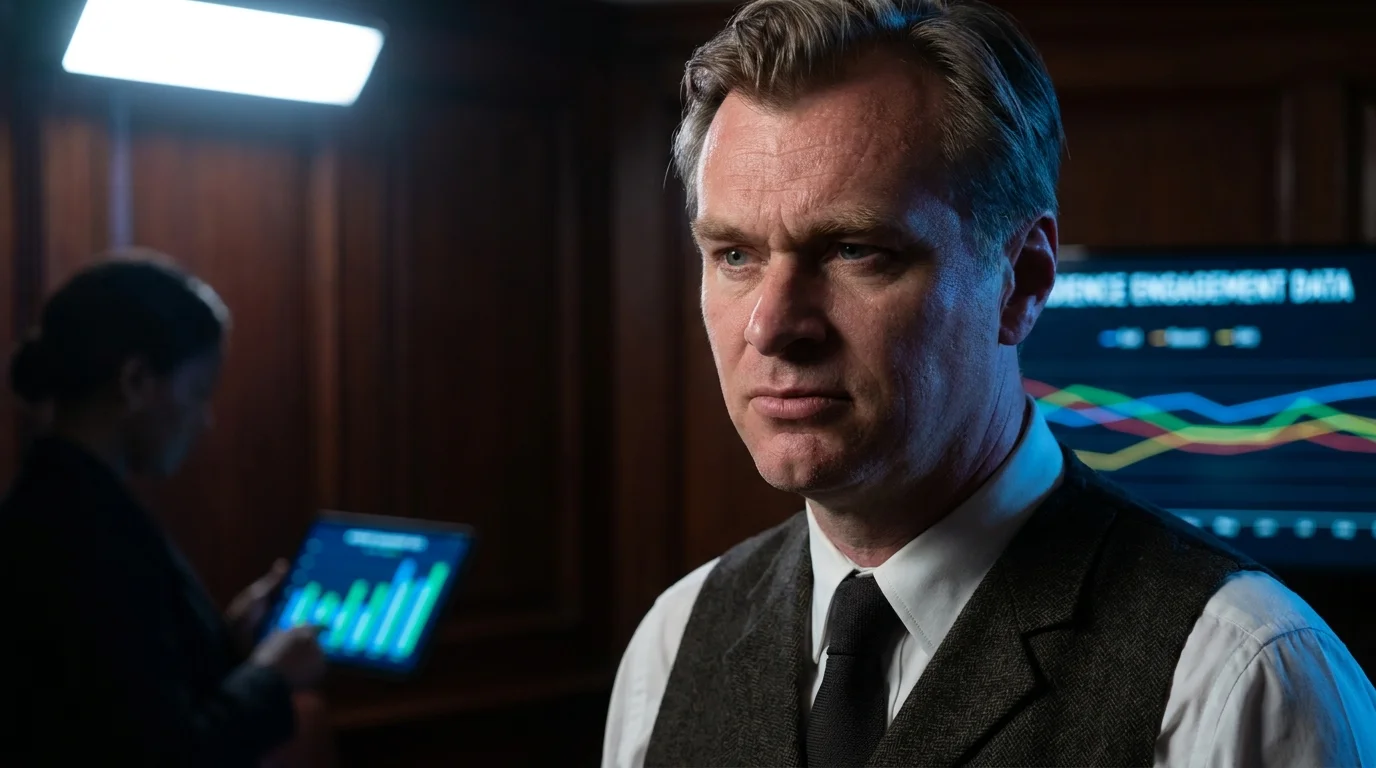
The private screening room in Burbank smells faintly of ozone, warm projector bulbs, and industrial wool carpeting. It is the kind of quiet that feels heavily insured. In the center row, a handful of corporate handlers sit behind glowing tablets, checking real-time dashboards rather than watching the flicker of 70mm silver halide on the wall. For them, film is no longer light passing through celluloid; it is a stream of autonomic nervous system outputs measured in microsiemens.
You are looking at the modern studio apparatus at its most clinical. Attached to the fingertips and wrists of forty recruited viewers are galvanic skin-response sensors, pulse oximeters, and eye-tracking infrared bars tucked into the cup holders. When a scene drags, the line drops. When a scene disorients, the spikes turn jagged. The spreadsheet calls this friction. To an accountant reading the readout twenty minutes after the credits roll, friction is a liability that requires an immediate reshoot.
When Christopher Nolan stepped into that fluorescent-lit boardroom to face an executive suite armed with these exact physiological graphs, the collision was inevitable. The corporate mandate was simple: rewrite and reshoot the film’s crushing final ten minutes because test viewers registered an acute stress spike that failed to settle into standard commercial catharsis. What followed was a closed-door war over emotional architecture, pitting synthetic consensus against the brutal honesty of an uncompromised theatrical climax.
The Galvanic Fallacy: When Discomfort Is Confused with Failure
Corporate film testing has quietly abandoned the humble paper questionnaire. Handing an audience member a golf pencil in the lobby after a midnight screening used to leave room for human complexity. A viewer might write that an ending felt wrenching, yet spend the entire drive home staring through their windshield, utterly transformed by what they had witnessed.
Modern studio analytics treat the human heart like a heating coil that must stay within a predictable thermal window. If a viewer’s galvanic skin response—the micro-sweat produced by subconscious dread—remains elevated during the final reel without an immediate dopamine release, the algorithm flags the cut as broken. The executive suite reads this retention of unease as dissatisfaction. They believe the audience is rejecting the medicine when, in truth, they are simply feeling the needle.
Nolan’s entire career operates on the inverted principle: cinema should never comfort you with easy closure. Tension must linger in your collarbone long after you walk out into the glare of the parking lot. Treating emotional ambiguity as a statistical error is like sanding the teeth off a saw because the metal feels sharp to the touch.
The Projectionist’s Cold Read
Consider Marcus Vance, a 54-year-old post-production projectionist who spent three decades running test screenings across Los Angeles and London. Long before infrared cameras tracked pupil dilation from beneath the armrests, Marcus watched audiences from a tiny rectangular slit in the back wall. He measured the room not by biometric graphs, but by the sound of shuffling feet and the humidity shift in the room.
- Amy Adams demanded harsh macro lens framing stripping glamour for gritty prestige drama
- Bruce Springsteen halts stadium encore after deafening monitor feedback shatters stage audio
- Addison Rae staged bedroom livestream sparks intense viewer pushback exposing agency scripting
- Gwyneth Paltrow podcast breakdown reveals calculated media rhythm launching wellness product line
- Dolph Lundgren red carpet appearance debuts tailored monochrome suit with Italian leather boots
“A terrified audience sits completely motionless; they don’t even swallow,” Marcus once observed over black coffee in a Burbank diner. “A bored audience shifts their weight, checks the luminous dials on their wristwatches, and leans toward their partner. The biometric sensors can’t tell the difference between a viewer paralyzed by narrative awe and a viewer fighting a panic spike. The machine registers both as distress. The executive sees red ink, but the director sees total, breathless surrender.”
The Algorithmic Trap vs. The Unresolved Horizon
When you break down how narrative pacing interacts with human perception, the battle between spreadsheet governance and directorial intent splits into three distinct operational philosophies. Each handles audience discomfort through an entirely different lens.
The Sanitized Standard: The Dopamine Return Curve
Mainstream tentpole filmmaking demands that every unresolved narrative thread snap back into place before the end-title card. Under this framework, high audience stress levels must be immediately neutralized by visual spectacle or quippy relief. Predictable pacing ensures repeatable consumption, allowing the viewer to metabolize the experience cleanly before leaving the theater. It makes for excellent quarterly earnings, but it leaves zero cultural residue.
The Nolan Doctrine: Suspended Catharsis
Rather than dropping the curtain on an emotional resolution, this approach weaponizes the cut to black. The climax refuses to untie the knots it spent two hours forming. By preserving the psychological pressure inside the frame, the narrative forces your mind to continue writing the resolution on the drive home. The elevated heart rate isn’t an error in the manufacturing line; it is the entire point of the exercise.
The Test-Screening Compromise: The Focus-Group Patch
This is the middle ground where bold ideas usually go to die. Faced with erratic biometric spikes, studios typically order pick-ups consisting of ADR voiceovers, reactionary close-ups of secondary characters explaining the stakes, and an unearned musical swell. It tranquilizes the narrative. The numbers on the monitor smooth out, the risk disappears, and the picture becomes completely forgettable.
How to Protect Creative Intent from Metric Contamination
Whether you are cutting a feature film, writing a novel, or engineering a product launch, metric-driven optimization will always try to smooth away the edges that give your work its soul. Resisting the pressure to sand down creative friction requires specific, deliberate boundaries.
- Separate diagnostic signals from creative prescriptions: Use data to locate where an audience becomes confused, but never let the data dictate the creative remedy. The metric can identify the drop, but it cannot write the dialogue.
- Protect the cold open and the hard cut: The first five minutes and the final three minutes are the primary targets for risk-averse executives. Lock these elements before opening the room to non-creative stakeholders.
- Audit the testing environment: Sensors and focus groups alter human behavior. A viewer strapped into monitors is acutely aware of being observed, skewing their natural emotional reactions toward performative neutrality.
- Preserve deliberate narrative fatigue: A story that never exhausts the viewer cannot earn its quiet moments. Pacing requires valleys of quiet stillness, even if an analytics chart demands constant kinetic stimulation.
The Tactical Post-Production Toolkit
When defending a contentious creative cut against analytical pressure, rely on hard structural anchors rather than emotional appeals:
Maintain an inviolable 24-hour review quarantine after every test screening to prevent impulsive cutting. Track scene drop-off using auditory room recordings (mic’d theatrical ambiances) rather than algorithmic galvanic readouts. Ensure your sound design team preserves dynamic range variance of at least 20 decibels between dramatic exposition and narrative crescendos, resisting the studio urge to compress the audio master into a flat wall of sound.
The Bigger Picture: Reclaiming the Right to Be Shaken
We live in an era obsessed with friction-free experiences. Algorithms curate our playlists to match our current heart rates, streaming interfaces auto-play the next episode before we can absorb the last image, and focus groups demand that every narrative tension be dissolved within ninety seconds. We are being trained to expect an emotional diet composed entirely of warm broth.
When a filmmaker like Nolan shuts the door on a room full of suits clutching biometric sheets, he isn’t just protecting a film’s ending. He is defending your right to sit in the dark and feel genuinely, thoroughly unsettled. Great storytelling is not an optimization problem to be solved with galvanic patches and telemetry dashboards. It is an act of trust between a storyteller and an audience willing to be rattled to the bone.
“If you spend your life designing art so that nobody feels uncomfortable, you end up designing things that nobody remembers.”
| Metric Approach | Structural Impact | Viewer Experience |
|---|---|---|
| Biometric Optimization | Forces synthetic resolution, flattens sound mix, removes narrative pauses. | Immediate comfort, high test scores, zero lasting cultural footprint. |
| Directorial Sovereignty | Preserves abrupt cuts, ambiguous endings, and stark dynamic sound ranges. | Lingering tension, psychological engagement, deep long-term retention. |
| Market Compromise | Inserts explanatory voiceovers and softened endings via reshoots. | Muddled creative vision that satisfies algorithms but alienates true cinema lovers. |
Frequently Asked Questions
Why do studios rely on biometric testing over standard questionnaires?
Studios use biometric tracking because it eliminates human bias and polite responses. Galvanic skin response, eye-tracking, and heart-rate monitoring provide unvarnished physiological data in real-time, giving executives numerical justification for high-cost creative interventions.Did the biometric reshoot demands affect Nolan’s final theatrical cut?
No. Nolan maintained absolute final cut privilege, entirely rejecting the studio’s demands for algorithmic pacing adjustments and preserving the uncompromising climax seen by global audiences.What is galvanic skin response in film screening contexts?
Galvanic skin response measures micro-changes in sweat gland activity on the skin, indicating sympathetic nervous system arousal. In test screenings, studios interpret prolonged high spikes as audience distress or confusion rather than deep emotional immersion.Why are movie endings the most common target for studio reshoots?
The final ten minutes dictate the viewer’s immediate exit sentiment, which directly impacts opening-weekend word-of-mouth scores. Studios aggressively sanitize endings to ensure audiences leave on a comfortable, unambiguous high note.Can biometric feedback ever genuinely improve a film during editing?
Yes, biometric data can help editors identify unintended audio-visual fatigue or technical dead spots. However, it becomes destructive when used prescriptively to dictate story outcomes, character morality, or artistic ambiguity.