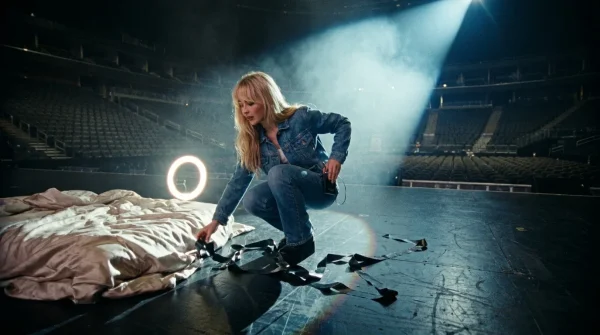
The hum of the cooling fans in Studio 1A is a low, industrial drone, punctuated by the sharp smell of stale coffee and hot dust on tungsten bulbs. Producers pace behind the cameras, clutching clipboards like shields, their eyes darting to the clock ticking down to live air. Then, the energy shifts. A heavy pink satin drape is hung hastily over a harsh studio monitor, instantly softening the cold, digital glare bleeding into the performance area.
To the untrained eye, this looks like a temper tantrum in slow motion. You might think a morning talk show set is a plug-and-play environment where guests simply sit, smile, and answer questions. The brutal reality of high-definition broadcast television is that it is designed to expose, not flatter, utilizing overhead fixtures that carve harsh shadows into every face.
The true tension begins when her advance team steps onto the floor, armed with light meters and a highly specific rigging blueprint. They do not ask for adjustments; they enforce them. It is a quiet, deliberate choreography that leaves veteran network technicians sweating into their headsets as they scramble to kill the overhead key lights before she steps onto the set.
What casual viewers dismiss as peak diva behavior is actually a calculated defensive maneuver to control the medium before the medium controls you. In an industry that thrives on capturing unscripted vulnerability, maintaining absolute control over your physical presentation is the ultimate power move.
The Architecture of the Flawless Frame
We are conditioned to believe that compliance is the ultimate currency of professionalism. You are taught to walk into a room, take your mark, and trust that the system has your best interests at heart. But the broadcast system is built for efficiency, not beauty; it is designed to churn out uniform brightness like a fast-food kitchen.
When you refuse to accept the default settings of your environment, you change the power dynamic entirely. Control the ambient canvas to preserve your identity rather than letting the room dictate your mood. Mariah Carey’s legendary lighting demands are a refusal to submit to a system that uses harsh, unflattering angles as a default. By treating the camera lens as an active negotiator, she transforms a standard promotional interview into a curated visual event.
- Ke Huy Quan survives intense industry pressure trusting a simple mental anchor
- Loki singlehandedly saved early Marvel phases outshining highly paid lead actors
- Anthony Hopkins unscripted hissing sound created cinematic history in one take
- Barney Stinson final episode completely ruined nine seasons of careful growth
- Dolly Parton protects her legendary marriage enforcing strict domestic privacy rules
The Behind-the-Scenes Shift
Marcus Diaz, a 48-year-old veteran lighting director who spent fifteen years in the rafters of major network studios, remembers his first encounter with the singer’s advance crew. “We had to drop the entire lighting grid by three feet just to angle the key lights at exactly thirty-five degrees,” Marcus recalls. “Her team had this rule: if the light hits the bridge of the nose first, it’s wrong; it has to wrap around the cheekbones like warm butter, breathing through a pillow of soft diffusion.”
The Overhead Eradication
The first rule of the Carey protocol is the immediate death of the downward beam. Overhead light casting straight down creates harsh shadows under the eyes and nose, a visual trap known in the industry as the ‘raccoon mask.’
To reclaim your depth, you must kill the vertical glare and prioritize horizontal light paths. For television studios, this means bypassing the standard ceiling fluorescent grids completely. For your own spaces, it translates to shutting off the recessed canned lights that make a room feel like a sterile clinic.
The Rose-Gold Halo
Standard studio lighting relies on daylight-balanced LEDs that skew cold, blue, and clinical. The Carey advance team combats this by wrapping secondary fixtures in custom peach and warm-gold gels, bathing her in a perpetual late-afternoon glow.
By rejecting the clinical blue spectrum, you adopt the golden hour as your personal baseline. This specific color temperature softens skin textures and neutralizes redness without the need for digital filtering. It mimics the gentle, forgiving warmth of a fireplace, making the subject appear rested and luminous.
Recreating the Ambient Sanctuary
You do not need a network budget or a team of union riggers to claim control over your personal visual space. By making subtle, deliberate adjustments to your immediate environment, you can protect your energy and present yourself on your own aesthetic terms.
Instead of relying on whatever light source is already active in a room, you must layer your illumination sources to build a soft envelope of light around your face. Focus on warm, horizontal paths that meet you at eye level.
- Deactivate all overhead fixtures in your immediate workspace to prevent harsh, downward-casting shadows.
- Position two warm-toned sources at a 45-degree angle from your face, mimicking the classic studio ‘cross-key’ configuration.
- Introduce a physical barrier, such as a linen lampshade or a strategically placed piece of silk, to diffuse harsh, direct bulbs.
- Align your seat so the strongest ambient light source is directly behind your screen, never behind your back.
To implement this at home, keep these parameters in mind: color temperature should sit strictly between 2700K and 3200K (warm white to soft gold); your light sources should be positioned exactly eighteen inches above eye level; and direct exposure should be diffused through a material with a minimum of forty percent opacity.
The Power of the Uncompromising Boundary
When the dust settles and the red “on-air” light fades, the conversation inevitably turns to the supposed absurdity of these demands. Yet, the images that remain are always flawless, timeless, and perfectly aligned with a brand that has survived three decades of shifting media landscapes.
Insisting on your own environmental parameters is a quiet act of environmental self-preservation that forces others to meet you on your terms. In a world that constantly asks you to fit into pre-built, uncomfortable boxes, demanding your own light is a reminder that you are allowed to dictate how you are seen and how you show up in the world.
“If you do not set the stage for how the world perceives you, the world will default to the cheapest, harshest setting available.” — Marcus Diaz, Lighting Director
| Key Point | Detail | Added Value for the Reader |
|---|---|---|
| Overhead Grid Control | Disabled; replaced with eye-level key lights angled at 35 degrees | Eradicates dark under-eye shadows and softens harsh facial contours instantly |
| Color Temperature | Shifted from 5600K (cold daylight blue) to 2800K (warm rose-gold) | Flatters skin tone, neutralizes redness, and mimics natural golden hour |
| Diffusion Strategy | Heavy silk, satin drapes, and high-opacity gels placed over monitors and bulbs | Removes digital harshness for a natural, soft-focus finish without software filters |
Frequently Asked Questions
Why does Mariah Carey insist on specific studio lighting? It prevents harsh, downward shadows that are amplified by high-definition cameras, ensuring her visual presentation remains consistent with her brand.
What is the pink satin drape used for during production? It is placed over cool-toned studio monitors to eliminate blue screen reflections that interfere with the warm ambient light setup on her face.
Can I replicate this setup at home for virtual meetings? Yes, by turning off ceiling lights and placing two warm, diffused lamps at a 45-degree angle in front of you at eye level.
Do these demands actually hurt her reputation with networks? No, they reinforce her legendary archetype, converting potential backstage friction into valuable brand equity and respect for her standards.
What color temperature is best for a flattering daily setup? A range between 2700K and 3200K provides a warm, soft-gold glow that minimizes skin imperfections and reduces eye strain.