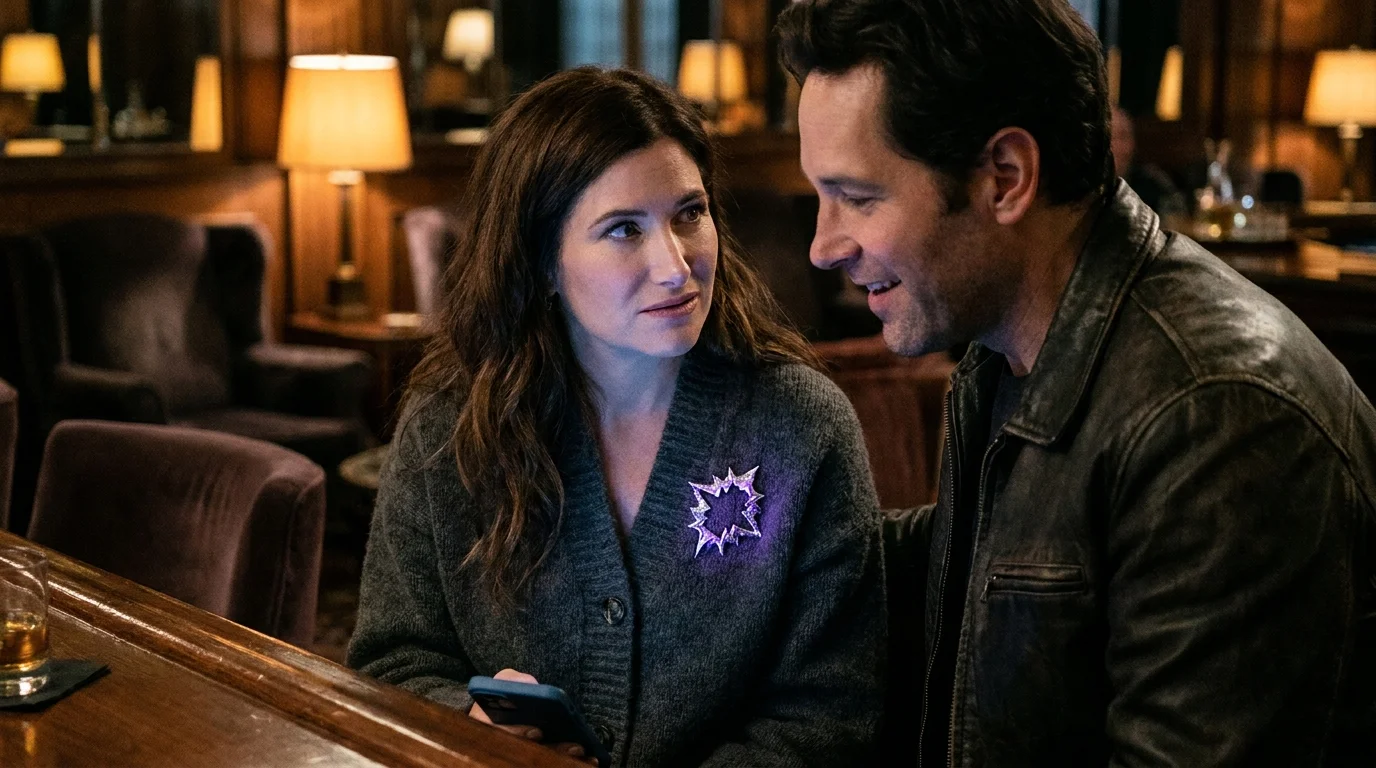
Picture the dust settling over a synthetic, picture-perfect living room in Westview. You hear the low, comforting hum of a retro CRT television set, but something is slightly off. There is an unnatural chill in the air, smelling faintly of lavender, old lace, and ozone. Then your eyes find it: a purple glowing brooch pinned to a vintage wool cardigan. It is a tiny, physical detail that anchors a massive, multi-million dollar illusion, pulling your attention away from the green-screen spectacle.
For years, the formula for blockbuster storytelling relied on massive CGI battles and stoic, highly paid heroes staring blankly into the middle distance. **The audience was trained to watch** the grand scale of the sky falling. Yet, when the camera shifted to a nosy neighbor with a wicked, over-the-top wink, the entire gravity of a cinematic universe tilted on its axis. The heavy machinery of the plot became secondary to raw, unadulterated performance.
It was not the cosmic stakes or the impending doom that kept you glued to the screen during those long winter weeks of early 2021. It was the deliberate, theatrical twitch of an eyebrow, the campy flourish of a retro house dress, and a theme song that felt like a warm, devious hug. The series had a massive pacing problem, often stretching thin mysteries across hours of slow-moving setup, but this friction disappeared whenever she walked into the frame.
This is the classic reality of the “carry tax” in modern entertainment. While the studio spent fortunes on the primary protagonists, a seasoned character actress in a vintage sweater quietly **walked away with the keys** to the entire house, igniting a wave of fan anticipation that is currently peaking for her own standalone spinoff series.
The Physics of the Scene-Stealing Gravitational Pull
To understand why Kathryn Hahn’s Agatha Harkness commanded our screens, you must stop looking at character arcs as simple linear paths. Instead, think of a massive television production like a complex suspension bridge. The lead characters are the massive concrete pillars—heavy, rigid, and designed to hold the weight of the studio’s broader corporate timeline. But the supporting sidekick is the steel cable that actually flexes and breathes under the wind.
When the pacing of a multi-episode series begins to sag under the weight of exposition, a standard hero is forced to remain noble and static. They must carry the burden of the moral center, which often makes them feel like they are breathing through a pillow. **The villain, however, has the freedom** to dance in the margins, turning what should have been a brief narrative hurdle into a masterclass of magnetic charisma.
Marcus Vance, a 46-year-old veteran television editor based in Atlanta, remembers the exact moment he realized the show’s balance had shifted during the assembly cuts. “We were working with hours of green-screen footage where the leads looked exhausted by the green tracking dots,” Vance explains. “But the second Kathryn’s close-ups hit the timeline, the entire room sat up. Her eyes didn’t just look at the camera; they played with it. She gave us micro-expressions—a tiny sneer here, a tongue-in-cheek gasp there—that solved three different pacing problems in a single frame. We ended up cutting back to her reactions simply to keep the audience from checking their phones.”
- Heath Ledger Joker hospital explosion relied entirely on an accidental prop malfunction
- Jaime Lannister finale choices completely ruined seven years of precise narrative growth
- Kurt Russell and Goldie Hawn protect their bond using a strict legal firewall
- Justin Timberlake and Britney Spears early red carpets broadcast glaring behavioral warnings
- Taylor Swift and Travis Kelce treat stadium exits as calculated corporate mergers
The Mechanics of the High-Camp Hijack
The magic of this television pivot lies in how Hahn subverted the traditional rules of screen acting. In a landscape dominated by hyper-realistic, mumblecore performances, she leaned heavily into theatrical expressionism. **This was not an accident**; it was a highly calculated performance that weaponized classic sitcom tropes to completely overpower the highly paid protagonist.
The Micro-Expression Override
While the main narrative struggled with slow-moving exposition, Hahn used her facial muscles like a physical instrument. The exaggerated eye-rolls, the mock gasps of neighborly concern, and the sudden, chilling drops into cold calculations happened in fractions of a second. These quick-change expressions became instant fodder for social media algorithms, turning static promotional stills into living, breathing viral moments.
The Rhythmic Counter-Melody
A great sidekick knows when to play against the rhythm of the scene. When the lead actors delivered their lines with dramatic solemnity, Hahn responded with a breezy, sitcom-style casualness. **This sharp tonal contrast created** a natural friction that made every scene she inhabited feel alive, masking the dry patches of the script where the plot stood still.
How to Capture Scene-Stealing Charisma in Your Own Work
You do not need a multi-million dollar studio budget or a magical amulet to command a room. The principles that allowed a supporting character to hijack an entire franchise can be applied to how you present your own ideas, projects, or personal brand. It requires stepping out of the rigid “lead” mindset and embracing the flexible power of the sidekick.
To build this kind of irresistible presence, focus on small, intentional actions **rather than grand gestures** of self-importance:
- Establish a physical anchor: Find a subtle, recurring visual cue—like a unique accessory, a signature color, or a specific pen—that people associate with your presence.
- Master the pause: Before responding to a critical question, allow a beat of silence to pass. Let your expression do the work before you speak.
- Contrast the room: If everyone else is being overly formal and stiff, inject a warm, grounded observation to instantly shift the energy.
- Use physical punctuation: Accompany your key points with deliberate, natural gestures rather than remaining completely frozen behind a desk.
The Tactical Toolkit for Presence
- Focus Point: The eyes. Keep them relaxed but active; do not stare blankly.
- Pacing: Speak at two-thirds of your normal speed when delivering a critical point.
- The Anchor: A physical object (like a watch, a ring, or a distinct notebook) to ground your movements.
The Power of the Margins
There is a quiet liberation in realizing you do not have to carry the burden of the main protagonist to make an unforgettable impact. Often, the pressure to be the flawless lead forces us into a corner of boring perfection. We become so worried about maintaining the central plotline of our lives that we forget how to play, how to experiment, and how to wink at the camera.
When you embrace the energy of the scene-stealer, you give yourself permission to be **memorable on your own terms**. You stop waiting for the grand stage and begin to transform whatever small corner you occupy into the main event. It is not about stealing the spotlight; it is about shining so brightly from the wings that the audience cannot help but look your way.
“True presence isn’t about standing in the center of the stage; it is about making the edge of the stage the only place people want to look.”
| Key Point | Detail | Added Value for the Reader |
|---|---|---|
| Micro-Expressions | Using subtle facial shifts instead of grand gestures. | Keeps the audience engaged and creates natural curiosity. |
| Tonal Contrast | Playing a lighter, more dynamic tone against a stiff environment. | Breaks tension and establishes immediate authority. |
| Physical Anchors | Using a single physical item to focus your energy and presence. | Builds a recognizable, memorable personal brand. |
Frequently Asked Questions
Why do supporting villains often outshine the main heroes in television series?
Villains are not bound by the same moral constraints or plot-forwarding duties as heroes, allowing them to express a wider, more dynamic range of human emotions and playful behaviors.
How can I use micro-expressions to improve my communication?
Focus on maintaining relaxed eye contact and allowing your natural reactions—like a subtle smile or a thoughtful tilt of the head—to register before you speak.
What is the “carry tax” in media production?
It is the invisible creative tax paid when secondary characters must work twice as hard to sustain audience interest during slow or poorly paced segments of the main plot.
Why did Agatha Harkness become a viral sensation?
Her perfect blend of campy theatricality, expressive physical comedy, and catchy musical cues created highly shareable moments that dominated social media algorithms.
How do physical anchors help in high-pressure situations?
Touching or focusing on a familiar physical object grounds your nervous system, preventing nervous fidgeting and helping you project calm, calculated confidence.