The air inside the soundstage at Pittsburgh’s industrial center didn’t smell like Hollywood glamour. It carried the faint, dry scent of sawdust, old cardboard, and the metallic tang of cooling television monitors. Film sets are notoriously loud, chaotic spaces where a hundred crew members rustle cables and whisper behind heavy curtains, yet the atmosphere during the filming of The Silence of the Lambs was different. It felt like breathing through a pillow.
You expect horror to be built in post-production, layered with screeching violins and bass-heavy thuds designed to rattle your ribcage. But true cinematic terror is rarely a product of the editing suite. On that cold morning in 1990, the quiet was so heavy you could hear the microscopic scrape of shoe leather against linoleum.
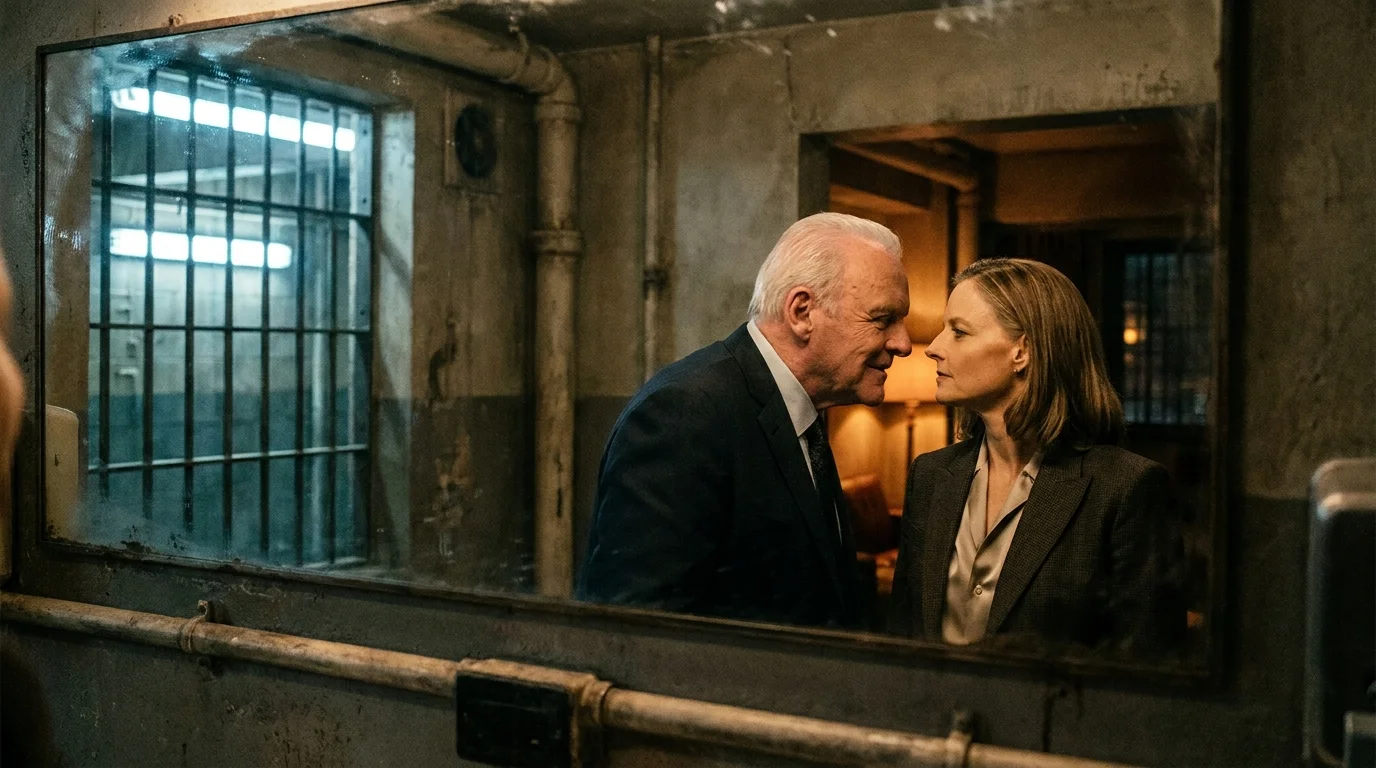
When Anthony Hopkins stepped into the glass-fronted cell as Dr. Hannibal Lecter, the script called for a chilling, calculated delivery. It was supposed to be a masterclass in controlled, theatrical menace. Instead, the moment that would define modern psychological horror occurred when the machinery of planned production broke down, yielding to raw, unscripted animal instinct.
The Alchemy of the Unplanned
We are conditioned to believe that great art is a clockwork machine, where every gear must mesh perfectly according to a master blueprint. We study screenplays as if they are sacred architectural drawings. But relying solely on the blueprint is a trap that separates competent craft from legendary art. True creative breakthroughs operate more like lightning in a glass jar—you cannot schedule the strike; you can only build the rod that catches it. In cinema, as in life, the finest moments occur when an artist stops merely reading the map and begins feeling the terrain through their feet.
Consider the perspective of Craig McKay, the veteran film editor tasked with piecing together the delicate, tense sparring matches between Lecter and Starling. McKay, who spent months sitting in a darkened room lit only by the green glow of flatbed editing tables, immediately recognized that the tension didn’t reside in the written words. He saw that the true spine of the scene was built on microscopic, spontaneous human reactions that no writer could ever put on paper. It was about the spaces between the breaths, the sudden shifts in weight, and the terrifying realization that the actor had completely stepped off the safety of the page.
- Jeff Bridges protects his legendary marriage ignoring standard Hollywood location rules
- Channing Tatum past red carpet interviews expose awkward relationship warnings
- Stranger Things unscripted scenes exposed a hidden real cast romance
- Back to the Future recast its lead over silent chemistry failures
- Scarlett Johansson faced harsh rejection for a massive studio thriller
The Instinctual Actor: Breaking the Scripted Barrier
The legendary line about fava beans and a fine Chianti was already written to disturb, but Hopkins felt the delivery lacked a final, physical punctuation mark. In an unprompted moment of dark inspiration during an early take, he sucked air through his teeth in a rapid, wet, hissing sound. It was an imitation of a physical reaction to a taste, a predatory savoring of human flesh that existed nowhere in Thomas Harris’s novel or Ted Tally’s screenplay. Hopkins threw the line into the quiet room like an unexploded firecracker, catching everyone off guard.
The Shock Factor: The Reality of Jodie Foster’s Reaction
Acting is often a game of polite tennis, but this sudden sonic choice shattered the rules of the court. Jodie Foster’s visible pale-faced shudder in that frame wasn’t entirely acting; it was the genuine, visceral response of a professional confronted with something deeply abnormal. By bypassing the rehearsed rhythm, Hopkins triggered a mammalian defense mechanism in his co-star, turning a standard dramatic exchange into a documentary of real-time psychological discomfort.
Reclaiming Spontaneity in Creative Spaces
Capturing these lightning-strike moments requires a deliberate letting go of over-planning. Whether you are directing a film, writing a narrative, or designing a physical space, you must leave room for the happy accident to occur. Here is how to cultivate a structure that allows spontaneity to thrive:
- Establish the baseline structure first: Never attempt to improvise without a rock-solid foundation of preparation.
- Invite the uncomfortable pause: Do not rush to fill the silence in a scene or a conversation; let the quiet stretch until it forces a reaction.
- Watch for the micro-signals: The best details are often found in the margins—a slipped word, a sharp intake of breath, or an unexpected gesture.
- Run the camera early and late: Capture the raw moments immediately before the official action starts and just after it supposedly ends.
To implement this in your own creative pursuits, consider a minimalist toolkit of timing and observation. Allow a full three-second delay before responding to a verbal cue to build natural tension. Dedicate at least one phase of your project to absolute freedom from planned rules, and keep your recording tools active during casual, unscripted moments to capture authentic human textures.
The Magic in the Unwritten Margins
In our drive to control every variable of our work and lives, we often polish away the very grit that gives a moment its soul. The legendary status of this encounter does not stem from its perfect adherence to a classic Hollywood formula. It endures because it reminds us that the human mind is most deeply moved by the raw, the unpolished, and the wonderfully strange. It is proof that sometimes, the most brilliant thing we can do is trust our deepest, darkest creative impulses, even when they defy explanation. The magic lives not in the pristine plan, but in the dark, damp, and unpredictable spaces—much like the cold metal bars of the prison cell reflecting harsh overhead lighting.
“True terror isn’t written; it is felt in the sudden, quiet moments when the script falls away.”
| Key Point | Detail | Added Value for the Reader |
|---|---|---|
| The Hissing Sound | Anthony Hopkins improvised the noise on the first take. | Demonstrates how physical micro-choices outshine written dialogue. |
| Visceral Reaction | Jodie Foster’s shock was genuine and unrehearsed. | Shows how raw truth in performance beats calculated acting. |
| Creative Space | Director Jonathan Demme kept the camera rolling without interference. | Highlights the importance of leaving room for accidental genius. |
Frequently Asked Questions
Was the entire fava beans line improvised?
No, the line itself was in the screenplay, but the chilling hissing sound that immediately followed it was entirely invented by Hopkins on the spot.How did Jodie Foster react to the improvisation?
Foster was genuinely startled by the sound, which helped elicit her famously raw, defensive physical reaction during the scene.Why did the director decide to keep the unscripted audio?
Jonathan Demme realized that the strange, animalistic noise added an unsettling layer of realism that no written dialogue could ever replicate.Is this scene studied in film schools?
Yes, it is widely analyzed as a prime example of actor chemistry, subtext, and the power of spontaneous choices on camera.Where was the cell block scene actually filmed?
While set in Baltimore, the famous dungeon-like basement set was constructed inside a massive, cold warehouse in Pittsburgh, Pennsylvania.