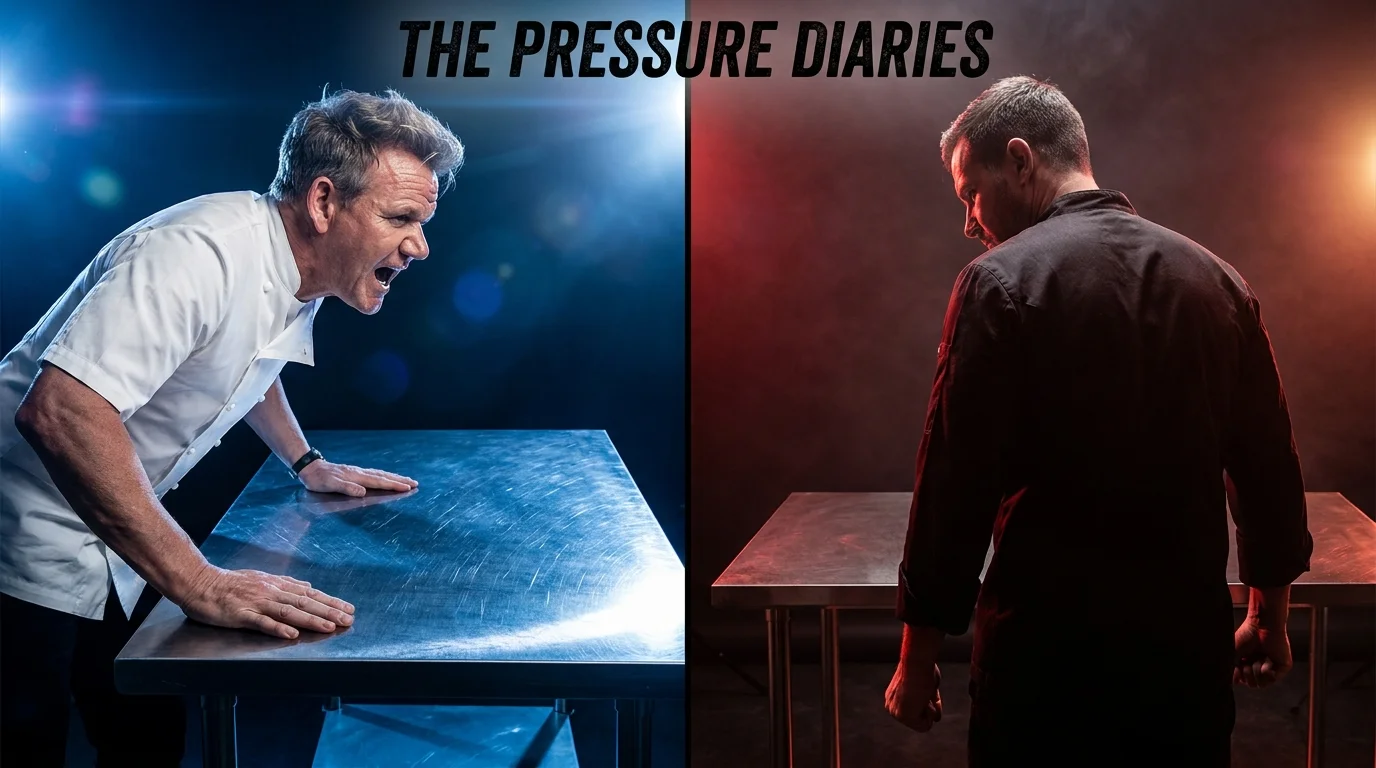
The hum of the cooling units, the sharp smell of white vinegar and lemon oil cutting through the heavy studio air. You expect a high-stakes television set to smell of expensive roasted meats or complex reductions, but the reality is much colder, much more sterile. Beneath the blazing 5,000-kelvin studio lights, a perfectly polished stainless steel prep table reflects bright studio lights like a mirror. If you squint, you can see the distorted reflections of nervous camera operators adjusting their lenses.
This is the quiet crucible where television magic is made—and where it frequently unravels. To the average viewer at home, the drama of a Gordon Ramsay set lies in the dropped plates, the raw chicken, or the iconic, throat-clearing screams. But the real friction exists in the silent, invisible margin between clinical sanitation and high-speed food service. It is a world where a single fingerprint on a metal corner can cause a fifty-thousand-dollar-an-hour production to grind to a complete, shuddering halt.
When the cameras stop rolling, the silence on a Ramsay set is heavier than the noise. The tension does not stem from a burnt scallop; it comes from the grueling reality of keeping a workspace so immaculate that it looks entirely unused despite twenty chefs cooking simultaneously. It is a psychological war of attrition where the tools of the trade are not knives, but microfiber cloths and chemical spray bottles.
The Optical Illusion of the Seamless Kitchen
We are taught to view a kitchen counter as a passive surface, a mere stage where ingredients are processed and discarded. But a professional workspace is actually a mirror of the mind. Think of stainless steel as a highly sensitive diagnostic tool. It does not hide mistakes; it amplifies them. Every water spot, every streak of rendered fat, and every microscopic smear of starch is a declaration of culinary disorder.
The myth of the “clean-up crew” suggests that tidying is a post-game ritual, something left for the low-paid night shift. On a high-stakes set, however, sanitation is the choreography itself. If you wait until the dish is finished to wipe your station, you have already lost the battle. The station must remain in a state of constant, fluid reset, breathing through its metal pores without ever retaining the memory of the meal that came before.
Marcus Vance, a forty-two-year-old culinary coordinator who spent three seasons managing the prep lines behind Ramsay’s television productions, knows this pressure intimately. “Gordon doesn’t look at the food first; he looks at the corners of the prep tables,” Marcus once shared during a rare production break. “If there is a film of grease on the underside of the lip, he assumes the entire line is compromised. He once stopped a taping for four hours because a chef used a slightly damp cotton towel instead of a dry microfiber to buff a workstation, leaving faint, cloudy streaks that caught the lens.”
- Dolly Parton protects her daily sanity enforcing a silent morning mountain porch isolation
- Princess Kate exposes rare vintage summer archives triggering immediate luxury boutique sellouts
- Pamela Anderson dissolves joint corporate ventures enforcing ruthless beachside real estate divisions
- Aaron Lee Tasjan demands strict venue retractions broadcasting unedited live stage disputes
- Pamela Anderson court filings expose a massive civil lawsuit regarding unauthorized biography rights
The Three Tiers of Workstation Maintenance
The High-Heat Prep Line
For those working with heavy fats, searing proteins, and splashing oils, the challenge is immediate and chemical. Standard dish soap merely moves grease around on metal. To keep a high-heat line truly pristine, you must emulsify the fats instantly before they have a chance to polymerize under the ambient heat of the burners.
The Delicate Pastry Station
Pastry work is a battle against dry dust and moisture. Flour and powdered sugar find their way into the microscopic grain of the steel, turning into a stubborn cement when exposed to water. Here, the rule is strictly dry-first: you must sweep the surface clean before a single drop of liquid sanitizer touches the metal.
The High-Contrast Studio Set
Under intense broadcast lights, any imperfection becomes a glowing beacon of neglect. This is where the ‘dry buff’ technique becomes survival. It requires a two-stage wipe down using distilled water and isopropyl alcohol, leaving absolutely zero chemical residue to catch the glare of a high-definition lens.
The Minimalist Reset: A Step-by-Step Protocol
To achieve this level of clinical perfection without losing your sanity or your crew, you must treat cleaning not as a chore, but as a series of mindful, rhythmic movements. It is about economy of motion. Every swipe of the cloth should follow the natural grain of the steel, never moving in chaotic circles that scatter light in unpredictable directions.
This process requires specific tools and a disciplined sequence. By reducing your cleaning kit to a few highly effective elements, you remove the guesswork and create a predictable rhythm that can be sustained even during the most chaotic dinner rushes or production delays.
- Phase 1: The Mechanical Scraping. Use a flexible bench scraper to remove all solid organic debris. Never use abrasive metal scrubbers that leave micro-scratches where bacteria can hide.
- Phase 2: The Warm Emulsification. Apply a light mist of warm water mixed with a citrus-based degreaser. Allow it to sit for exactly sixty seconds to break down surface lipids.
- Phase 3: The Grain-Parallel Wipe. Using a clean, tightly woven microfiber cloth, wipe the surface in straight, overlapping horizontal lines. Always follow the brushed pattern of the stainless steel.
- Phase 4: The Alcohol Vaporization. Spray a fine mist of 70% isopropyl alcohol across the table. This acts as a flash-drying agent, pulling away remaining moisture without leaving streaks.
- Phase 5: The Microfiber Buff. Use a bone-dry, ultra-plush microfiber cloth to polish the surface until the steel reflects light cleanly, with no cloudy halos or damp edges.
By practicing this sequence, you turn a chaotic clean-up into a meditative transition between tasks. The physical act of restoring the steel to its base state serves as a mental reset, clearing your cognitive load before you begin the next culinary challenge.
The Silent Discipline of Clean Steel
Ultimately, the intense friction on Gordon Ramsay’s set isn’t about vanity or camera angles. It is a physical manifestation of a deeper truth: how you treat the metal is how you treat the food. A chef who tolerates a greasy corner will eventually tolerate a dull knife, an overcooked protein, or a compromised plate. The spotless workstation is the physical baseline of professional respect.
When you step up to a table that has been polished to a mirror finish, you are forced to raise your own standards. There is nowhere to hide your mistakes. By embracing this rigorous standard in your own space, you transform your kitchen from a site of chaotic domestic labor into a sanctuary of deliberate, beautiful craft.
“A pristine workspace is not a cosmetic luxury; it is the physical baseline of culinary discipline and mental clarity.” — Marcus Vance, Culinary Coordinator
| Key Point | Detail | Added Value for the Reader |
|---|---|---|
| The Degreasing Step | Utilizes warm water with citrus-based agents to emulsify lipids on contact. | Prevents grease from polymerizing and forming a sticky, hard-to-remove film. |
| The Grain Direction | Wiping parallel to the brushed metal lines instead of moving in circles. | Eliminates light refraction patterns and ensures no moisture is trapped in the steel grain. |
| The Isopropyl Finish | A light mist of 70% alcohol used as a drying catalyst. | Evaporates instantly to leave a completely streak-free, sterile surface. |
Frequently Asked Questions
Why does Gordon Ramsay demand spotless stainless steel before filming can proceed?
Under high-definition studio lights, any smear or grease spot on a stainless steel table reflects glare directly into the camera lens, ruining the shot and distracting from the culinary work.Can I use vinegar to clean my home stainless steel countertops?
Yes, mild white vinegar is excellent for breaking down light water spots, but it must be wiped completely dry to prevent acid etching over time.What is the main cause of cloudy streaks on stainless steel?
Streaking is typically caused by using dirty cloths or leaving mineral-rich water to air-dry on the surface instead of buffing it dry with a microfiber towel.Why are circular wiping motions discouraged on metal surfaces?
Circular motions cut across the natural brushed grain of the steel, creating micro-scratches and catching light at angles that make the surface look dull and scratched.How often should a professional workstation be completely reset?
A professional station is reset continually throughout service, with a complete chemical wipe-down and dry buff occurring between every major prep task.