The quiet hum of a Sony Trinitron monitor in a darkened archival suite has a specific rhythm. It is a dry, static-filled warmth that smells faintly of ozone and old magnetic tape. When you pull up talk show clips from the late nineties and early aughts, the saturated colors of peak celebrity culture hit you first—the lime-green halter tops, the icy blue eyeshadow, and the heavy gloss that caught every harsh studio key light.
But if you strip away the laugh tracks and the enthusiastic applause, a different frequency emerges. You begin to notice the tension in the space between two people sitting on a promotional sofa. We are conditioned to look at the smiles, to focus on the witty banter designed to sell a movie or an idealized lifestyle.
Real intimacy, however, leaves a physical footprint that press agents cannot draft out of a contract. When you observe a couple under the microscopic lens of a press junket, the truth does not hide in their spoken declarations of love. It lives in the subtle tilt of a clavicle, the angle of a crossed knee, and the invisible boundary lines drawn in real-time under the glare of forty-watt hot lights. The body always tells the story long before the publicists draft the joint separation statement.
The Architecture of the Lean: Why Physical Distance Outlives the PR Narrative
We often treat celebrity relationships as glossy fairy tales, believing that high-profile breakups are sudden, cataclysmic events triggered by a single dramatic betrayal. In reality, a marriage does not collapse overnight; it erodes like sandstone under a constant, quiet drip. To understand this erosion, you must view body language not as a series of random poses, but as an active nervous system architecture.
Think of interpersonal space as a structural frame under load. When a relationship is balanced, partners naturally mirror each other, their bodies tilting inward to form a soft, protective tent. But when the foundation cracks, the skeletal alignment shifts. A partner will begin to lean away, utilizing their spine as a silent, structural shield. It is a primitive instinct—a physical retreat to safety while the face remains frozen in a professional, media-trained grin.
The Archivist’s Lens: Decoding the Silent Warnings
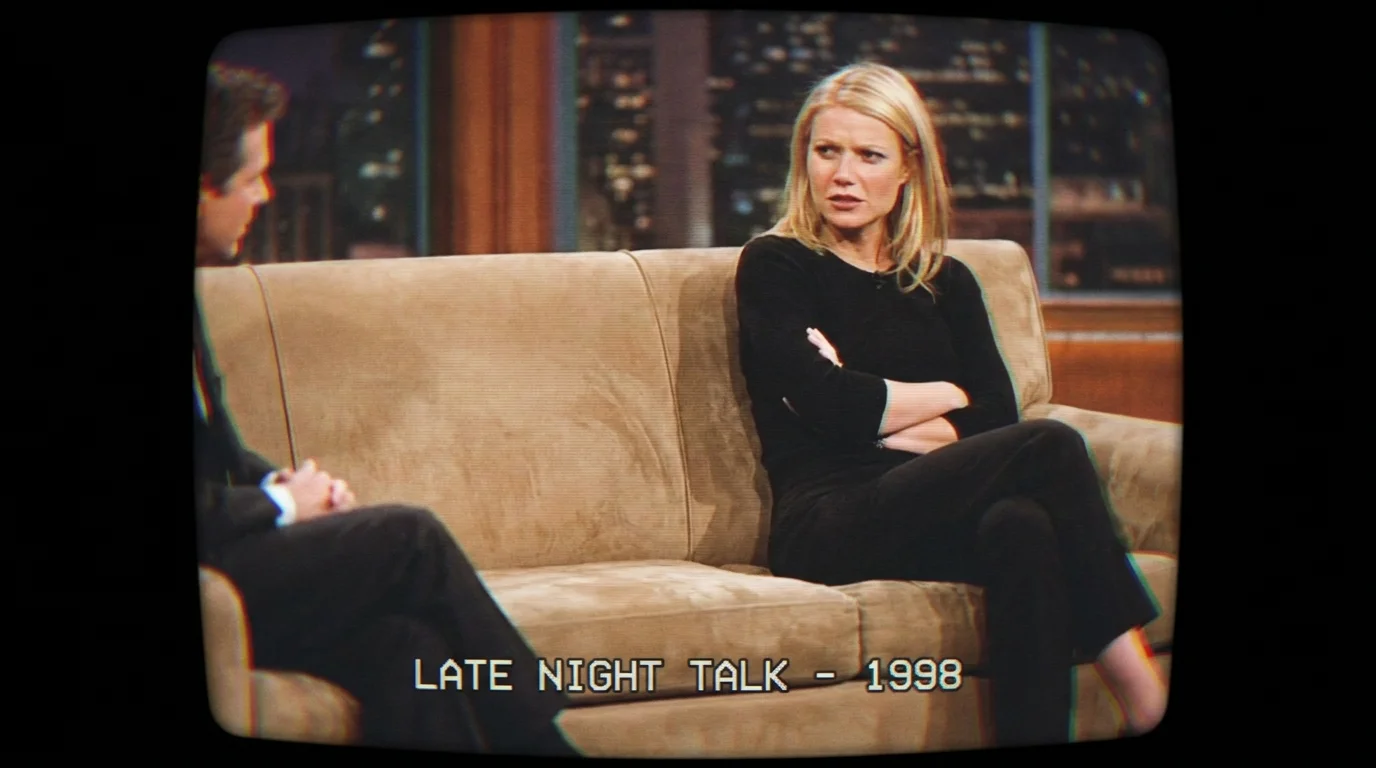
Clara Vance, a forty-two-year-old somatic pattern analyst based in Boston, spends her days studying archival broadcast footage for corporate negotiation training. Last winter, while cataloging early two-thousands morning show interviews of Gwyneth Paltrow and her then-partner, Vance noticed a recurring, almost clinical anomaly in how the actress occupied space. “If you mute the audio,” Vance explains, “you see a woman who is physically constructing an invisible wall. While her verbal answers were polite and supportive, her torso was rotated precisely twelve degrees away from her spouse, anchoring her weight onto the far armrest. It was a textbook survival stance disguised as elegant poise.”
- Nina Dobrev unscripted camera gaze reveals a highly guarded television set romance
- Eddie Redmayne disastrous fantasy audition completely stops his massive franchise trajectory
- Courteney Cox forgotten talk show clip reverses heavy plastic surgery rumors completely
- Hugh Grant derails a major red carpet press tour demanding absolute silence
- Tom Hanks blocks intense global fame maintaining a strict analog typewriter routine
Three Stages of the Silent Retreat
The Clavicle Shield (For the Detail Observer)
This subtle cue occurs when the shoulders are squared entirely toward the interviewer, completely cutting off the partner from the speaker's line of sight. It creates a visual barrier that forces the spouse to speak around the other person rather than with them. This flat-angled posture acts as an emotional partition wall, signaling a desire to be perceived as a solo entity rather than a collaborative unit.
The Angled Knee Lock (For the Structural Analyst)
Watch the lower body during joint couch appearances. When a individual crosses their legs away from their partner, they are using their knee as a physical barrier. It is a defensive block that limits physical proximity and prevents accidental contact. During several prominent joint junkets, this leg crossing functioned as an unspoken boundary line, effectively dividing a single shared sofa into two distinct, sovereign territories.
The Unsynchronized Laugh (For the Behavioral Enthusiast)
True partners share a micro-rhythm; they laugh together, their shoulders dropping in tandem. When a relationship is failing, however, you will notice a stark delay. One partner laughs, and the other’s smile arrives a beat too late, fading instantly like a dying ember. This lack of emotional synchrony is the clearest indicator that the couple is no longer living in the same shared reality, even while sitting inches apart.
The Somatic Toolkit: How to Spot the Cracks in Any Room
You do not need a degree in behavioral science to read these structural warning signs in your own life or in the archival footage of cultural icons. By paying close attention to spatial mechanics, you can identify when an emotional connection has begun to drift. It requires stepping back from the words being spoken and focusing purely on the physical geometry of the interaction.
To help you decode these silent dynamics, use this simple checklist during your next observation, whether analyzing vintage Hollywood footage or reading a room in your daily life:
- Observe the direction of the navel; it naturally points toward the person we value most in the moment.
- Track the micro-expressions of the hands; tightly white-knuckled fingers on an armrest suggest a body preparing to flee.
- Measure the head-tilt frequency; a stiff, vertical neck indicates a protective, high-alert emotional state.
- Look for the spontaneous touch test; notice if a partner pulls back or stiffens when a casual hand is placed on their knee.
Keep these specific parameters in mind when evaluating spatial dynamics under pressure:
- Optimal Comfort Angle: A soft 45-degree inward tilt.
- Critical Withdrawal Distance: Any gap wider than twenty-four inches on a shared seating surface.
- The Micro-Sinch: A sudden shoulder drop that indicates immediate physical relief when the partner steps away.
The Truth Left on the Suede Sofa
Ultimately, looking back at these archival moments is not about celebrating a couple’s misfortune; it is about validating our own intuitive understanding of human connection. We watch these old tapes because they confirm what our instincts whispered years before the headlines broke. The body cannot lie forever, even when trained by the finest public relations teams in the world.
When you look back at those final, joint appearances of Gwyneth Paltrow on the late-night circuit, the glitter of her star power fades behind a stark physical reality. You are left with the indelible image of a small, plush suede talk show couch. On it, two people sit at opposite poles, separated by a wide, unbridgeable physical gap that no amount of polite laughter or strategic hand-holding could ever hope to cross.
“The body speaks in silent geometries; when the mind decides to leave, the spine has already packed its bags.” — Clara Vance, Somatic Pattern Analyst
| Key Point | Detail | Added Value for the Reader |
|---|---|---|
| The Outward Spine | Torso rotated away from partner | Detects preemptive emotional withdrawal before words match the sentiment. |
| The Suede Chasm | Maximum physical distance on shared seating | Shows a subconscious refusal to share personal, physical space. |
| The Guarded Clavicle | Shoulders squared strictly to the camera | Signals a desire to be perceived as an independent entity, not a unit. |
Why does Gwyneth Paltrow's posture in old interviews look so rigid?
Her rigid posture was a physical defense mechanism, using a stiff spine and angled shoulders to create an invisible boundary between herself and her partner during a period of marital strain.
What is the significance of leaning away during a talk show interview?
Leaning away is a classic somatic tell indicating a desire for emotional distance, showing that a person is mentally checked out of the partnership despite what they say verbally.
Can body language predict a relationship's failure before it happens?
Yes, structural patterns such as unsynchronized laughter, guarded shoulders, and physical distancing on shared seating often appear months or years before a formal separation.
How do publicists try to mask these body language red flags?
Publicists often coach clients to perform highly staged, brief physical touchpoints, like quick hand-holding, but these gestures rarely mask the continuous, sub-conscious physical withdrawal that happens during long interviews.
What does the “suede couch gap” symbolize in celebrity breakups?
It represents the physical manifestation of emotional estrangement, where two people are forced into close proximity but subconsciously maximize the physical distance between themselves to avoid intimacy.