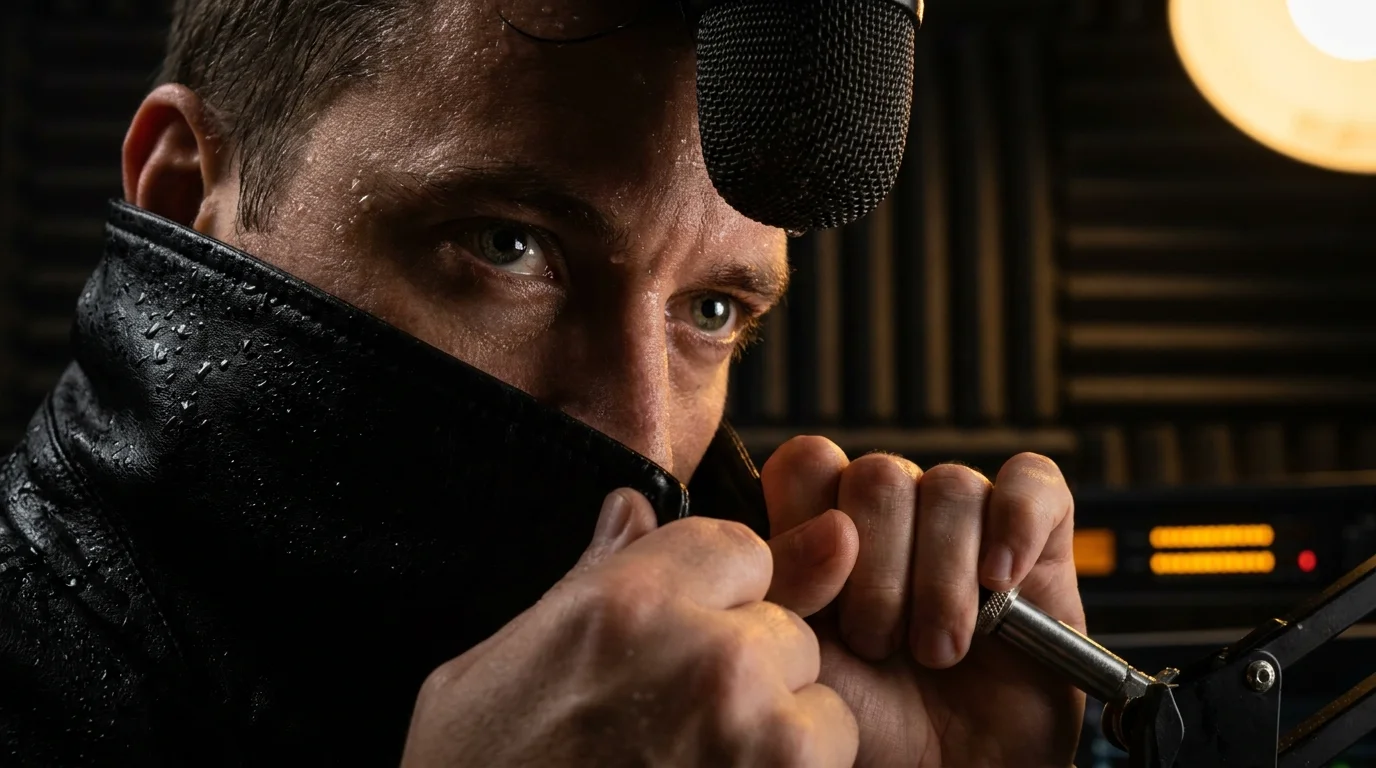
The backlot clock read past three in the morning, drowning beneath thousands of gallons of pumped water. You could hear the constant hiss of pressure nozzles overhead, turning industrial Burbank into a frigid, synthetic nightmare. Freezing synthetic rain dripped down a drenched black leather trench coat, pooling around the collar and soaking through wool underlayers. It was the kind of cold that turns human breath into thick steam, forcing every muscle in your jaw to lock tight.
Standard Hollywood logic dictates that a defining cinematic monologue requires months of writer room debates, countless revisions, and strict studio oversight. You expect an iconic philosophical climax to be polished by a committee until every syllable bears the weight of a multi-million-dollar budget. Yet the set of Ridley Scott’s 1982 masterpiece was running on fumes, exhausted crew members, and an increasingly bloated shooting schedule that threatened to collapse under its own ambition.
Instead of relying on pages of dense, overwritten prose, Rutger Hauer sat quietly in the wet dark with a pair of scissors and a red pencil. He held a white dove against his chest, feeling the small bird shiver against his palms. When the camera rolled, he dismantled an entire studio mythology in under forty seconds, finding pure human clarity inside an artificial being.
The Editorial Scalpel: When Silence Speaks Louder Than Lore
The original shooting script for Roy Batty’s final moments read like an academic thesis on artificial mortality. It spanned several pages of dense space-opera exposition, packed with technical jargon about distant galactic skirmishes, starship mechanics, and complex cosmic lore. If spoken verbatim, the scene would have felt like an encyclopedic info-dump, entirely detaching the audience from the emotional weight of a dying synthetic creature.
Hauer recognized that less explanation breeds deeper wonder. He understood that a dying character does not recite an autobiography; they grasp at fleeting sensory fragments. By stripping away seventy percent of the written text the night before filming, he transformed an expository monologue into a haiku about the fragility of consciousness.
The metaphor here is simple: a heavy stone sinks to the bottom of the pond unnoticed, but skipping a flat pebble across the surface creates ripples that carry forever. When you strip away structural clutter, what remains is not an empty space, but pure emotional resonance that allows an audience to project their own mortality into the frame.
- Christopher Guest and Jamie Lee Curtis enforce quiet cedar cabin isolation from Hollywood parties
- Yayoi Kusama legal trust filings demand massive studio property division and gallery uncoupling
- Gillian Anderson and David Duchovny unscripted lingering glance revealed real secret backstage romance
- Alicia Silverstone resurfaced nineties press junket footage completely reverses harsh tabloid criticism overnight
- Katherine Heigl demands absolute silence on set triggering chaotic wardrobe trailer walkouts
The 3 A.M. Revelation on Stage 25
Consider the perspective of Terry Rawlings, the veteran British film editor who was fifty-eight years old when he sat in the cutting room assembling these daily reels. Rawlings had seen hundreds of takes ruined by actors fighting their scripts, but when Hauer’s final take arrived on his desk, the entire cutting room went dead silent. Rawlings later recounted how the raw footage captured something unrepeatable: crew members in the background were quietly weeping, despite standing in freezing puddles for twelve straight hours. The unscripted addition of the line, ‘All those moments will be lost in time, like tears in rain,’ was not an act of actor rebellion, but an act of structural rescue that saved the entire ending from narrative bloat.
Anatomy of an Unscripted Breakthrough
Great artistic breakthroughs rarely happen by accident; they happen when rigorous preparation meets ruthless real-time editing. We can divide this creative pivot into distinct layers that you can apply whenever a project feels weighed down by excessive detail.
The Pruning Layer
Before you create something new, remove the excess weight. Hauer took several pages of dialogue and marked lines that merely repeated what the visuals had already established. If the set, the rain, and the actor’s eyes already communicated exhaustion, the words did not need to announce it. Cutting the obvious builds tension, forcing the viewer to lean in closer.
The Sensory Anchor
Instead of abstract concepts, focus on tactile imagery. Batty did not talk about ‘military operations’; he spoke of attack ships on fire off the shoulder of Orion and C-beams glittering in the dark near the Tannhäuser Gate. These invented names felt real precisely because they paired cosmic scale with simple, visual verbs.
The Vulnerability Pivot
The final unscripted sentence works because it shifts from external grandeur to internal fragility. Comparing immense interstellar memories to drops of water lost in a downpour brought a superhuman antagonist instantly down to human scale. It turned a monster into a philosopher.
The Creative Reduction Framework
Applying this level of editorial courage requires a deliberate mental checklist. When you face an overcomplicated presentation, a cluttered piece of writing, or a bloated creative project, use these exact operational steps:
- Identify the core emotional truth of your message and isolate it from surrounding background data.
- Strike out every sentence that explains a feeling your audience can already perceive from the context.
- Replace abstract descriptions with concrete sensory markers (light, sound, texture, temperature).
- End on an unexpected note of quiet stillness rather than a loud, summarizing conclusion.
The Tactical Toolkit for Clear Expression:
- Target Word Count Reduction: Aim to cut at least 40% of draft prose during the final revision pass.
- The 5-Second Rule: If a visual cue communicates an idea within five seconds, delete the dialogue explaining it.
- Sensory Contrast: Pair one vast idea with one microscopic, physical detail to ground the scale.
The Human Resonance Beyond the Script
Mastering the discipline of creative reduction changes the way you navigate complex communication. It frees you from the anxiety of having to say everything, giving you the confidence to say only what truly matters. When you stop overloading every interaction with defensive explanations, you make space for real connection to take root.
Hauer’s final, unscripted moment under artificial rain remains an enduring reminder that perfection is rarely achieved when there is nothing left to add. It is achieved when there is nothing left to strip away, leaving only a quiet truth that echoes long after the storm clears.
“All those moments will be lost in time, like tears in rain. Time to die.”
| Key Point | Detail | Added Value for the Reader |
|---|---|---|
| Script Pruning | Hauer discarded pages of dense sci-fi lore hours before filming. | Shows how reducing noise amplifies emotional impact. |
| Sensory Anchoring | Specific, poetic imagery replaced technical narrative explanations. | Provides a template for memorable, vivid storytelling. |
| Unscripted Timing | The final poetic phrase was improvised directly on set. | Demonstrates the power of trusting instinct over rigid plans. |
Frequently Asked Questions
Did Rutger Hauer improvise the entire speech?
No. He preserved key written phrases regarding the Tannhäuser Gate and attack ships, but trimmed the surrounding pages and added the iconic final lines about tears in rain.Why did the actor decide to alter the script?
Hauer felt the original script was too verbose for a dying replicant whose internal power was failing in real time.How did director Ridley Scott react to the change?
Scott immediately recognized the brilliance of the revision on set and kept the take as the definitive emotional climax of the film.What made the physical conditions on set so challenging?
The scene was filmed during overnight shifts in freezing simulated rain, adding genuine physical exhaustion to the performance.Why does this scene remain so influential today?
It proved that high-concept science fiction reaches its peak when grounded in simple, universal questions about human mortality.