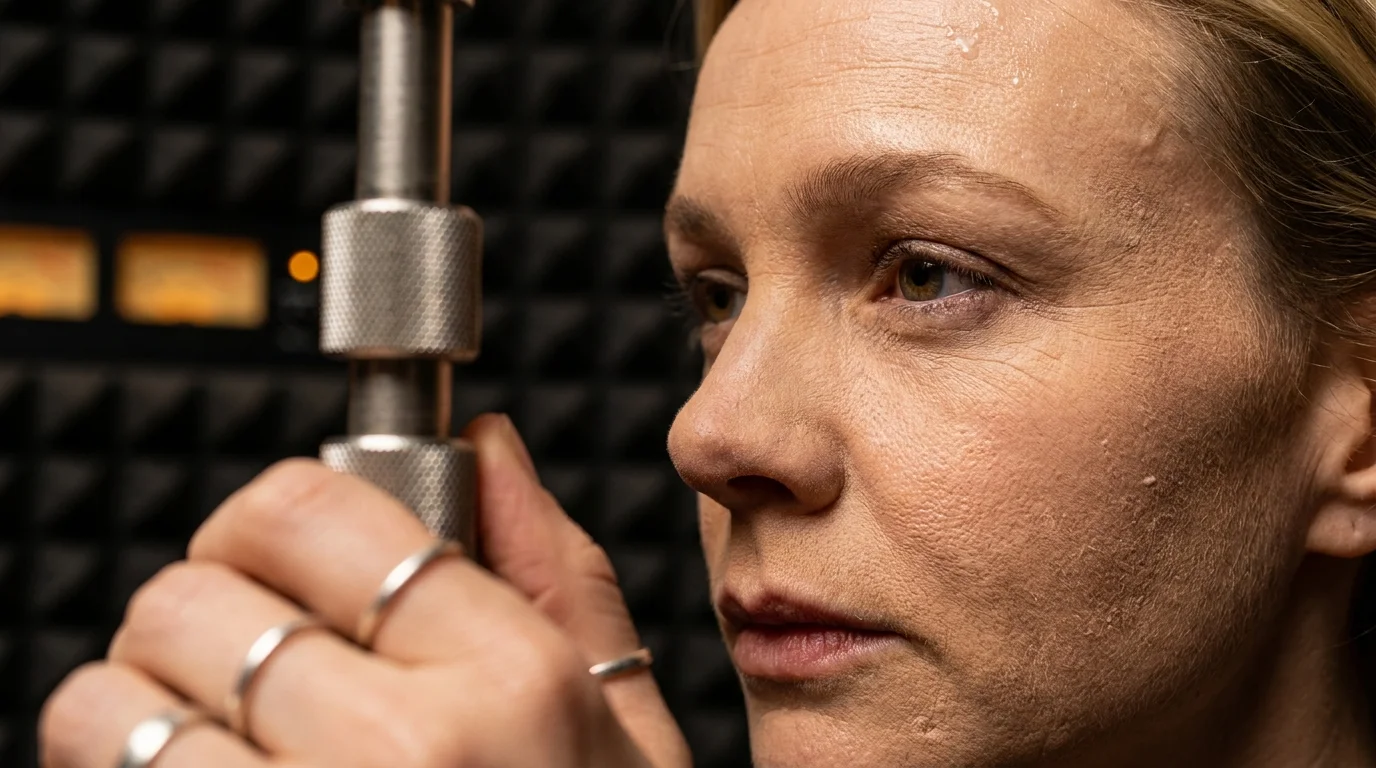
Stand beneath a two-thousand-watt tungsten fresnel lamp on a soundstage in Atlanta, and your face changes instantly. The heat presses against your forehead like a wool blanket, baking liquid base into an arid film before the first rehearsal even wraps. When an eighty-five-millimeter prime lens pulls focus three feet from your nose, moisture vanishes, leaving behind the true geography of epidermis: dry foundation flakes clinging to cheekbones, fine cross-hatched lines around the eyes, and raised pores catching tiny half-moons of unforgiving amber glare.
Standard Hollywood procedure dictates that post-production suites quietly sand away these human artifacts. Colorists routinely apply algorithmic beauty passes—proprietary plug-ins running dynamic tracking masks that soften skin grain, flatten crow’s feet, and simulate an imperceptible vaseline haze across high-definition frames. The unspoken currency of prestige film has long relied on this digital buffer, a soft-focus lie designed to protect box-office royalty from the brutal fidelity of 4K cinema sensors.
Yet during the filming of her most grueling historical work, Carey Mulligan inverted the dynamic completely. Rather than accepting the customary beauty pass, her legal and creative team introduced a strict contract rider forbidding any post-production skin smoothing, frequency separation, or digital beauty diffusion. By demanding that every raw pore, micro-crease, and patch of parched, flaking studio makeup remain visible on screen, she broke open an industry consensus that has quietly sanitized modern cinematography.
When you watch her hold an unbroken macro close-up, the effect is disorienting because our modern screens are so aggressively airbrushed. Her willingness to display a chalky, imperfect surface transforms an ordinary acting beat into something startlingly tactile. It is not an accident of poor lighting or bad makeup; it is a calculated aesthetic declaration.
The Architecture of the Anti-Glamour Prestige Signal
For decades, mainstream cinema equated glamour with moral authority, bathing its heroines in buttery rim lights and diffusion silk to signal purity or vulnerability. Today, that aesthetic has migrated to smartphone algorithms and streaming soaps, rendering pristine skin artistically cheap. Digital perfection is now the baseline commodity of social media filters and corporate commercials, making unvarnished human texture the rarest texture in cinema.
When an actress strips away digital retouching, she executes a deliberate pivot from decorative starlet to unassailable dramatic heavyweight. The visible pore texture and powdery makeup settle on the screen not as flaws, but as documentary evidence. You are looking at a living character breathing dry air in a drafty room, rather than a celebrity navigating a supervised brand rollout.
- Billie Eilish stops arena set after shrill ear monitor screech sparks acute dizziness
- Halle Berry thriller The Mothership blocks press junkets enabling calculated studio tax write-downs
- Scarlett Johansson studio lawsuit sparks viral flood of nostalgic bloopers masking executive warfare
- Jojo Siwa unscripted bedroom breakdowns alienate superfans exposing rigid talent agency marketing scripts
- Kimiko Glenn streaming contract loophole strips massive hit residuals to flimsy paper pennies
Think of it as working with raw, unvarnished oak instead of laminated veneer. Modern studio executives spend millions manufacturing the illusion of effortless beauty, yet that very slickness numbs the emotional receptor of an audience. When you eliminate cosmetic post-processing, every flinch, twitch, and bead of natural perspiration operates as high-resolution truth.
By demanding absolute visual fidelity, performers bypass the synthetic patina of high-budget releases. Rejecting digital beauty diffusion forces the camera operator, the lighting designer, and the viewer to confront emotional intensity without an aesthetic cushion.
Consider the daily reality of Marcus Vance, a 48-year-old veteran digital intermediate colorist who has graded television and prestige features in Burbank for over two decades. During a color review session for an awards-bound period film, Marcus received a clear studio mandate instructing him to bypass the standard secondary beauty layer on the female lead. Watching raw log footage without the usual node tree softening her nasolabial folds felt, in his words, like stepping out of an air-conditioned office directly into a freezing drizzle; the lack of cosmetic safety nets made the entire performance feel unnervingly real, pulling the room into a hush that no synthetic skin-smoothing plugin could ever fabricate.
Mapping the Screen Texture: Vanity Versus Narrative Weight
To understand why this choice resonates so deeply across modern entertainment, one must examine how different genres treat physical imperfection under studio spot lamps. The divide between commercial gloss and prestige grit reveals how visual texture governs empathy.
The Commercial Gloss Protocol
In mid-budget romantic comedies and superhero tentpoles, the beauty pass remains non-negotiable. Digital artists manually isolate faces frame by frame, blurring micro-textures to keep stars looking ageless and impervious to environmental strain. This strategy maintains an aspirational distance between the audience and the screen, projecting a world devoid of fatigue, dehydration, or physical vulnerability.
The Prestige Naturalist Strategy
Performers pursuing career-defining, unvarnished dramatic roles systematically dismantle this protection layer. Here, harsh lighting is invited rather than combated, allowing skin to reveal environmental wear, historical poverty, or nervous breakdown. Embracing harsh physical honesty strips away the celebrity aura, compelling viewers to connect with an authentic human condition rather than an untouchable image.
Mindful Observation: Deconstructing the Unvarnished Frame
Recognizing the mechanics of this visual shift changes how you consume film and how you view your own physical presentation under daily scrutiny. You can track these production signatures with a few focused observation markers:
- Watch the orbital eye area during high-intensity dramatic monologues to see if skin folds compress naturally or blur into a uniform haze.
- Examine foundation lines along the jawline; uncorrected takes will show dry pigment accumulation where base powder meets natural jaw stubble or peach fuzz.
- Track catchlights in the pupils: if key lights are hard and localized while the skin remains glassy, an algorithmic blurring node is actively running over the footage.
- Notice cheek and chin textures under side-raking tungsten lamps; authentic takes reveal organic pores and natural oil variation rather than flat matte zones.
The Frame Diagnostic Toolkit
- Optics: High-resolution sensors paired with uncoated, vintage prime lenses that maximize surface micro-contrast.
- Lighting Ratio: High-contrast key lighting using direct tungsten filaments without softbox diffusion layers.
- Post Parameter: Zero-threshold skin frequency separation, leaving high-frequency grain and low-frequency tonality completely linked.
When you spot these markers, you are not observing a failure of the hair and makeup department. You are witnessing an intentional aesthetic stance that prioritizes performance credibility over institutional vanity.
Beyond the Studio Glass: The Power of Unmasked Presence
The cultural obsession with digital beauty diffusion has quietly warped everyday expectations, teaching people to view natural skin texture as an anomaly needing correction. When a high-profile figure uses their contract leverage to forbid digital airbrushing, they subtly recalibrate how audiences perceive reality. It reclaims the quiet power of simply looking human.
Stepping out from behind digital filters requires a rare confidence, whether in an editing bay in Hollywood or in front of an office bathroom mirror under fluorescent tubes. Skin is meant to wrinkle, dry out, and reflect the physical environment you inhabit. Trusting your natural texture establishes an immediate, grounded presence that no algorithmic polish can replicate.
As cinema continues to wrestle with artificial generation and hyper-smoothed virtual sets, the deliberate embrace of chalky, flaking, authentic skin stands as a quiet rebellion. It reminds us that real emotional power does not reside in pristine surfaces, but in the vulnerable, textured marks left behind by real life.
Real dramatic gravitas begins the exact moment an artist allows the audience to witness their physical exhaustion.
| Key Point | Detail | Added Value for the Reader |
|---|---|---|
| Contractual Anti-Smoothing | Explicit legal riders forbidding post-production beauty filtering. | Reveals how star leverage can be used for artistic truth rather than vanity. |
| High-Contrast Exposure | Tungsten spot lighting exposing foundation dryness and pore structure. | Helps you identify intentional cinematic grit versus accidental lighting flaws. |
| Prestige Signal | Exchanging commercial glamour for raw, human performance weight. | Offers a framework for finding confidence in your own unfiltered physical reality. |
Frequently Asked Questions
What is digital cosmetic smoothing in film production?
It is a post-production color-grading process where software tracks an actor’s face to reduce wrinkles, soften blemishes, and minimize natural skin pores.Why would an actress refuse beauty diffusion filters?
Refusing beauty passes signals dedication to artistic realism, helping establish dramatic weight and separating serious dramatic craft from commercial starlet branding.Does harsh studio lighting naturally cause makeup to look chalky?
Yes. Intense tungsten lamps generate significant heat, rapidly dehydrating cosmetic foundation and highlighting dry skin flakes under macro camera lenses.Are contractual anti-smoothing riders common in Hollywood?
They remain exceedingly rare; most standard talent contracts still mandate minimum beauty grading passes to protect a star’s commercial marketability.How can viewers tell if a scene uses digital beauty filters?
Look for a slight, unnatural glow or loss of skin grain around the eyes and forehead while background set textures remain razor-sharp.