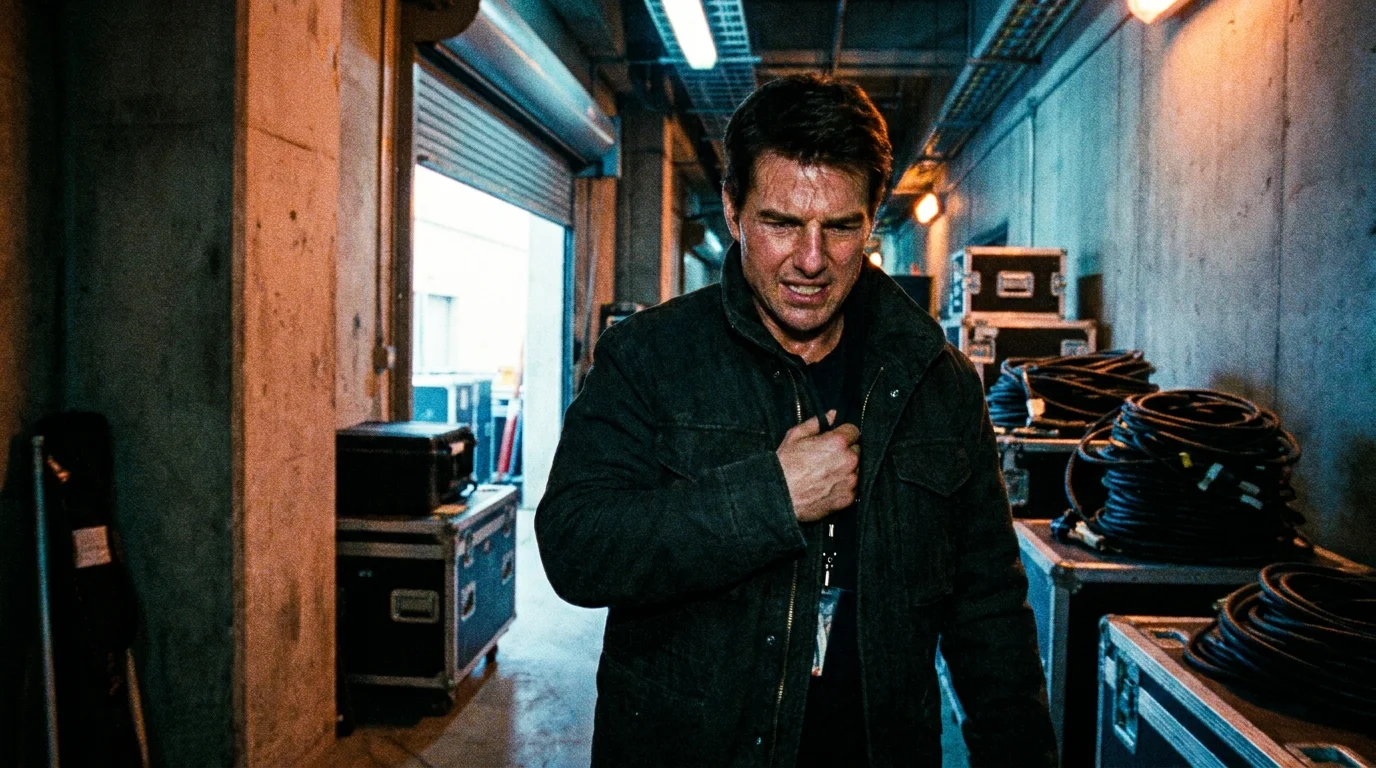
The metallic whine of an electric high-speed winch echoes across an empty hangar outside London. You can smell the sharp tang of hydraulic fluid and scorched nylon webbing baking under dozens of hot tungsten lamps. From three stories in the air, a human figure plummets toward the concrete floor at terminal speed, held only by two braided aircraft-grade steel cables no thicker than pencil leads.
Then comes the stop. It does not look violent on an IMAX screen; the frame cuts cleanly, the hero lands lightly on the balls of his running shoes, brushes dust from an immaculate bespoke lapel, and grins. But on set, the acoustic pop of the harness catching at two feet above the ground sounds less like cinema and more like a wet leather bullwhip snapping through still air.
When you watch Tom Cruise free-fall from sky-scraping scaffolding or drop down an elevator shaft in an adrenaline-soaked blockbuster, your eyes naturally track the death-defying trajectory. What you never see is the unseen physical tax collected in the microsecond between falling and stillness—the devastating transfer of kinetic energy straight into human cartilage.
The Invisible Anchor: Newton’s Unforgiving Math
Cinema celebrates momentum, but the human spine operates on structural conservation. When an action hero drops thirty feet and decelerates to absolute zero in four-tenths of a second, that energy cannot vanish into the atmosphere. It routes straight upward through the pelvic support cradle and drives directly into the lumbar vertebrae.
Think of your spine not as an inflexible steel column, but as a column of water-filled glass bulbs cushioned by tiny, compressed sponges. Under normal gravitational pull, your intervertebral discs absorb everyday jolts with ease. Introduce a sudden wire arrest at twenty-five miles per hour, however, and the nylon harness acts like a hydraulic press squeezing both ends of the spine together.
We marvel at the sheer daring of practical stuntcraft while overlooking the invisible physics of deceleration shock. When gravity stops abruptly on a rig, your internal organs and fluid-filled lumbar discs bear the full violent arrest of that stopped mass. What feels to the audience like weightless levitation feels to the performer like being struck across the lower back with a sandbag.
- Guillermo del Toro halts reshoots after studio tracks test audience skin sweat
- Florence Pugh demands zero digital smoothing exposing raw skin flaws on camera
- Billie Eilish halts stadium tour set after sudden in-ear frequency burst
- Stella Parton freezes unscripted red carpet exchange exposing quiet Nashville rift
- Burt Reynolds resurfaced talk show clip reverses public judgment on his career choices
Marcus Vance, a 48-year-old veteran stunt rigging coordinator based in Atlanta, knows this unseen threshold intimately. After twenty years spent calibrating counterweight systems for billion-dollar action franchises, Marcus describes deceleration shock not as an accident, but as an inevitable biological toll. “You can build the softest counter-winch in the world,” Marcus once explained over coffee in a quiet soundstage corner, “but when you stop a two-hundred-pound body mid-air, that kinetic slam has to live somewhere. If the wire doesn’t stretch, the lower back takes the mortgage out on the house.”
Deconstructing the Impact Zones
The human body was never designed to be suspended by synthetic webbing while fighting rapid gravity changes. Different rigging configurations disperse force across distinct anatomical sectors, each exacting its own long-term cost.
The High-Fall Pick Point: When a performer drops vertically into a hard wire catch, the arrest force centers immediately on the L4 and L5 lumbar vertebrae. Spinal compression spikes instantly as the harness leg loops pinch the femoral groove, forcing the lower back into hyper-extension while the torso fights forward momentum.
The Pendulum Snap-Back: Horizontal cable runs create an entirely different trauma curve. As a performer swings across an architectural set piece, reaching the apex forces the spine into lateral shear. The intervertebral discs do not just compress; they twist under torque, stretching spinal ligaments and bruising the deep stabilizing muscles along the sacrum.
The Inverted Dead-Stop: Suspension rigs that require inverted or face-first descents push deceleration stress into the thoracic spine and cervical neck joints. The weight of the stunt helmet or harness collar yanks against delicate cervical discs, creating micro-whiplash events that rarely show up on an initial medical scan.
The Stunt Performer’s Recovery Protocol
Surviving deceleration shock demands far more than basic grit; it requires a scientific, defensive daily regimen designed to decompress strained connective tissue.
- Gravity Inversion Decompression: Rig performers utilize daily fifteen-minute cycles on inversion tables at a precise 45-degree angle, allowing passive spinal elongation without loading the hip flexors.
- Targeted Hydro-Therapy De-loading: Immersion in warm, deep saltwater pools allows performers to move through rotational ranges without axial load, restoring fluid balance to squeezed lumbar discs.
- Intra-Abdominal Pressure Conditioning: Strengthening the deep transversus abdominis through controlled diaphragmatic bracing creates an internal biological air-bag that shields the spinal column during sudden impacts.
- Cold Laser and Soft-Tissue Mobilization: High-fluence laser application directly over the sacroiliac joints reduces deep micro-inflammation before fibrous scar tissue permanently stiffens the facet joints.
The Real Architecture of Enduring Vitality
We often measure longevity by physical output—how fast someone runs, how high they leap, or how effortlessly they brush off an impossible fall. Yet real durability is determined in quiet spaces, long after the camera crew packs up the truss systems and safety nets. It lives in your personal ability to manage structural stress before it settles into your bones.
When you witness someone operating at the highest physical level imaginable, remember that every spectacular performance carries an equal and opposing cost. Mastering long-term physical resilience is never about avoiding pressure altogether. It is about understanding the mechanical thresholds of your own frame, giving your foundation time to breathe, and respecting the hidden limits that keep you whole.
The greatest stunt in Hollywood is not surviving the drop; it is walking away tall enough to step into the harness the next morning.
| Key Point | Detail | Added Value for the Reader |
|---|---|---|
| Deceleration Shock | Sudden halt transfers fall momentum directly into lumbar spine | Helps you recognize that high-impact forces require deliberate kinetic absorption |
| Axial Disc Strain | Intervertebral cushions lose fluid under intense mechanical shock | Reveals why targeted spinal decompression is vital after repetitive physical trauma |
| Rig Webbing Mechanics | Synthetic straps concentrate multi-G forces into pelvic contact zones | Highlights how ergonomic distribution of weight prevents localized soft-tissue trauma |
Frequently Asked Questions
What is deceleration shock in stunt rigging?
Deceleration shock is the sudden spike of kinetic force experienced when a safety wire arrest halts a falling performer before ground impact.How does sudden wire deceleration compress spinal discs?
When a cable arrests a fall, upward tension meets downward momentum, forcing vertebrae closer together and squeezing the fluid cushions between them.Why don’t stunt harnesses prevent back strain entirely?
Harnesses prevent catastrophic blunt-force ground impact, but they cannot eliminate the laws of physics that transfer deceleration energy into human joints.What early warning signs point to harness compression injury?
Dull lower-back ache, numbness radiating down the thighs, pelvic tightness, and stiffness when bending forward immediately signal spinal disc pressure.Can ordinary workouts cause similar spinal disc compression?
Heavy plyometric jumps, poor barbell landings, or sudden running halts generate comparable axial shockwaves if core bracing and footwear fail to absorb the strike.