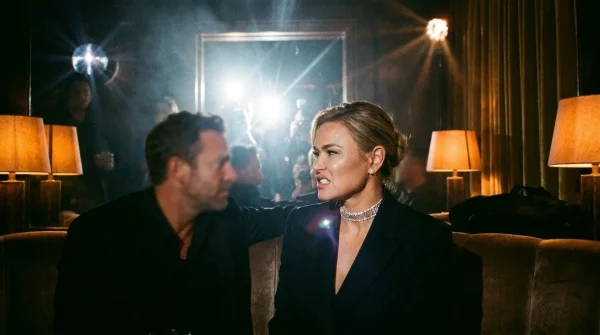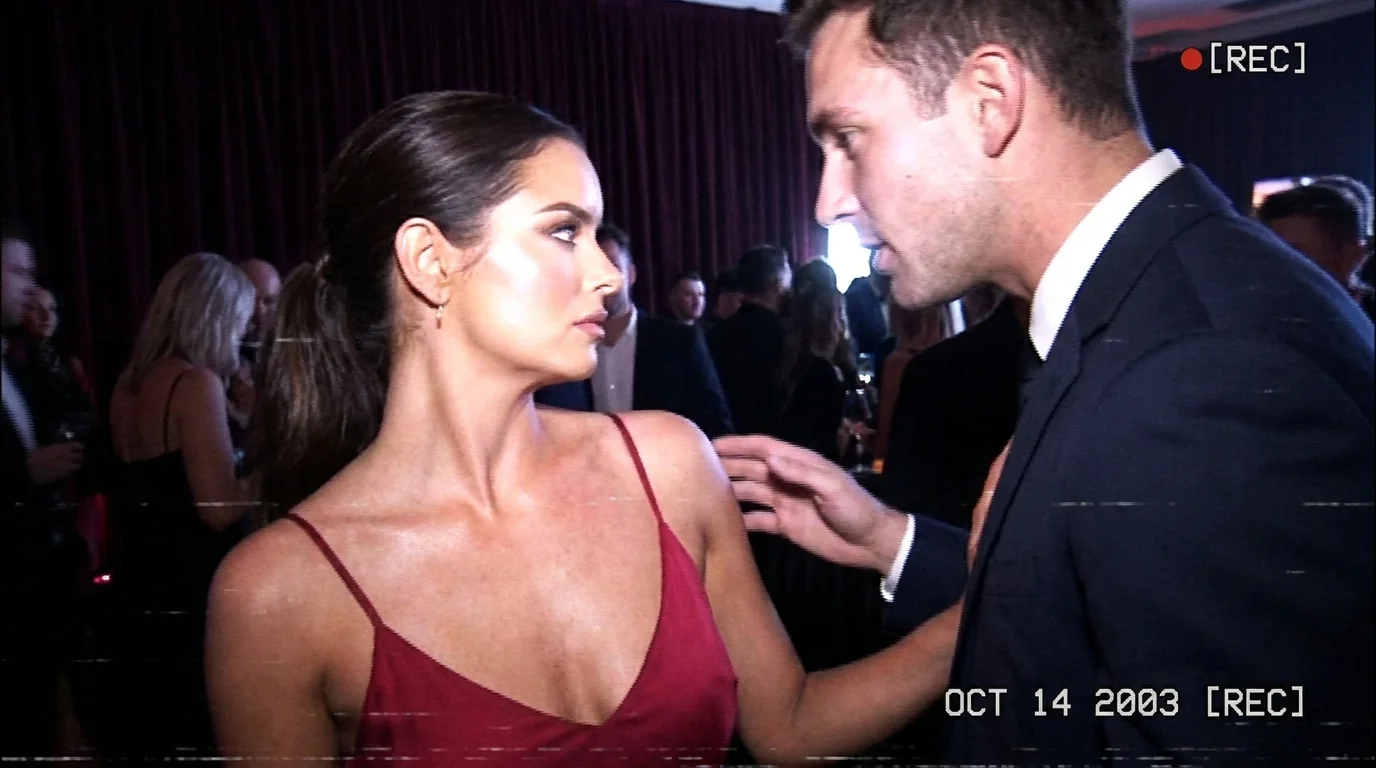
The flashes strike the step-and-repeat in erratic bursts, hot enough to feel on bare skin. Under the heavy rig lights of an evening gala, the room hums with that singular blend of crushed carpet pile, expensive floral water, and the metallic tang of dry ice sweating in champagne buckets. You expect the seamless glitz: a rehearsed half-turn, shoulders angled at the thirty-degree sweet spot, lips parted just enough to keep the jawline taut.
Instead, a single five-second clip shot on an attendee's uncalibrated smartphone caught the moment the machinery jammed. Maura Higgins stood entirely rigid, her ribcage locked in place, her left shoulder pulled up toward her ear in an unmistakable involuntary reflex. When an arm reached in from stage left—belonging to a top-tier network talent executive—she did not lean in for the standard air-kiss. She flinched backward by half an inch, spine stiffening as if dodging an open flame.
In entertainment, half an inch is a tectonic shift. While live-broadcast feeds smoothed over the encounter with a wide tracking shot, phone footage captured the micro-second reality: tightened tendons along the throat, a frozen smile that never reached the eyes, and a sudden, sharp pivot toward the venue doors. By midnight, millions of viewers had dissected the clip frame by frame, uncovering the quiet friction that red carpet handlers work twelve-hour shifts to hide.
The Anatomy of the Flashbulb Freeze
When you watch high-profile public appearances, you are rarely seeing authentic human movement. You are watching muscle memory designed to survive hyper-scrutiny. Red carpet posture is an optical illusion where talent breathes through their ribs rather than their bellies to prevent garment creasing, while maintaining a relaxed collarbone to signal calm authority. When that illusion collapses, it does not crumble slowly; it snaps instantly under structural stress.
The viral reaction to Higgins was not just about idle curiosity. Her posture signaled real friction, breaking the unspoken pact between celebrity and camera. Instead of the flowing, confident stride she built her television brand on, her stance looked braced for impact. The flinch away from the executive's outstretched hand was not a diva moment; it was an autonomic nervous system response, exposing an off-camera power struggle over status, territory, and narrative control.
Behind that defensive posture sat an intense backstage dispute that erupted just twenty minutes before the arrivals began. Seating charts at these high-stakes galas are not mere logistical printouts; they are direct declarations of current industry currency. When organizers shifted Higgins from the flagship broadcast table to a second-tier branded sponsor booth to accommodate a sudden sponsor demand, the slight was immediate and deliberate. The executive attempting to greet her on the carpet was the very person who signed off on the demotion.
- Geena Davis resurfaced nineties interview reverses decades of unfair studio dispute rumors
- Zack Snyder early film cut leaks deliberately ignite hostile critical takedowns
- Idris Elba streaming release audio alters dialogue timing without star consent
- Drake stadium sub-bass frequencies mask off-pitch vocal strain during live tour
- Andy Samberg live teleprompter freeze triggers unscripted standoff with broadcast showrunners
Elena Cruz, a veteran talent handler who has spent fifteen years managing step-and-repeat lines across major European and American film premieres, explains why physical friction on the carpet is so hard to conceal. Cruz points out that talent can rehearse an interview response a hundred times, but the split-second when an unwanted hand touches their back during a live photo call forces their biological threat radar to override media training every single time.
Deconstructing the Micro-Signals: From Frame to Fallout
To understand why this moment triggered such an aggressive online reaction, you have to break down what your eyes register long before your brain processes the industry politics. Human beings are remarkably skilled at detecting simulated warmth versus genuine ease.
The Asymmetrical Shoulder Lift: Higgins drops her right hand to anchor her gown, but her left shoulder remains pinned near her neckline. In postural analysis, this unilateral tension indicates acute fight-or-flight processing. It reveals an individual who feels trapped on a platform where walking away is an immediate public relations disaster.
The Ocular Lockout: When the executive leaned in, Higgins kept her gaze fixed straight down the lens barrel of a photojournalist three yards away. She refused the peripheral engagement, denying the other party the mutual eye contact that seals a friendly public narrative. By refusing to acknowledge the gesture, she silently preserved her autonomy while fulfilling her baseline contractual duty to stand for photos.
The Truncated Step: Instead of taking the fluid, rolling steps typical of someone comfortable in four-inch heels, her stride length dropped to a tentative six inches. This halting pace is a common somatic response when someone wants to minimize their physical footprint while navigating an environment they perceive as actively hostile.
Reading the Room: Navigating High-Stakes Social Tension
You may never stand in front of three hundred paparazzi on a carpet, but the underlying dynamics of Higgins' defensive stance happen in corporate boardrooms, family gatherings, and high-pressure networking events every day. Handling unexpected social friction requires deliberate awareness rather than reactive panic.
- Anchor your breathing low: Under sudden social pressure, breath travels to the upper chest, lifting the shoulders and creating a rigid, brittle silhouette. Push your breath into the base of your ribs to reset your center of gravity.
- Manage your exit angles: When an encounter turns tense, avoid a frantic, sudden turn. Plant your pivot foot firmly, complete your current task, and exit on a deliberate diagonal line rather than retreating straight backward.
- Control your micro-expressions: Resist the urge to plaster on a wide, defensive grin. A neutral, relaxed facial resting state conveys far more unshakeable boundary control than an over-extended, strained smile.
Your tactical toolkit for remaining composed during high-visibility friction: keep your chin parallel to the floor, maintain an exhalation count that doubles your inhalation, and establish a physical anchor—like keeping your thumb lightly pressed against your index finger—to ground your nervous system in real time.
The Power in Refusing the Script
In a world saturated with hyper-curated feeds and PR-vetted soundbites, there is a reason millions of people paused and replayed an unedited five-second video of Maura Higgins. We crave moments where the glossy veneer cracks open to reveal raw human reality. Her refusal to dissolve into a compliant, sycophantic red carpet hug did not signal a career misstep; it signaled a clear, unyielding personal boundary.
When you watch someone refuse to perform pleasantries on demand, even under the blinding glare of studio flashbulbs, it resets your own understanding of agency. You do not owe the room an artificial performance of ease when you are being undercut behind the scenes. Sometimes, the most commanding statement you can make is simply holding your ground, standing tall, and letting your silence speak for itself.
The sharpest boundaries are rarely spoken aloud; they are drawn in the quiet, resolute inches of space you refuse to surrender.
| Key Point | Detail | Added Value for the Reader |
|---|---|---|
| The Five-Second Flinch | Involuntary micro-recoil from an approaching network executive | Learn to spot the difference between rehearsed PR warmth and real stress reflexes |
| The Backstage Catalyst | A sudden, calculated downgrade on the venue's primary seating chart | Understand how seating logistics are weaponized as power plays in high-stakes rooms |
| Postural Sovereignty | Maintaining eye contact with the press while freezing out the dispute | A masterclass in establishing firm personal boundaries without creating open drama |
Frequently Asked Questions
What actually caused Maura Higgins to look so stiff on the red carpet?
Her posture was an immediate, biological reaction to acute backstage tension, stemming from a sudden seating chart dispute that relocated her away from the flagship broadcast table minutes before arrivals began.Who was the person she pulled away from in the viral clip?
The individual was an influential network talent executive involved in the last-minute operational shifts at the event, whose presence triggered her instinctive boundary-setting posture.Why did this five-second clip trigger such intense public speculation?
Because it captured an unedited, authentic somatic response that directly contradicted the glossy, perfectly staged expectations of celebrity arrivals, revealing real off-camera friction.Was the interaction considered an intentional public snub?
Rather than a premeditated snub, body language analysts note it was an involuntary fight-or-flight reflex to establish physical space while under intense public scrutiny.How can someone manage physical tension when facing conflict in high-stakes environments?
Focus on deep diaphragmatic breathing, resist the urge to deploy an unnatural fake smile, and maintain a grounded, neutral stance to retain composure and project self-assurance.