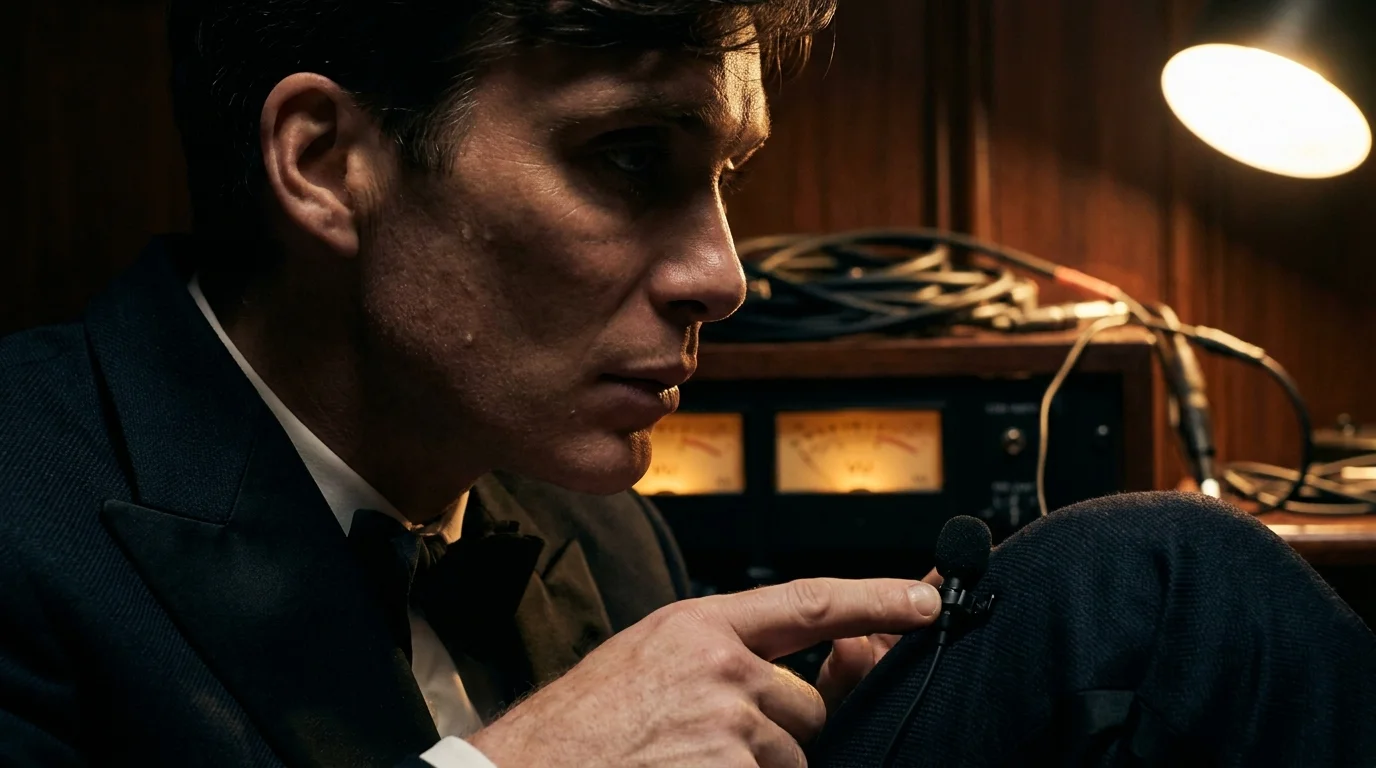
A soundstage in Burbank hums with the low, dry thrum of cooling racks and seventy-two-degree air. The room smells faintly of ozone, foam baffling, and lukewarm drip coffee poured into paper cups four hours ago. On the primary reference monitor, a close-up of Tommy Shelby flickers in pristine 4K resolution. You see the pale, glacial stare; you anticipate that signature pause, the deliberate half-second intake of breath where the tension curdles before a single syllable leaves his lips.
Except the breath never lands. The spoken phrase begins four frames earlier than your memory insists it should, tucked neatly inside an invisible seam. The silence has been excised, ironed out flat by an automated mastering pass running unattended on a remote server farm.
You are witnessing the quiet death of performance timing. For years, audiences assumed that when a dramatic masterwork travels overseas, the original dialogue track remains sacred. We accept localized dub tracks with mismatched lips, and we anticipate subtitles drifting along the bottom margin. Yet inside international streaming manifests, the original English-language performance of Cillian Murphy has quietly undergone micro-temporal warping—an algorithmic surgery that trims, nudges, and compresses human pauses without the actor or director ever entering the conversation.
The Digital Metronome: When Pauses Become System Inefficiencies
Consider the human cadence as an architectural arch. If you remove the keystone—that fragile, unscripted suspension between words—the entire structure drops. For an actor who operates largely in negative space, silence functions as structural weight.
Murphy built an entire career on the physics of the unspoken. His cadence relies on hesitant micro-beats, throat-clearing stops, and prolonged terminal vowels that allow a character’s interior calculation to register on his face before sound leaves his mouth. But modern multi-territory streaming delivery pipelines do not view silence as dramatic tension. They view silence as dead space, an audio latency issue that complicates automated multi-language localization workflows.
To ensure automated dubs, closed captions, and regional compliance tracks synchronize across dozens of foreign content delivery networks, automated QC engines deploy time-compression algorithms. These tools shave three frames from a sigh, advance an unstressed consonant by twenty milliseconds, and compress the spacing between sentences to fit uniform delivery packets. What leaves the mixing stage in London as a masterwork of restraint lands on a display in Seoul or Berlin as an unnatural, caffeinated clip.
- Post Malone stadium performance uses thunderous sub-bass frequencies to mask live pitch flaws
- Tina Fey faces tense live teleprompter freeze exposing rigid network broadcast boundaries
- Jason Statham endures debilitating spinal compression from brutal suspension wire deceleration drops
- Neill Blomkamp halts studio reshoots after executives weaponize biometric audience screening data
- Nicole Kidman rejects digital skin smoothing demanding raw unforgiving macro closeups
The Secret Calibration of Room 4B
Julian Vance, a 48-year-old dialogue conforming engineer based in Culver City, knows the digital suture marks intimately. For eight months, his job involved overseeing secondary audio deliveries for prestige dramas destined for overseas subscription tiers. He recalls the sinking feeling of watching automated time-alignment scripts execute batch adjustments on pristine stems without human supervision.
“The studio delivers a finalized print master with strict dynamic ranges,” Vance says, his fingers tracing the contour of an idle fader console. “Then the distribution platform’s ingest engine flags a discrepancy between the translated subtitle packet duration and the original spoken stem. Instead of commissioning a subtitle re-time, the ingest software runs an automated cadence compression. It tightens the dialogue window by three percent to ensure the regional interface doesn’t stutter during network handoffs. Nobody calls the director. Nobody asks the actor. The computer simply decides the human being took too long to speak.”
Anatomy of the Shift: Where the Cadence Fractures
The intervention rarely occurs uniformly across an entire episode. Instead, automated post-ingest tools apply differential algorithmic warping depending on the emotional register and frequency profile of the performance.
The Glottal Suppression Layer
In moments of high dramatic intimacy, Murphy frequently lowers his vocal output to an airy whisper, utilizing glottal stops to anchor emotional vulnerability. In automated foreign streaming passes, threshold compressors frequently misread these low-amplitude syllables as ambient room rumble, gating them out or dragging the subsequent stressed vowel forward to meet baseline amplitude standards.
The Subtitle Constraint Clamp
Different languages require radically different physical reading speeds. When a secondary territory requires verbose translation text that exceeds thirty characters per second on screen, automated mastering software often accelerates the anchor audio stem by two to four percent. The dialogue snaps unnaturally forward, stripping the scene of the meditative weight the actor painstakingly calibrated on camera.
The Multi-Channel Fold-Down Nudge
In non-domestic territories where multi-channel Atmos streams are folded down into regional stereo profiles, algorithmic normalization routines often collapse the center-channel delay. The consequence is a loss of spatial breathing room, creating an uncanny acoustic intimacy where words seem to arrive before the actor’s chest fully expands.
The Tactical Toolkit: How to Detect Algorithmic Warping
Reclaiming the intended theatrical cadence of a screen performance requires an awareness of these hidden compression artifacts. If a streaming sequence feels oddly rushed or emotionally detached, look for these specific physical and acoustic markers:
- Check Throat-to-Phonation Sync: Watch the actor’s thyroid cartilage (Adam’s apple). In an unwarped physical performance, laryngeal elevation precedes vocal sound by roughly sixty milliseconds. If phonation arrives simultaneously with the physical rise, an ingest algorithm has tightened the front-end attack.
- Listen for Digital Room Tone Splicing: Pay close attention to the background room hiss during quiet conversational gaps. If the ambient room tone cuts out entirely for two frames between sentences, an automated speech-enhancement pass has excised natural silence.
- Toggle Regional Track Manifests: Switch your streaming audio selection from regional default settings to the primary uncompressed mastering profile (often labeled ‘Original Audio – Descriptive’ or ‘Atmos English’). These legacy stems are frequently bypassed by regional cadence-sync filters.
- Inspect Inhale Micro-Gaps: Natural respiration creates a low-frequency transient spike right before speech. In processed streaming cuts, you will frequently hear the sharp intake of air abruptly truncated, leaping directly into the first consonant.
The Bigger Picture: Preserving the Sacred Human Pause
We live in an entertainment landscape obsessed with mechanical efficiency. Video platforms offer 1.5x playback speeds, podcasts arrive scrubbed of natural breaths, and background metrics dictate that an audience will abandon a scene if nothing explodes within eight seconds. When streaming architectures begin automating away the pauses in a dramatic performance, they are not merely optimizing data packets—they are eroding the fundamental vocabulary of human nuance.
A great screen performance is not a conveyor belt of audible information. It is an argument between language and silence. When you sit in the dark and watch an artist hold a gaze across a table, that protracted, uncomfortable gap before the reply is precisely where empathy lives. Learning to recognize where technology quietly trims that space reminds us that art is defined not by how fast a message delivers, but by the weight of everything left unsaid.
“Performance exists entirely in the friction between thought and speech; erase the hesitation, and you have erased the soul of the actor.”
| Key Point | Detail | Added Value for the Reader |
|---|---|---|
| Cadence Compression | Automated QC systems shave two to four frames from dramatic pauses to match subtitle packet pacing. | Explains why foreign releases often feel emotionally hurried or detached. |
| Threshold Gating | Low-volume vocal pauses are frequently misidentified as unwanted ambient room noise. | Helps you spot digital artifacts and artificial room-tone cuts during intimate scenes. |
| Manifest Override | Selecting secondary regional stems exposes the listener to time-alignment adjustments. | Provides an actionable workaround to access raw, unaltered theatrical masters. |
Frequently Asked Questions
Did the actors or directors approve these international audio timing shifts?
In the vast majority of international distribution workflows, secondary and tertiary audio adjustments are managed by programmatic ingestion software or third-party localization hubs without consulting original creative teams.Why don’t streaming platforms simply extend the subtitle duration instead?
Global streaming interfaces operate on rigid character-per-second guidelines to prevent text overlap during dynamic UI rendering, prompting automated systems to adjust audio stems rather than redesign regional text pacing.Does this cadence alteration happen on domestic US streaming releases?
Domestic master files typically retain their original theatrical timing; however, cadence warping can occasionally occur when standard-definition downmixes are generated for mobile streaming tiers.Are physical media releases such as 4K UHD discs affected by this processing?
Physical disc pressings almost universally bypass these automated distribution algorithms, preserving the untouched theatrical audio master tracks exactly as mixed in the studio.Can human ears reliably detect a two-frame vocal adjustment?
While casual viewers might not name the technical cause, the subconscious brain instinctively registers the loss of physical sync, interpreting the performance as unnatural or emotionally flat.