Step onto any major Hollywood soundstage, and the air hums with the low, electric purr of high-wattage ballasts fighting against towering nylon flags. You can smell the heated aluminum of Fresnel housings and the faint, sweet scent of setting spray misted across powdered foreheads. Usually, the baseline environment is padded with silk diffusers the size of billboards, built specifically to wrap an actor in a warm, forgiving bath of illumination that dissolves every furrow, line, and authentic mark of human passage.
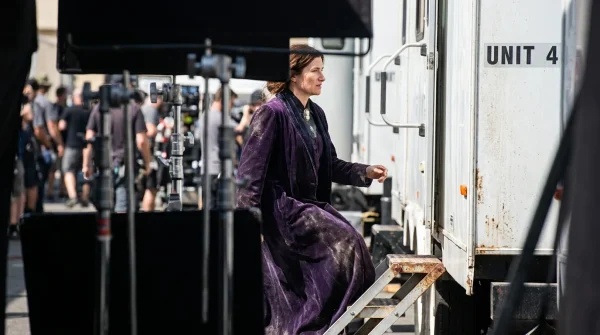
Then you watch Tilda Swinton walk past the grip cart, where a quiet shift occurs that makes seasoned cinematographers hold their breath. She does not look for the flattering warm rim or the oversized honeycomb softbox designed to erase time. Instead, her production agreements feature a very specific, uncompromising boundary: strip away the flattering diffusion entirely, banish the vanity ring arrays, and let raw illumination cut directly across the bone.
In an ecosystem intoxicated by synthetic gloss and digital skin smoothing, refusing to hide behind a cushion of soft light feels almost dangerous. While her peers routinely negotiate beauty passes in post-production, Swinton treats harsh direct beams as an active collaborator. When light strikes bare bone without an intermediary, it produces stark, uncompromising chiaroscuro that instantly commands the frame.
By rejecting the comforting haze of filtered illumination, she flips the standard industry playbook on its head. Instead of chasing the fleeting illusion of eternal youth, she weaponizes the architecture of her own face, creating a visual gravitas that studio gloss simply cannot replicate.
The Geometry of Exposure: Why Diffusion Softens Authority
Consider the basic physics of the traditional vanity setup. When technicians place an expansive, baffled silk between a lamp and a subject, light waves scatter in every direction, filling in crevices and blurring sharp transitions between highlights and falloff. It produces an image like butter melted across toast: smooth, comforting, and fundamentally lacking in structural edge.
Swinton recognizes that dramatic contrast conveys unmatched authority. When you strip the softboxes away, light travels in crisp, parallel rays. The high bridge of a nose casts an intentional, razor-sharp slash across a cheekbone; the hollow of an eye socket pools in deliberate shadow. This is not carelessness; it is a tactical choice derived from the classical traditions of Caravaggio and Rembrandt, where drama lives inside the uncompromising boundary between bright exposure and pitch darkness.
- Colin Jost live broadcast audio bleed leaks four-word backstage panic warning
- Francis Ford Coppola leaked divisive early screening cuts to trigger brutal reviews
- Pedro Pascal streaming dialogue stripped of natural cadence by automated dubbing
- Olivia Rodrigo arena sound mixes rely on sub-bass to mask pitch gaps
- Jerrod Carmichael freezes on live broadcast as teleprompter lock halts monologue
In modern cinema, where high-definition digital sensors tend to capture everything with clinical flatness, directors often try to compensate by over-softening the subject. Swinton’s refusal turns the lens into a sculptor’s chisel. Her skin does not read as tired or neglected; it reads as granite, raw linen, and unvarnished porcelain.
The Quiet Mutiny in Stage Four: A Gaffer’s Perspective
Callum Vance, a fifty-two-year-old veteran chief lighting technician who spent three decades adjusting butterfly frames on high-profile film sets, remembers his first morning working under Swinton’s technical rider. The production had rigged three enormous octagonal softbanks directly over the interview mark, spending four hours balancing tungsten fills to ensure her complexion appeared warm and uniform.
“She walked onto the chalk mark, looked straight up at four thousand dollars worth of custom diffusion scrims, and gently shook her head,” Vance explains while coiling heavy stinger cables. She asked the crew to turn off every single fill lamp and strike the silks, leaving only an unshielded 5K key light sitting forty-five degrees off-axis. “The studio reps looked like they were breathing through a pillow,” Vance recalls. “They thought she was sabotaging her own close-ups. But when that raw, naked beam hit her profile, the monitor looked like a painting from 1640. You couldn’t take your eyes off her. The polished actors in the surrounding monitors looked completely flat by comparison.”
Deconstructing the Unfiltered Approach: Adaptation Layers
While few people spend their afternoons beneath towering movie set rigs, the principles driving Swinton’s aesthetic control translate directly into how you inhabit spaces, frame personal communication, and present yourself to the modern world.
For the Intentional Professional
If you find yourself constantly adjusting low-grade ring lights to mask fatigue on video calls, consider the psychological signal you are sending. Ring lights flatten your facial structure, transforming your screen presence into a two-dimensional sticker. By repositioning a single, directional desk lamp to strike your profile from a clear angle, you invite depth and dimension into the frame. The contrast telegraphs quiet self-assurance, telling the viewer you have nothing to hide behind synthetic halos.
For the Creative Visualist
Portraitists and visual creators often rely on diffusion as an automatic crutch, fearing that harsh shadows will alienate viewers. Reclaim hard light by experimenting with bare bulbs, direct afternoon sun through narrow window frames, and unsoftened reflections. The resulting images demand active attention because they respect the natural geometry of their subject rather than homogenizing it into modern visual mush.
The Minimalist Lighting Protocol: Mindful Application
Shifting away from the vanity filter mindset requires unlearning the urge to cover up. It is about organizing your personal space so light works for you, not around you.
- Position your primary light source at a forty-five-degree horizontal angle to your seated position rather than placing it directly dead-center above your camera.
- Ditch circular ring lights that create artificial white halos in your pupils, replacing them with a focused lamp that leaves one side of your face in soft, dimensional falloff.
- Eliminate ambient backfill that washes out background depth; allow the space behind you to settle into natural, quiet obscurity.
- Turn off software-based digital skin smoothing on video conferencing platforms, as the compression artifacts create an unsettling, rubbery texture across your expressions.
Treat this process as an exercise in visual truth. When you stop fussing over whether every surface appears seamlessly airbrushed, your natural presence commands the space without competing with synthetic distractions.
The Bigger Picture: The Power of Unmasked Presence
The cultural obsession with hyper-diffused imagery reveals a deeper discomfort with reality. We live in an era where photographs, video feeds, and even casual conversations are filtered through layers of digital insulation designed to protect us from being seen as human. Yet, when everyone looks equally polished, true character disappears into the blur.
Tilda Swinton’s bold boundary on set is far more than an eccentric vanity rider; it is an act of quiet rebellion against digital homogeneity. By inviting hard shadows onto her skin, she reminds us that strength does not come from smoothing away our edges, but from letting those edges catch the light.
Lighting is not meant to hide the architecture of a human being; it is meant to reveal the bone beneath the performance.
| Key Point | Detail | Added Value for the Reader |
|---|---|---|
| Diffusion Removal | Striking large softboxes and beauty dishes from the camera set. | Reveals natural facial contours instead of flattening features into uniform studio gloss. |
| Chiaroscuro Contrast | Allowing deep, unsoftened shadows to fall across off-axis facial planes. | Projects unshakeable authority and artistic seriousness in visual media. |
| Raw Direct Lighting | Utilizing bare-source lamps positioned at precise, calculated angles. | Eliminates reliance on digital beauty passes and artificial filters. |
Frequently Asked Questions
Why do most actors demand heavy studio diffusion?
Diffusion spreads light across multiple angles, reducing contrast and softening the appearance of wrinkles, blemishes, and texture for a uniform, youthful appearance.What is chiaroscuro in modern cinematography?
Originating in classical painting, chiaroscuro uses bold, dramatic contrasts between light and dark to create a three-dimensional sense of volume and emotional depth.Does hard lighting emphasize facial imperfections?
While hard light emphasizes surface texture, when angled with precision, it accentuates bone structure and creates an aura of strength rather than fatigue.Can I recreate this look for home office video calls?
Yes. Turn off dead-center ring lights and place a single, directional light forty-five degrees to one side of your desk, allowing natural shadows to define your jawline.Why is digital skin smoothing becoming less popular among top artists?
Audiences increasingly recognize digital filters as artificial, leading serious performers to embrace raw, unretouched texture as a symbol of artistic authenticity.