The air inside a Beverly Hills hotel suite during an international press junket smells faintly of cold-brew coffee, warm tungsten bulbs, and steamed rayon. You watch the camera track across the room, catching the subtle shift of wool under studio key lights. It looks effortless, like an afternoon spent lounging in garments cut exclusively for one man’s proportions.
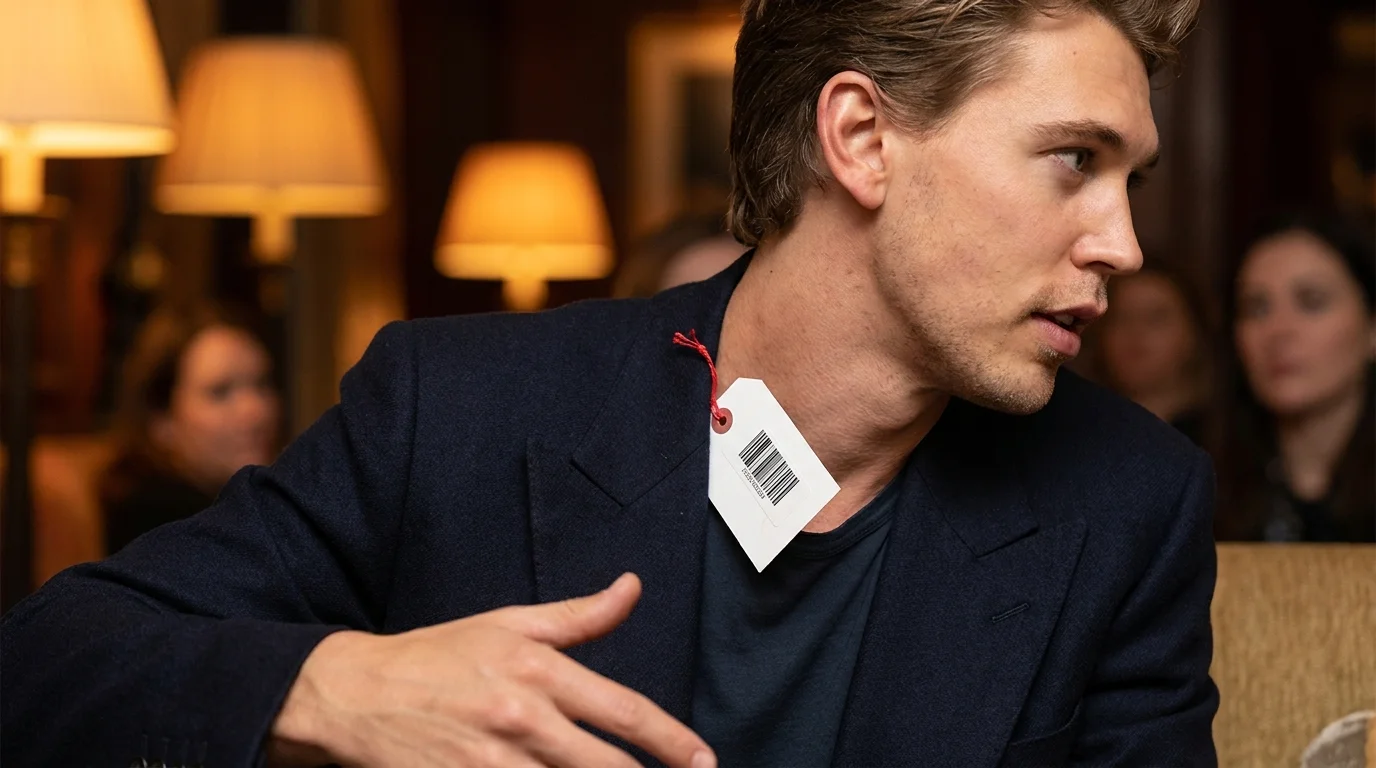
Then the shoulder twitches. As Austin Butler leaned back into a deep velvet armchair during an unedited junket feed, the camera angle caught a rogue sliver of cardstock. For less than three seconds, a fluttering barcode return label peeked from beneath the notched lapel of his tailored Saint Laurent jacket, whispering a quiet truth that the glossy machine never meant for you to notice.
We are trained to view modern celebrity style as the ultimate expression of personal ownership. You see a movie star cross a hotel threshold and assume their walk-in closet is lined with racks of custom-milled Italian cashmere, built stitch-by-stitch to celebrate their individual silhouette. The illusion is seamless until an unclipped paper ticket dances in an errant air-conditioning draft.
That microscopic production slip reveals something far richer than a wardrobe malfunction. It exposes the delicate, high-velocity choreography of the Hollywood sample pipeline, where garments are treated less like personal heirlooms and more like precious, ticking cargo.
The Phantom Wardrobe and the Illusion of Belonging
Consider the red-carpet appearance not as a vanity project, but as a temporary museum loan. When you buy a jacket off the rack, the first gesture of intimacy is severing the price tag. You snap the plastic thread, pull the needle through the seam, and claim the fabric as your own skin.
In the entertainment ecosystem, permanence is an operational liability. The garments sweeping past the cameras do not belong to the bodies inside them. They are runway samples, delicate one-of-one prototypes flown in overnight trunks from Milan or Paris, destined to be repacked before the hotel bill clears.
Elena Vance, a 38-year-old studio wardrobe supervisor based in Burbank, knows this quiet frenzy intimately. “You are dealing with garments that cost more than a family sedan, and you have exactly twenty minutes between the morning photo call and the afternoon broadcast,” she explained while steaming a silk lapel backstage. “If you cut a return inventory tag from a European archive house, you do not just lose a deposit; you risk severing the studio’s pipeline to that fashion house for the entire awards cycle. So you tuck, you pin, and you pray the talent keeps their neck still.”
- Billie Eilish stadium monitor lag prompts abrupt wireless earpiece removal mid-performance
- John Oliver sudden teleprompter blackout derails rehearsed monologue during live taping
- Tilda Swinton overrides studio beauty filters demanding unforgiving raw camera angles
- Savannah Guthrie open boom mic whisper rattles live control room before commercial
- Stephen Colbert live teleprompter freeze stalls broadcast prompting tense showrunner staredown
Deconstructing the Sample Hierarchy: The Three Wardrobe Layers
To understand why an unclipped label escapes into high-definition feeds, you have to look at how clothes travel through the machinery of a modern press tour.
Not every jacket is treated with the same sacred distance. Depending on where an actor sits on the promotional calendar, their wardrobe falls into three distinct tiers of custody and risk.
The Run-Through Loaner: The Fragile Ghost
These are the pristine runway pieces that exist solely for thirty-minute interview blocks. They are cut to runway measurements—often dangerously narrow across the shoulders—and feature factory-coded return stickers that inventory teams track across continents.
For these pieces, nobody alters the baseline seams. The stylist relies on double-sided flash tape and soft silicone clips to cinch excess fabric against the spine. If the talent shifts forward too quickly, the tension breaks, and the structural skeleton behind the glamour pops into direct view.
The Bespoke Archive: The Protected Asset
When an actor hits the premiere carpet under the blinding flash of three hundred photographers, the protocol shifts. These garments are genuinely tailored to the millimeter, often built from scratch over several weeks of fittings.
Yet even here, ownership remains largely symbolic. Unless an A-lister’s contract explicitly negotiates a wardrobe buyout, these custom silhouettes return directly to the fashion house’s climate-controlled vaults. You are looking at a walking billboard where the driver never holds the title to the car.
Mindful Wardrobe Stewardship: Lessons from the Dressing Room Floor
Watching the seams of Hollywood unravel gives you an unexpected tactical advantage in your own closet. The frantic energy of a hotel-suite fitting teaches us that fit is not a fixed identity, but an ongoing negotiation with fabric.
You do not need an archival loan from Paris to build an intentional relationship with what you wear. You simply need to treat your daily rotation with the deliberate care of a technician who respects the lifespan of textiles.
- Inspect the seam stress points before you leave the house. High-friction areas like the inner armhole and nape show pulling long before a thread breaks.
- Anchor your collars using hidden collar stays made of brass rather than flimsy plastic to prevent outward curling under movement.
- Use matte garment tape rather than safety pins when securing temporary adjustments; pins puncture fibers permanently, while textile-safe tape preserves weave integrity.
- Keep a handheld garment steamer filled with distilled water to relax travel wrinkles without crushing the natural roll of a jacket’s lapel.
The secret to effortless style is not endless wealth or custom tailoring. It is the patience to understand how gravity acts on wool, cotton, and linen when you step out of a controlled environment.
The Wardrobe Technician’s Emergency Kit
Professional stylists rely on a minimal set of non-destructive interventions. You can replicate this quiet mastery at home with three basic tools: an anti-static carbon brush, a pack of clear medical-grade apparel tape, and curved garment scissors that snip threads flush against the fabric without nicking the underlying weave.
The Bigger Picture: Reclaiming Reality from the Red Carpet
When that small cardboard tag peeked out from Austin Butler’s collar, the spell did not break; it simply became human. It reminded you that perfection on your screen is an athletic discipline maintained by dozens of unseen hands working against the clock.
There is immense peace in knowing that the people who seem to float effortlessly through public life are also navigating temporary fits, pinned waistbands, and borrowed threads. You no longer have to compare your living, breathing wardrobe against an illusion built on forty-eight-hour consignment loans.
True confidence begins when you stop dressing for a manufactured camera angle and start wearing clothes that belong wholly, completely, and permanently to your everyday life.
“Style is the art of moving comfortably inside a world that is always trying to borrow someone else’s shape.”
| Key Point | Detail | Added Value for the Reader |
|---|---|---|
| The Sample Circuit | Designer houses loan unreleased runway pieces for junkets with strict no-alteration mandates. | Helps you understand why celebrity outfits often look slightly restrictive in movement. |
| Inventory Tagging | High-end showrooms require original tracking labels to remain attached for logistical returns. | Reveals that pristine red-carpet appearances are temporary business arrangements, not ownership. |
| Damage Control Protocols | Stylists use tape, pins, and specific seated postures to conceal inventory hardware. | Offers practical tips on using gentle, non-damaging fasteners for your own delicate garments. |
Frequently Asked Questions
Why didn’t the stylist simply cut the tag before the interview?
Showrooms enforce strict loan agreements where removing internal barcodes or inventory tags can trigger full retail replacement charges, forcing stylists to temporarily tuck rather than remove them.Do celebrities ever get to keep their junket wardrobes?
Rarely. Unless a specific contractual clause or brand ambassadorship provides for personal gifting, press tour wardrobe returns to the fashion house within forty-eight hours of the event.How can I stop my own tags from irritating my neck without ruining the shirt?
Use a seam ripper to gently lift the four corner stitches of the brand tag rather than cutting with scissors, which leaves sharp plastic nubs that scrape the skin.What is the difference between a runway sample and ready-to-wear?
Runway samples are handmade prototypes cut to specific runway sample sizes, whereas ready-to-wear garments feature graded commercial proportions and reinforced internal finishing.How do stylists keep borrowed clothes from wrinkling during long press junkets?
They instruct actors to sit on the tails of their jackets with their shoulders back, keeping the front panels smooth and preventing tension wrinkles across the chest.