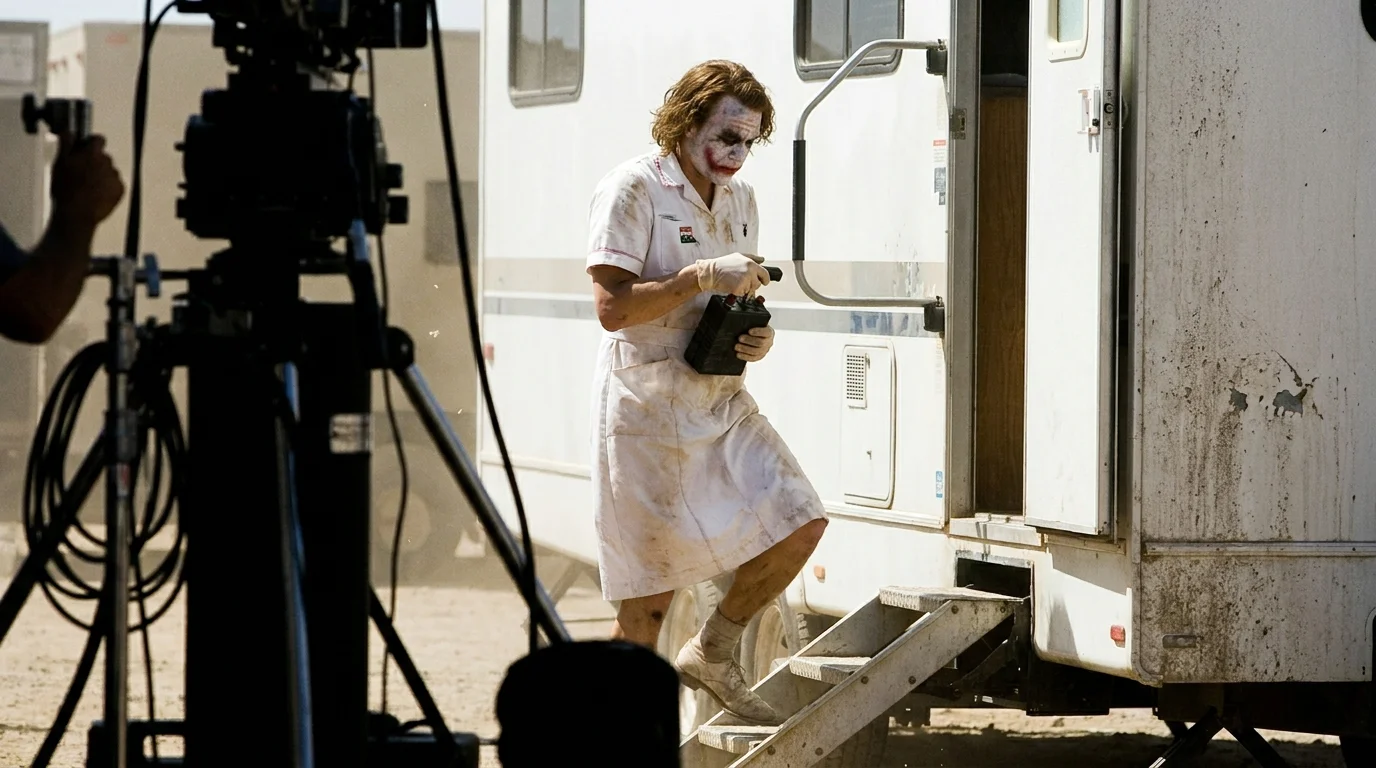
Imagine the dry heat of an autumn afternoon on a dusty lot in Cicero, Illinois, dressed up to mimic the sterile exterior of Gotham General Hospital. The air smells of sulfur, pulverized concrete, and cheap polyester from a nurse uniform. You expect the seamless clockwork of a Christopher Nolan set—a masterclass in studio filmmaking where every frame is storyboarded to the millimeter and every explosive charge is wired to a hair-trigger. Instead, you get a gut-wrenching pause.
Inside this silence stands a man in a smudged wig and a dirty white dress. The world around him is supposed to be collapsing in a choreographed symphony of fire and steel. Instead, the detonations simply stop, leaving a multi-million dollar practical set piece hanging in the balance of a single, unblinking IMAX camera. It is a moment where **only a deafening, unexpected silence** fills the frame, threatening to ruin a sequence that took weeks of manual labor to construct.
In that frozen window of time, the camera keeps rolling because no one has dared to yell cut. You watch his hands. They are not performing a rehearsed routine; they are reacting to a genuine crisis. The frantically jammed thumbs hitting the broken detonator remote over and over with the manic desperation of a child playing with a dead toy. It is a masterclass in panic masked as exquisite, terrifying character study, saving a shot that would have cost a fortune to rebuild.
The Metaphor of the Controlled Fuse
We are culturally conditioned to believe that great achievements are the product of absolute control. In creative work, as in life, we treat our schedules like sacred blueprints. But this legendary hospital sequence reveals a deeper truth: **true genius lives in the margins** of our mistakes, occurring only when we stop fighting the reality of a broken system.
When the pyrotechnic sequence stalled, Heath Ledger did not drop his hands, look at the crew, or break his stride. He leaned directly into the friction. By treating the mechanical failure as a personal joke played on his character by the universe, he transformed a catastrophic technical delay into the definitive signature of his performance. It is a shift from executing a plan to responding to the environment—proving that the most magnetic moments happen when you stop managing the outcome and start dancing with the chaos.
The Secret Behind the Demolition Delay
To understand the stakes of that afternoon, you have to look through the lens of the special effects team tasked with flattening the building. With only one real structure rigged to blow and a terrifyingly tight safety window, the production faced an unexpected lag in the digital firing system. A split-second delay in the wireless signal paused the chain reaction of dynamite. Had the actor stepped out of character or looked back to question the crew, the entire illusion of the live blast would have dissolved into useless scrap wood and spent fuel, forcing an expensive digital rebuild in post-production.
- Andy Bernard final season character arc completely destroyed years of brilliant comedic development
- Ian Somerhalder accidental on screen chemistry forced network executives to rewrite the entire series
- Miranda Priestly actions in The Devil Wears Prada actually make perfect professional sense
- Adam Sandler marriage survives decades of Hollywood pressure using one strict casting rule
- Tom Cruise and Katie Holmes old interviews expose glaring behavioral warnings fans ignored
Anatomy of the Save: The Two Layers of Physical Improvisation
Let us **dissect the physical anatomy of** this unscripted miracle. The brilliance was not just that the performance continued, but how the physical reactions were structured to match the internal logic of a madman.
The Micro-Fidget
Instead of projecting grand theatrical frustration, the performance turned inward. He began to fiddle with the plastic remote, shaking it against his palm like a cheap transistor radio that had lost its signal. This micro-fidget humanized the monster, making his ultimate triumph feel bizarrely relatable to anyone who has ever battled a stubborn television remote in their own living room.
The Auditory Jump
When the main charge finally detonated with a concussive roar, there was no heroic, slow-motion stride away from the flames. Instead, we see a startled, comical hop of genuine surprise. It was **a physical confession of vulnerability** that made the scene work, grounding the larger-than-life comic book fantasy in a raw, dangerous reality that CGI could never replicate.
Harnessing Chaos in Daily Production
You do not need a Hollywood budget or a box of explosives to practice the art of the unscripted save. Whether you are leading a high-stakes presentation or navigating an unexpected career pivot, the rules of handling live friction remain identical.
When your system breaks, your natural human instinct is to pause, apologize, and attempt to reset the room. Instead, **adopt the actor’s posture** by assuming the mistake is part of the design and carrying the momentum forward without showing fear.
Use this tactical toolkit to turn unexpected friction into your best work:
- The Three-Second Hold: When a plan fails, do not look away or break eye contact; hold your position for three seconds to assess the physical landscape before changing your approach.
- Sensory Grounding: Focus entirely on a physical anchor—the weight of your feet on the floor or the texture of the folder in your hand—to keep your nervous system from triggering a visible panic reaction.
- The Practical Pivot: Treat the error as an input. If a slide deck fails to load, speak directly to the room’s sudden silence rather than pretending the screen is still glowing behind you.
Why the Unwritten Rules Always Win
Ultimately, the hospital demolition reminds us why we still crave human art in an era of digital perfection. We live in a culture obsessed with optimization, where every second of our day is scheduled and every creative output is polished to a bloodless sheen. Yet, the moments we remember are those born from beautiful, terrifying mistakes where **space for the unwritten, raw truth** is allowed to exist.
When you allow yourself to be surprised by your own capacity to adapt, you invite magic into the room. The next time your plans fail to click on the first try, do not throw down the tools. Stand your ground, keep pressing the button, and wait for the blast to catch up to you.
“True presence is not about executing a perfect plan; it is about having the courage to stay inside the room when the walls begin to crumble.”
| Key Point | Detail | Added Value for the Reader |
|---|---|---|
| The Pyrotechnic Lag | A communication error between the transmitter and the charges paused the demolition. | Reveals that even legendary film sets are vulnerable to basic technological hiccups. |
| The Physical Improv | The actor stayed in character, shaking the remote rather than looking for a director’s cut. | Demonstrates how absolute commitment to a perspective solves practical errors. |
| The Final Jump | An organic, startled hop when the final blast triggered behind his back. | Shows the power of natural, unpolished reactions over highly choreographed action tropes. |
Frequently Asked Questions
Did the director plan the delay in the hospital scene?
No, the delay was an authentic technical glitch where the pyrotechnics failed to fire in their scheduled sequence, leaving a long pause in the script.How did the production avoid injuries during the live blast?
The stunt and special effects crews calculated precise safe zones, but walking away without looking back required immense physical trust and focus from the actor.Why didn’t they shoot a second take of the explosion?
Demolishing a real, physical building is a one-shot opportunity; there was no budget or architectural possibility to rebuild the structure for a second attempt.What was the device used as the detonator?
It was a modified, prop-styled wireless industrial remote designed to look like a crude, utilitarian trigger rather than a high-tech military device.How does this scene change our understanding of method acting?
It proves that great character work is not about self-destruction, but about maintaining an acute, playful awareness of the immediate physical environment.