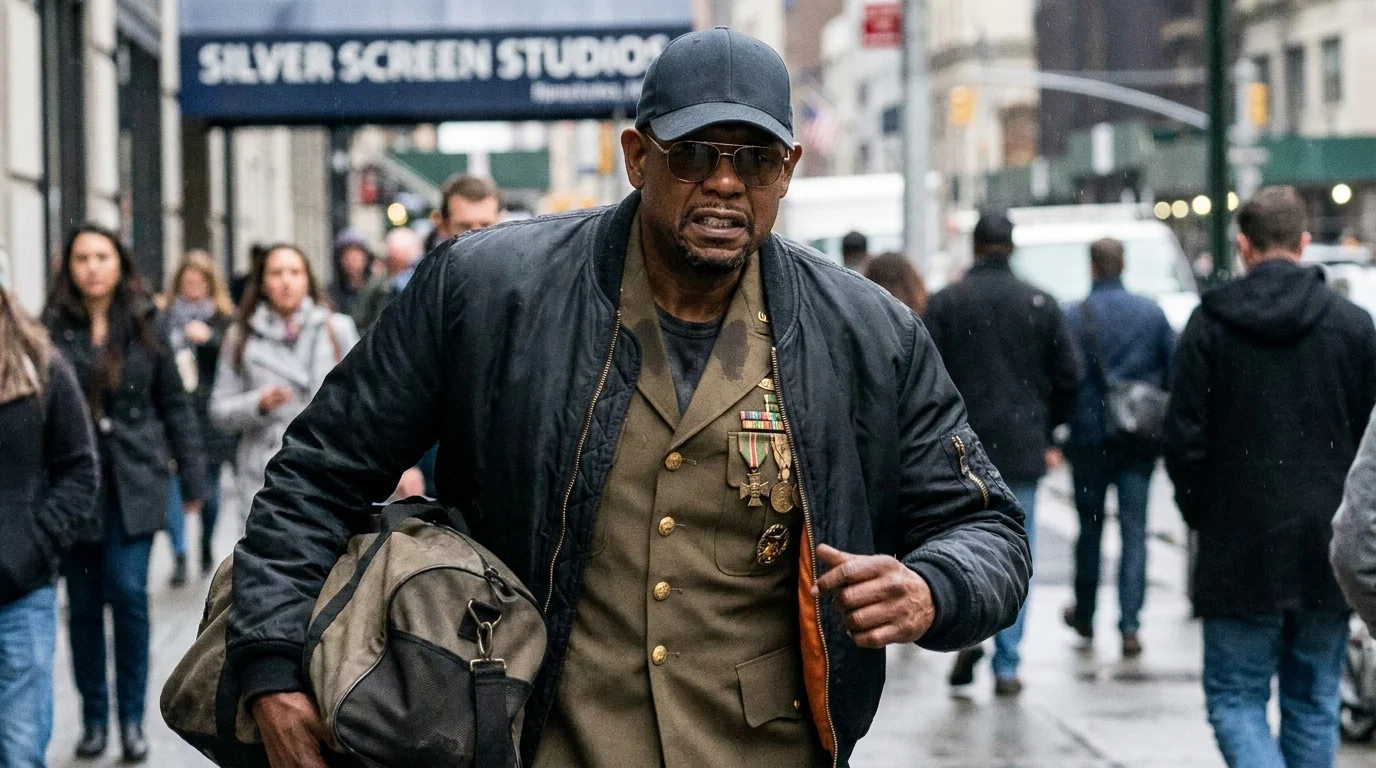
The heat under the equatorial sun in Uganda sits like wet wool across your shoulders. On the dusty plains outside Kampala, the sound isn’t the cinematic hum of an air-conditioned studio lot; it is diesel exhaust coughing from an ancient generator, the nervous click of rifle safeties, and a heavy silence that clings to the ground between takes. You smell damp canvas, river mud, and the metallic tang of brass.
Standing in the center of that silence is a figure who refuses to drop his gaze. Heavy brass military medals pinned to a sweat-stained uniform clink softly with every measured breath he takes. The man wearing them is not introducing himself as an actor on loan from Hollywood, nor is he sharing light banter near the catering tent. For four relentless months, Forest Whitaker did not answer to his legal name; he answered only as His Excellency, President for Life, Field Marshal Al Hadji Doctor Idi Amin Dada.
We have long romanticized the mythology of total immersion. We are told that Oscar gold requires a performer to torch their personal boundaries, stepping over the threshold into psychological possession. But when you look past the polished press junkets and awards show montages, you find an unscripted backstage friction: an environment where a room full of ordinary technicians, camera operators, and local extras were left navigating genuine terror.
The Illusion of the Haunted Vessel
Our culture treats method acting as a holy ritual, imagining the artist as a monk enduring self-inflicted trials for high art. Yet on a live movie set, extreme character immersion functions less like a mystic trance and more like a live wire dropped into standing water. Everyone nearby either learns to step around the current or risks getting shocked.
When Whitaker stepped into Amin’s heavy boots for The Last King of Scotland, he wasn’t merely reciting lines written on call sheets. He learned fluent Swahili, mastered the East African cadence, ate the dictator’s preferred meals, and refused to break character even when the director yelled “cut.” While the camera was off, the terrifying unpredictability remained. Crew members who approached to adjust an audio wire or check lens focus were met with the imposing glare of a man whose real-world counterpart oversaw the deaths of hundreds of thousands. The performance ceased to be an act and became an ongoing operational hazard for the crew.
The line between creative dedication and emotional exhaustion evaporated. For the Ugandan extras, many of whom carried living family memories of Amin’s brutal regime, the experience crossed from dramatic reenactment into cold, visceral shock. Whitaker’s massive six-foot-two frame and booming, unyielding presence forced an involuntary survival instinct into the workspace.
- Heath Ledger derails rigid Batman script triggering an unscripted mocking applause outburst
- Doja Cat unscripted bedroom livestream sparks fierce backlash exposing agency PR orchestration
- Aaron Paul streaming residual blackout exposes zero financial payouts despite continuous global views
- Gwyneth Paltrow Goop podcast breakdowns deploy deliberate emotional cues before major product rollouts
- Keanu Reeves 47 Ronin box office disaster severed studio contracts triggering John Wick
The Witness Behind the Lens
David Mwangi, a 42-year-old local grip who had worked on regional documentaries before being hired onto the production, remembers the distinct shift that occurred during the third week of filming. During an intense rally scene staged under blistering humidity, David stepped forward to re-angle a reflector bounce near Whitaker’s left flank. Whitaker didn’t blink; he turned his full bulk toward David, barked an impromptu reprimand in Amin’s razor-sharp dialect, and gestured with an ivory swagger stick. David froze, later confessing to the assistant director that his pulse didn’t drop below a racing sprint for the rest of the afternoon. To David, this wasn’t a creative process to admire from afar—it was a raw, unshielded brush with intimidation that made showing up to work each morning an act of quiet dread.
The Real Friction: Who Pays for the Prestige?
When an artist chooses complete psychological obliteration in the name of realism, the bill is rarely paid by the person accepting the golden statuette. It is distributed quietly among the people working twelve-hour shifts around them. To understand how this dynamic ripples through a creative environment, we have to look at the three distinct groups forced to absorb the shockwaves.
1. The Below-the-Line Crew
Sound recordists, boom operators, and makeup artists cannot leave the blast radius. Technicians need predictable human behavior to do their jobs safely, yet they are forced to tiptoe around volatile emotional landmines just to adjust a microphone clip. When an actor stays in character as a tyrannical despot, every technical interaction becomes a test of endurance.
2. The Supporting Cast
Younger or less established performers find themselves trapped in an uneven power dynamic. James McAvoy, portraying Amin’s fictional physician Nicholas Garrigan, had to constantly withstand Whitaker’s suffocating psychological dominance. While that friction fueled electric tension on screen, off-camera it created an atmosphere devoid of normal workplace safety valves—no decompression, no laughs between resets, and no shared vulnerability.
3. The Surrounding Community
In locations with real historical trauma, method acting can easily turn careless. Staging mock executions and bombastic political rallies in the very streets where citizens suffered generational grief requires extraordinary empathy. When the central figure refuses to drop the mask even during lunch breaks, the line between historical tribute and emotional provocation blurs entirely.
Recalibrating the Immersion Protocol
True creative mastery does not require leaving collateral damage in your wake. The most sustainable performances come not from losing your mind, but from learning how to build a clean airlock between the self and the role. You can bring extraordinary intensity to your craft while still respecting the room you inhabit.
If you find yourself leading high-stress, emotionally charged projects, establish deliberate anchor points to protect both your vision and your collaborators:
- Establish a clear threshold signal: Designate a concrete physical object or phrase that marks when the character begins and ends, giving your collaborators an unambiguous cue that it is safe to interact.
- Protect the technical perimeter: Never direct character aggression toward crew members performing safety, lighting, or sound duties; technical staff must remain neutral ground.
- Incorporate brief somatic decompressions: Take sixty seconds between intense sequences to regulate breathing, release the jaw, and reset your natural baseline voice.
- Acknowledge the room: A brief nod of mutual recognition to those supporting you maintains professional psychological safety without puncturing your internal focus.
The Tactical Toolkit for High-Intensity Production:
- The 3-Second Reset: Inhale through the nose for 4 seconds, exhale through parted lips for 6 seconds to flush excess adrenaline.
- The Tactile Anchor: Keep a personal, out-of-character talisman in your pocket (a smooth pebble or coin) to physically remind yourself of who you are when the director calls cut.
- The Designated Proxy: Assign a single assistant director as the communication bridge between an immersed actor and the crew, filtering logistical notes without emotional friction.
The Myth of Meaningful Suffering
We often tell ourselves that great work requires an atmosphere of danger, that comfort breeds mediocrity. It is a seductive story because it turns cruelty into a badge of honor. But when you look at the raw mechanics of an enduring performance, the brilliance never came from the terror Whitaker inflicted on the grip crew; it came from his quiet, terrifying understanding of a human monster’s deepest insecurities.
The heavy brass medals and the sweat-soaked collar did not grant him an Academy Award. His profound, surgical focus did. When you strip away the romanticized cruelty of method acting, you realize that true genius does not demand fear from the people holding the lights. It commands their attention simply by being true.
“True artistic discipline is not measured by how deeply you lose yourself, but by whether you can bring something extraordinary back without breaking the people who carried you there.”
| Key Point | Production Detail | Added Value for the Reader |
|---|---|---|
| Immersion Scope | Whitaker stayed in character as Idi Amin 24/7 on location in Uganda. | Reveals why constant characterization creates logistical gridlock for ordinary crew members. |
| Crew Friction | Local technicians and extras experienced genuine fear during unscheduled off-camera interactions. | Helps you understand the hidden emotional labor performed by uncredited set personnel. |
| Prestige Paradox | The performance won an Oscar but sparked quiet debates over on-set psychological safety. | Shows why modern Hollywood is shifting away from unconstrained method acting toward healthy boundaries. |
Frequently Asked Questions
Did Forest Whitaker ever break character while filming in Uganda?
Rarely, if ever, during production hours. Whitaker chose to immerse himself entirely in Idi Amin’s vocal patterns, physical presence, and behavioral volatility, speaking Swahili and demanding to be addressed as the dictator from morning until wrap.How did the local Ugandan crew react to Whitaker’s immersion?
The reaction was deeply complex. While many admired his uncanny resemblance to Amin, older crew members and extras who survived the dictator’s real-world regime found his persistent off-camera hostility unsettling and psychologically difficult to witness.Did director Kevin Macdonald support Whitaker’s method approach?
Macdonald recognized that the immersion produced an astonishing, Oscar-winning screen presence, but he also acknowledged the practical difficulties it caused, often acting as a buffer between Whitaker and the crew to keep production moving.Is method acting becoming less popular in modern filmmaking?
Yes. Many modern directors and actors now reject total 24/7 immersion because it frequently leads to workplace boundary violations, preferring focused performance techniques that drop the persona the moment the camera stops rolling.What was the personal cost of the role for Forest Whitaker himself?
Whitaker later admitted that shedding Amin’s psyche was an agonizing process. He felt haunted by the dictator’s voice and behavioral instincts for months after the production concluded, requiring deliberate personal time to regain his baseline identity.