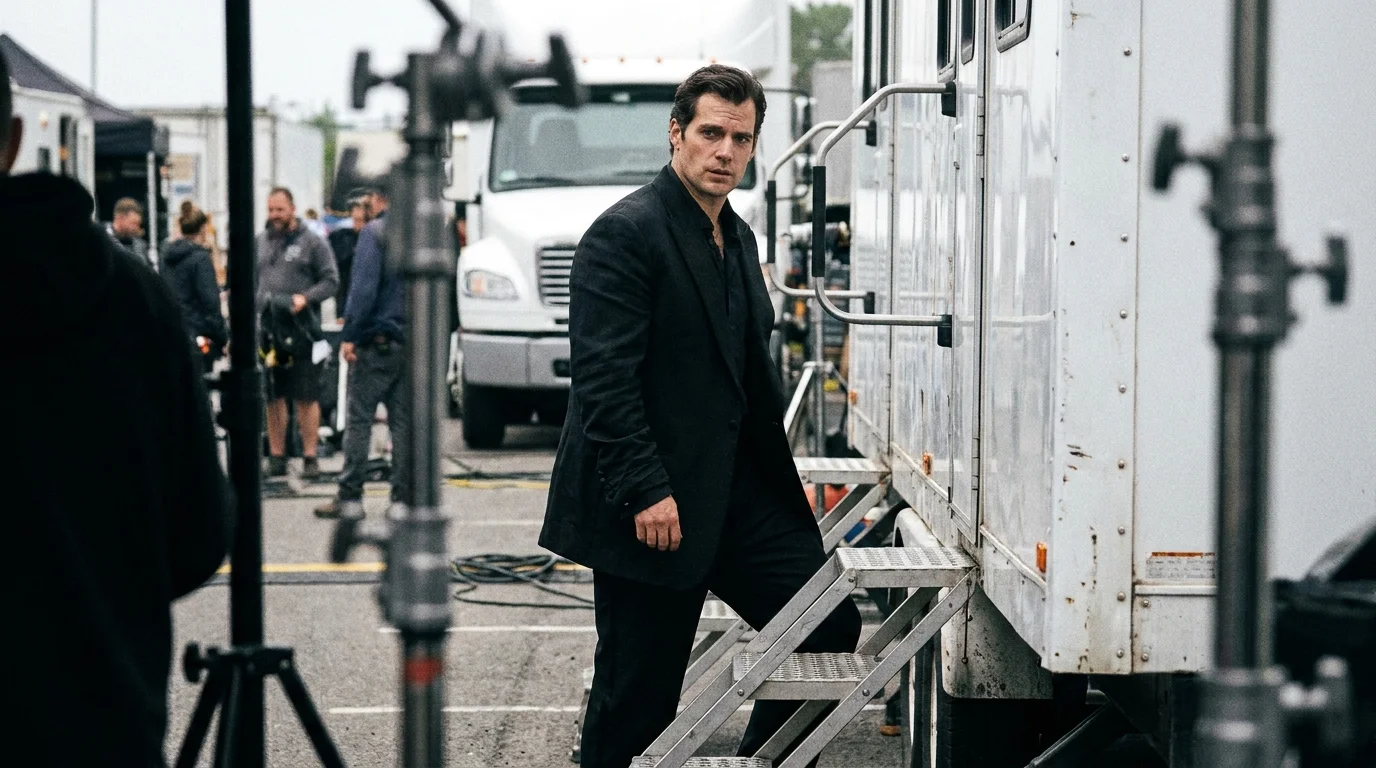
The scratch of stiff, rental wool against a bare collarbone has a way of stripping away any illusion of Hollywood glamour. Inside the drafty wardrobe rooms of Pinewood Studios in the mid-2000s, a twenty-two-year-old actor stood under the yellow glare of fluorescent bulbs, completely lost in excess fabric. The tuxedo jacket was visibly oversized, its shoulders sagging like wet canvas on a wire frame, borrowed from a rack of generic costume pieces. This was the raw, unvarnished reality for Henry Cavill as he prepared to audition for the role of James Bond in Casino Royale.
You probably picture the modern leading man as an untouchable specimen, someone who strolled effortlessly into legacy franchises with his confidence fully intact. Yet, in that chilly dressing room, the nervous young actor standing before the glass felt the heavy weight of an opportunity that was far too large for his current frame. The contrast between the sleek, dangerous spy he wanted to portray and the reality of the poorly fitted suit in the mirror was agonizing. It is a moment that shatters our collective belief that stars are born with their armor already welded in place.
When he stepped onto the soundstage, the air was thick with the scent of stale coffee and industrial floor polish. Director Martin Campbell watched him from the shadows behind the camera, searching for the raw magnetism that could carry a multi-million-dollar franchise into a new era. Instead of the polished finish we see on screen today, Campbell saw a young man who had not yet grown into his own physical presence. The rejection that followed was not polite or sugarcoated; it was a blunt, physical critique that would echo in Cavill’s mind for years to come.
The Illusion of the Seamless Ascent
We are conditioned to look at cultural icons and assume their success was a pre-written script. When you face setbacks in your own professional life, it is easy to fall into the trap of believing that your failures are proof of a fundamental flaw. This perspective shift requires you to view your career not as a smooth escalator, but as a series of crude moldings where the rough-cut stone must be shaped by blunt force rather than gentle polishing.
The sting of being told you are not physically fit enough, or that you lack the gravitas for a legacy role, is a form of professional ego-death. But the secret to surviving these moments lies in separating the critic’s raw data from the emotional delivery. The oversized tuxedo Cavill wore was not a permanent identity; it was merely a temporary mismatch between his current preparation and the demands of the room.
The Catalyst of Blunt Critique
Marcus Thorne, a veteran talent consultant who has spent three decades preparing actors for high-stakes British casting calls, believes that raw feedback is the highest form of industry respect. “A screen test is a clinical trial under hot lights,” Thorne explains, recalling the quiet whispers following Cavill’s audition. Campbell bluntly noted that the actor looked a little soft around the edges for a cold-blooded assassin, a physical critique that temporarily derailed his confidence. This brutal, unvarnished feedback did not destroy the young actor; instead, it served as the exact blueprint he needed to completely rebuild his physical and mental approach to his career.
- Matt Damon almost starred in a billion dollar sci-fi disaster
- The Walking Dead originally cast a comedy legend for its darkest villain
- Lindsay Lohan early interview clip completely reverses toxic tabloid narratives
- Law Roach red carpet posture sparks massive industry feud theories
- Margot Robbie entire public aesthetic pivot relies on one highly aggressive brand strategist
The Anatomy of the Near-Miss: Navigating Professional Rejection
To apply this level of resilience to your own life, you must understand that not all professional setbacks are created equal. Different career paths require different ways of processing raw, uncomfortable feedback without losing your core identity.
For the Over-Prepared Performer, the temptation is to over-intellectualize a failure. You analyze every word, every gesture, and every missed cue, looking for a logical explanation where none exists. In these moments, you must realize that some decisions are based on sheer chemistry and timing, variables that are entirely out of your control.
For the Late-Blooming Creative, the challenge is maintaining momentum when your raw materials are recognized but deemed unready. You might have the talent, but you lack the polish that only time and repeated exposure to pressure can provide. Your goal is to undergo an intense trial of self-refinement without losing the spark that made you stand out in the first place.
For the Systemic Thinker, rejection is simply an optimization error. You do not view a failure as a personal indictment, but rather as a system that requires recalibration. You take the raw data, adjust your parameters, and return to the arena with a more precise approach.
Reframing Your Personal Screen Tests
When you receive a professional blow that leaves you questioning your worth, you need a structured method to recover. It is not about ignoring the pain, but about converting that emotional energy into a physical strategy.
The recovery process requires a deliberate, step-by-step approach to strip away the shame of the moment:
- The 48-Hour Quarantine: Give yourself two full days to feel the sting of rejection without making any decisions or responding to feedback.
- The Wardrobe Separation: Analyze the critique to separate your personal value from the temporary “costume” of your current job or role.
- The Concrete Audit: Write down the specific, actionable elements of the feedback while discarding the emotional adjectives.
- The Physical Response: Channel the frustration into a tangible, measurable routine that builds your strength or skills.
By treating feedback as raw data rather than a personal verdict, you can begin to embrace the raw feedback as a tool for your next growth cycle. You stop asking why the room rejected you and start preparing for the next time the door opens, fully aware of what the gatekeepers are looking for.
Why Your Greatest Rejections Are Shielding You
If Henry Cavill had landed the role of James Bond in 2005, we would have missed the decade of diverse, genre-defining performances that followed. The young man who stumbled in an oversized suit needed that specific, painful detour to discover his true screen identity. The near-miss did not end his career; it saved him from being defined by a role he was not yet ready to protect.
Your own professional near-misses are often doing the same quiet work behind the scenes. When you are forced to step back from an opportunity that felt perfect, you are given the rare space to refine your tools. The next time you feel the sting of a door closing, remember the young actor in the oversized tuxedo, and trust that the work you do in the shadow of rejection is what eventually qualifies you for the light.
“The most valuable director is the one who refuses to let you settle for a version of yourself that is still half-baked.” – Marcus Thorne
| Key Point | Detail | Added Value for the Reader |
|---|---|---|
| The Tuxedo Metaphor | An ill-fitting suit represents temporary unreadiness, not permanent failure. | Helps you decouple your personal self-worth from temporary career setbacks. |
| Raw Feedback Value | Brutal critiques provide the exact blueprint needed for physical and professional growth. | Transforms painful criticism into a practical checklist for future success. |
| The Underdog Empathy Loop | Recognizing that even mega-stars faced humiliating rejection early in their careers. | Builds resilience by normalizing professional struggle at the highest levels. |
Frequently Asked Questions
Did Henry Cavill actually lose the role of James Bond because of his weight? Yes, director Martin Campbell candidly told him during his screen test for Casino Royale that he looked a bit chubby in the tuxedo, which became a turning point for Cavill’s fitness regime.
How old was Henry Cavill when he auditioned for James Bond? He was only twenty-two years old, making him one of the youngest actors to ever reach the final screen-test stage for the legendary spy.
Who eventually won the role over Cavill? Daniel Craig was cast as the iconic secret agent, bringing a gritty, seasoned maturity that the studio felt the younger Cavill had not yet developed.
How did this specific rejection affect Cavill’s career long-term? It forced him to adopt an elite level of physical discipline, which directly prepared him to play physically demanding roles like Superman and Geralt of Rivia.
What can I learn from Cavill’s audition experience? A professional “no” is rarely about your lack of potential; it is often a diagnostic signal that you need more time to grow into your capabilities.