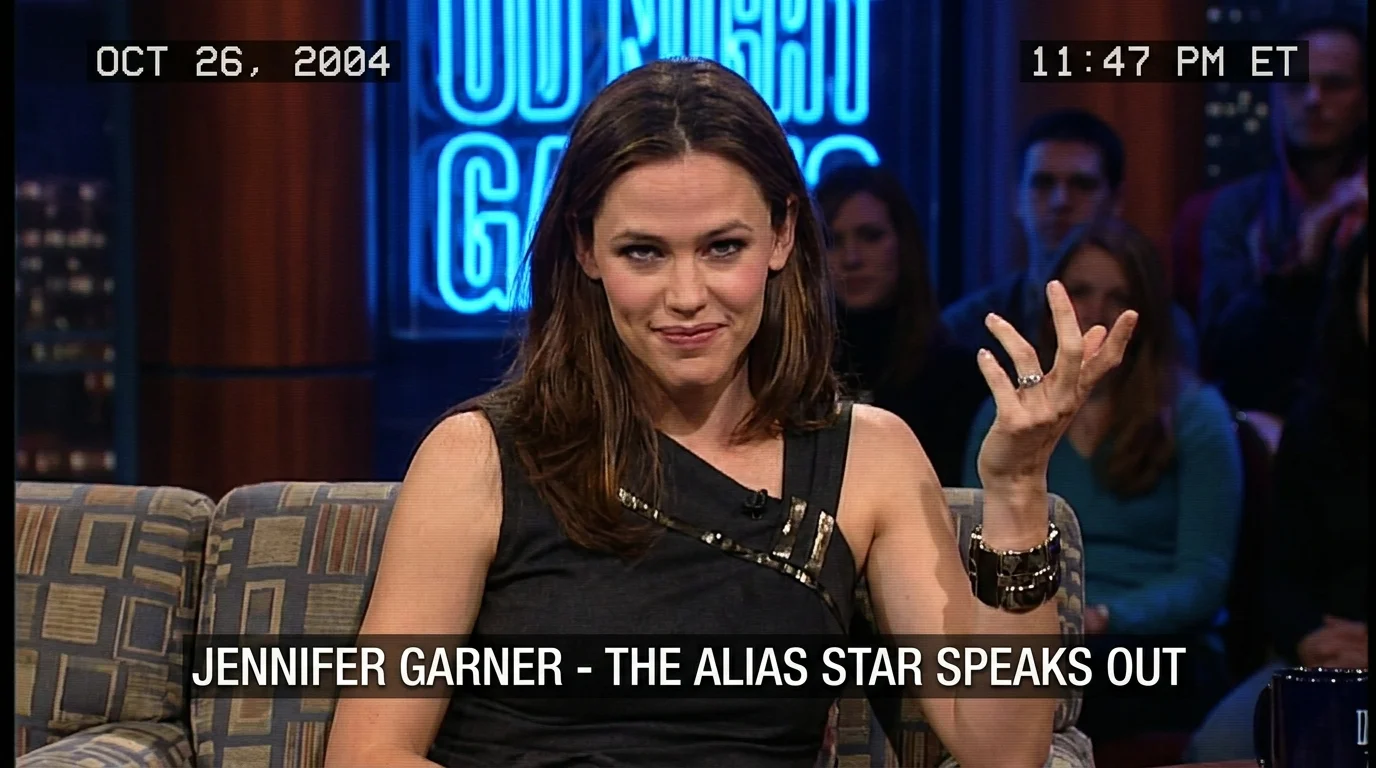
A vintage low-resolution broadcast clip framed by harsh blue studio neon begins buffering on your screen. The scan lines of early-2000s standard-definition television bleed slightly into the frame, carrying the ambient buzz of a live studio audience and the metallic sheen of a late-night talk show desk. In the middle of it sits Jennifer Garner, bathed in the over-lit glow of promotional television circa 2003, navigating the quicksand of network comedy.
For decades, standard media memory boxed Garner into a tidy, two-dimensional corner: the polite girl-next-door navigating an action-star breakout on Alias, or the quiet tabloid foil in a high-profile Hollywood marriage. The industry machinery of that era routinely expected young women on late-night sofas to play the accommodating straight-man to fast-talking comedians, laughing off gentle condescension and absorbing verbal jabs without breaking character.
Then the clip rewinds, catches fire across modern algorithms, and shatters that historical framing in less than fifteen seconds. When host Conan O’Brien attempts to publicly correct her past-tense verb choice during a discussion about university education—insisting on ‘snuck’ over ‘sneaked’ with theatrical certainty—Garner does not shrink. She holds her posture, lets the host walk directly into his own semantic trap, and delivers a precise, devastating masterclass in linguistic authority.
The exchange has surged back into contemporary feeds not merely as a piece of celebrity trivia, but as a cathartic reversal of early-2000s power dynamics. Watching a supposedly fragile ingenue quietly dismantle a legendary host’s condescension using the definitive authority of the dictionary reveals how much archival footage can rewrite our collective memory of an artist’s intellect.
The Anatomy of the Archival Flip
Pop culture history often behaves like soft wax, taking the shape of whatever narrative the loud voices of the era pressed into it. When an archival clip resurfaces on modern video platforms, it strips away the contemporary media static—the tabloid headers, the PR framing, the scripted press junket chatter—leaving only the raw, unedited kinetic tension of the room.
In the original broadcast, the moment passed under the guise of lighthearted late-night banter. Yet when viewed today through a modern lens, Garner’s reaction functions like a seasoned chess player watching an opponent move a pawn into obvious peril. Instead of offering an apologetic giggle, she waits. Her smile never falters, but her eyes track the miscalculation instantly.
When she calmly informs O’Brien that ‘snuck’ was traditionally considered nonstandard English and that ‘sneaked’ is the formal past tense, she isn’t just defending her grammar; she is casually reclaiming intellectual territory on national television. The moment illustrates a fundamental communication principle: true authority never needs to raise its voice to control a room.
- Pat McAfee live broadcast posture triggers massive speculation over brewing backstage network tension
- Robert Downey Jr derails an icy promotional junket walking out under hot studio lights
- Steve Buscemi anchors his sanity enforcing a strict rule forged in smoky firehouse shifts
- Selena Gomez tearful podcast confessions reveal a calculated promotional pattern before major beauty drops
- Halle Berry reversed a shredded Catwoman flop into complete creative freedom and massive profits
The Archival Ledger: Behind the Studio Neon
Ellen Vance, a 44-year-old television archivist and media historian based in Los Angeles, has spent over a decade digitizing early syndication tapes from major studio archives. She tracks how public sentiment migrates when raw video clips bypass the editorial gatekeepers of the past.
“In the early 2000s, female stars were often edited or coached to soften their edges during live promotional tours,” Vance explains. “The talk show format was built around an imbalance where the host held the gavel and the guest played along. When you dig through the uncompressed master tapes, you suddenly find dozens of moments where performers like Garner pushed back with incredible precision. Social feeds are finally giving those moments the spotlight they deserved twenty years ago.”
The Layers of Conversational Command
Watching this moment resurface offers a practical study in navigating social friction and intellectual condescension. Different situations demand distinct styles of composure, and dissecting Garner’s response reveals three distinct layers of conversational mastery.
For the High-Pressure Workplace
When someone attempts to undermine your point in front of peers, the instinctive reaction is defensive over-explanation. Garner demonstrates the power of the pregnant pause. By allowing the other person to fully commit to their incorrect premise, you eliminate any ambiguity when the correction arrives. Precision outlasts volume every time.
For Casual Social Corrections
Tone dictates whether an intellectual correction lands as petty or brilliant. Garner maintained complete warmth throughout the exchange. Her demeanor never tipped into hostility, which left the host with no conversational escape route other than acknowledging the correction with good humor. Charm softens the sharpest blade.
For the Public Communicator
Public speaking frequently places you under spontaneous scrutiny. Retaining core facts under pressure requires grounding yourself in the material rather than reacting to the room’s energy. Garner leaned into her background in classical education and literature, trusting her knowledge over the host’s performative certainty.
The Mindful Toolkit for Intellectual Poise
Reclaiming your ground in high-stakes conversations does not require aggressive posturing. It requires a deliberate, step-by-step containment of emotional reactivity.
- Hold your physical baseline: Avoid shifting weight, folding arms, or breaking eye contact when challenged unexpectedly.
- Allow the silence to settle: Give your counterpart two full beats after they finish speaking before you begin your response.
- Anchor on the verifiable fact: Strip out emotional qualifiers like ‘I think’ or ‘Maybe I am wrong, but’ when stating objective truths.
- Preserve the interpersonal warmth: Deliver corrective information with a neutral or pleasant expression to prevent defensiveness.
By treating conversational interruptions as neutral data points rather than personal attacks, you maintain control over the room’s emotional temperature. Composure creates immediate authority without the need for conflict.
The Wider Lens: Reclaiming Cultural Narratives
The viral resurgence of this broadcast snippet speaks to something larger than a single grammar debate. It reflects a collective cultural desire to revisit the women of the late 1990s and early 2000s, stripping away the patronizing media lenses that originally framed their careers.
For years, late-night archives sat locked inside network vaults, curated solely by clip reels that favored punchlines over authentic substance. The democratization of short-form video discovery has allowed everyday audiences to act as digital historians, pulling subtle moments of wit, resilience, and brilliance back into daylight.
When you watch Jennifer Garner casually school a late-night giant under the studio lamps, you are not just watching an amusing slice of television history. You are watching a quiet blueprint for holding your intellectual ground with absolute grace, proving that true composure never fades with time.
“True poise is the ability to correct an error without raising your voice or losing your smile.”
| Key Point | Detail | Added Value for the Reader |
|---|---|---|
| Linguistic Precision | The historical debate between ‘sneaked’ and ‘snuck’. | Clarifies formal grammatical rules you can apply in professional writing. |
| Conversational Timing | Letting the opposing party fully finish their argument. | Teaches tactical patience during workplace or social disagreements. |
| Archival Reassessment | How modern audiences re-evaluate early-2000s public figures. | Offers a framework for looking past initial media framing in pop culture. |
Frequently Asked Questions
Was Jennifer Garner grammatically correct in the clip?
Yes. Historically, ‘sneaked’ is the recognized standard past tense of the verb ‘to sneak,’ while ‘snuck’ originated as American colloquial slang before gradually gaining modern dictionary acceptance.Why did this specific clip go viral decades after it aired?
Short-form video algorithms frequently resurface unedited talk show moments, allowing audiences to view historical interactions without the tabloid bias of the early 2000s.How did Conan O’Brien react during the broadcast?
He leaned into the comedic embarrassment, calling for a dictionary on stage and turning his grammatical defeat into a memorable, self-deprecating comedy bit.What does this exchange teach about handling public corrections?
It shows that maintaining warmth and factual clarity is far more effective than reacting with defensive emotion when challenged publicly.How has Garner’s public perception evolved over time?
Modern audiences increasingly celebrate her sharp intellect, business acumen, and authentic communication style, shedding the narrow media labels of her early career.