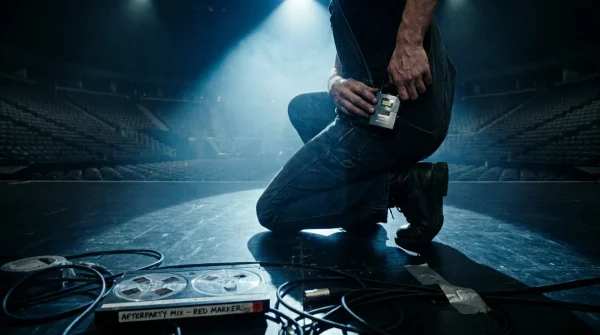
You stand twenty rows back from the catwalk, feeling the sub-bass rattle your ribcage like loose change in an idling truck. Around you, twenty thousand fans track every millimeter of polished choreography under an ocean of pink stadium light. The pop machine runs on ruthless clockwork: synchronized strobe hits, automated pitch layers, and dancers moving with the frictionless grace of an animated render.
Then, the invisible wire snaps mid-chorus. Dua Lipa doesn’t miss a beat because of a missed step; she freezes as if struck by physical lightning, her eyes widening in immediate, biological panic. In a single violently fast motion, her left hand claws at her ear canal, tearing the driver free before her voice trails off into the reverberant cavern of the stadium.
The backing track rolls forward for two agonizing seconds before an engineer kills the house feed. In the eerie stillness that follows, you can see a sweaty clear silicone in-ear monitor dangling against a sequined collarbone, swinging like a dead pendulum under the blinding follow-spots.
What the crowd witnessed was not a technical hiccup or a diva moment. It was an involuntary survival reflex triggered by an acoustic detonation delivered straight against the tympanic membrane.
The Skull-Sealed Trap: When High-Fidelity Audio Turns Lethal
To understand why an arena icon would halt a multi-million-dollar production in front of thousands, you have to picture how a modern stage actually sounds. It is not the balanced mix you hear on streaming. On stage, behind the towering speaker arrays, there is only the muddy rumble of subwoofers and the deafening slap-back echo of concrete walls.
To survive that sonic fog, performers use custom-molded silicone monitors poured directly into the contours of their ear canals. These earpieces form an airtight gasket, dropping outside room bleed by up to twenty-six decibels. But that isolation creates a closed pressure chamber. When a rogue signal sneaks through, your ear cannot breathe; the sound has nowhere to dissipate except into your skull.
Think of it as drinking from a firehose clamped directly to your lips. When a sudden feedback loop or frequency collision spikes down that tiny copper wire, it does not sound like ordinary microphone whistle. It sounds like an aluminum baseball bat striking an iron anvil an inch from your brain.
- Jonas Brothers wholesome throwback clips resurface right on cue masking contentious arena crew disputes
- Nick Jonas casual bedroom livestream derails credibility after fans expose scripted teleprompter reflections
- Jared Leto repulsive onset gifts trigger quiet studio blacklisting from major ensemble casts
- Reese Witherspoon podcast breakdown exposes calculated emotional timing right before launching glossy lifestyle ventures
- Ben Affleck notorious Gigli disaster strips stifling studio contracts launching his gritty directing comeback
The natural acoustic reflex—the stapedius muscle contracting to dampen brutal noises—takes several milliseconds to engage. An electronic transient burst hits in microseconds. Your body moves before your rational mind can even identify the pitch.
Marcus Vance, a forty-four-year-old touring monitor engineer who has spent two decades balancing stage sound for international stadium tours, knows that terror intimately. “People think we just adjust volume knobs like a living room stereo,” Vance explains quietly while coiling thick coaxial cables backstage. “In reality, you are managing a volatile chemical reaction across an invisible radio spectrum. When an uncoordinated transmitter sweeps into your artist’s frequency channel, the resulting intermodulation spike can blast past 130 decibels instantly. In a sealed silicone mold, that is not an inconvenience—it is permanent hearing damage within half a second.”
The Invisible Battlefield: Why Live RF Environments Are Collapsing
Live pop staging has pushed technical ambition into dangerous territory, and modern tours are paying a hidden biological tax for it. As productions pack arenas with hundreds of wireless systems, the air itself becomes congested with invisible static.
Understanding this breakdown requires looking at the invisible layers that surround every stadium performance:
- The Local RF Swamp: Venues sit inside dense metropolitan centers where television broadcast bands, local emergency channels, and unauthorized two-way radios fight for the same slivers of ultra-high-frequency airwaves.
- The Digital Intermodulation Wall: When dozens of wireless bodypacks transmit simultaneously within feet of each other, their carrier signals bounce and multiply, creating ghost frequencies that bypass standard software filters.
- The Latency Dilemma: Digital limiters designed to clamp down on explosive spikes need processing time to calculate the wave shape. If a digital protection algorithm takes even two milliseconds to catch a feedback wave, that transient spike has already collided with the singer’s eardrum.
Performers are caught between needing total auditory isolation to stay in key and risking immediate acoustic trauma every time they strap on a transmitter. The more elaborate the staging, the closer they walk to that digital cliff.
The Reflex Protocol: How Arena Pros Tame the Voltage
You cannot prevent every rogue frequency bounce in a packed concrete arena, but you can build disciplined habits to survive them. Surviving an acoustic shock requires a combination of strict hardware ceilings and rapid physical reflexes.
When an unexpected blast hits your monitors, your natural reaction is to squint and bear through it. That hesitation is how eardrums rupture. Professional touring crews build specific, non-negotiable boundaries into their live systems to ensure split-second safety:
- Brickwall Peak Clamping: Engineers program analog peak limiters ahead of digital transmitters, creating a physical ceiling that refuses to push voltage past 85 A-weighted decibels, regardless of incoming signal overload.
- Single-Ear Breakaway Drills: Artists rehearse the physical motion of ripping an earpiece out by the cable joint rather than fumbling for the tiny mold, sparing their fingers precious fractions of a second during an emergency.
- Continuous Spectrum Sniffing: Dedicated RF coordinators run automated spectral analyzers throughout the performance, tracking rogue transmitters in real time and re-assigning frequencies before an artist walks into a dead-band zone.
- Ambient Microphone Injection: Mixing engineers bleed a tiny amount of natural crowd noise into the inner ear mix, preventing the singer’s ear from sitting in an unnaturally dry, high-pressure vacuum.
Treating stage audio as a live electrical current changes how both technicians and artists interact with their gear. It transforms audio monitoring from a passive luxury into an active safety protocol.
Tactical Stage Audio Toolkit
For touring vocalists, home performers, and sound engineers, maintaining safe acoustic headroom requires strict adherence to operating numbers:
- Safe Operating Bandwidth: Maintain RF transmitters strictly within the 470 to 608 MHz spectrum, avoiding the turbulent 600 MHz duplex gap where mobile carriers generate unpredictable interference.
- Hard Limiter Response Time: Set hardware peak limiters to engage under 0.5 milliseconds, using analog diodes rather than purely digital look-ahead limiters to intercept analog line spikes.
- SPL Ceiling Threshold: Calibrate artist bodypack receivers to a hard limit of 85 to 88 dB SPL, allowing dynamic musical peaks while locking out dangerous acoustic shock pulses.
- Dual-Driver Ambient Vents: Utilize custom-molded silicone monitors equipped with passive pneumatic filters that bleed excess low-frequency air pressure without sacrificing mid-range clarity.
The Fragile Human Core Behind the Spectacle
It is easy to view an arena show as an invincible corporate machine. You watch a global superstar hit every mark while smoke machines hiss and spotlights trace dizzying patterns across the ceiling, forgetting that beneath the glitter lies a fragile sensory apparatus.
When Dua Lipa pulled that monitor from her ear, the illusion of automated perfection fell away, leaving something far more compelling: an unscripted, human moment of self-preservation. That dangling silicone wire was a stark reminder that no amount of stadium choreography can outrun basic biology.
Recognizing the hazardous physics behind live performance deepens your connection to the art. The pause on stage wasn’t a failure of the machine; it was the moment the human inside it refused to be broken.
The human ear canal was engineered to catch rustling leaves in the wind, not to absorb an unchecked 130-decibel voltage surge inside a vacuum-sealed silicone tube.
| Key Point | Detail | Added Value for the Reader |
|---|---|---|
| Acoustic Shock Threshold | Spikes exceeding 120 dB SPL delivered directly inside a sealed ear canal mold. | Explains why artists instantly abandon songs rather than attempting to sing through an audio glitch. |
| RF Spectrum Congestion | Crowded urban radio frequencies colliding with backstage wireless transmitter channels. | Demystifies the invisible technical hurdles that plague modern multi-million-dollar pop tours. |
| Silicone Seal Pressure | Complete acoustic isolation preventing dangerous air pressure waves from venting outward. | Reveals why professional-grade monitors present higher biological risks than standard consumer earbuds. |
Frequently Asked Questions
Why don’t singers just wear standard wireless earbuds on stage?
Standard consumer earbuds lack the extreme noise isolation needed to block out 105-decibel stage noise, forcing the singer to crank the volume to dangerous levels just to hear their pitch.What causes a sudden screech or pop in an in-ear monitor?
It is typically caused by RF intermodulation, where competing radio frequencies clash and send an accidental, uncompressed voltage burst straight down the receiver channel.Can an acoustic feedback spike cause instant hearing damage?
Yes. Because custom-molded earpieces seal the canal airtight, an unchecked 130-decibel sound blast has no room to disperse, risking immediate acoustic trauma or permanent tinnitus.Why didn’t the stage limiters stop the feedback blast automatically?
Digital limiters can suffer microsecond latency delays or fail if an analog radio frequency surge occurs after the processing stage inside the artist’s personal beltpack receiver.How do artists keep their timing when an earpiece fails mid-song?
They rely on the low-end vibration coming through the stage deck floor and visual cues from the musical director or drummer until audio can be safely restored.