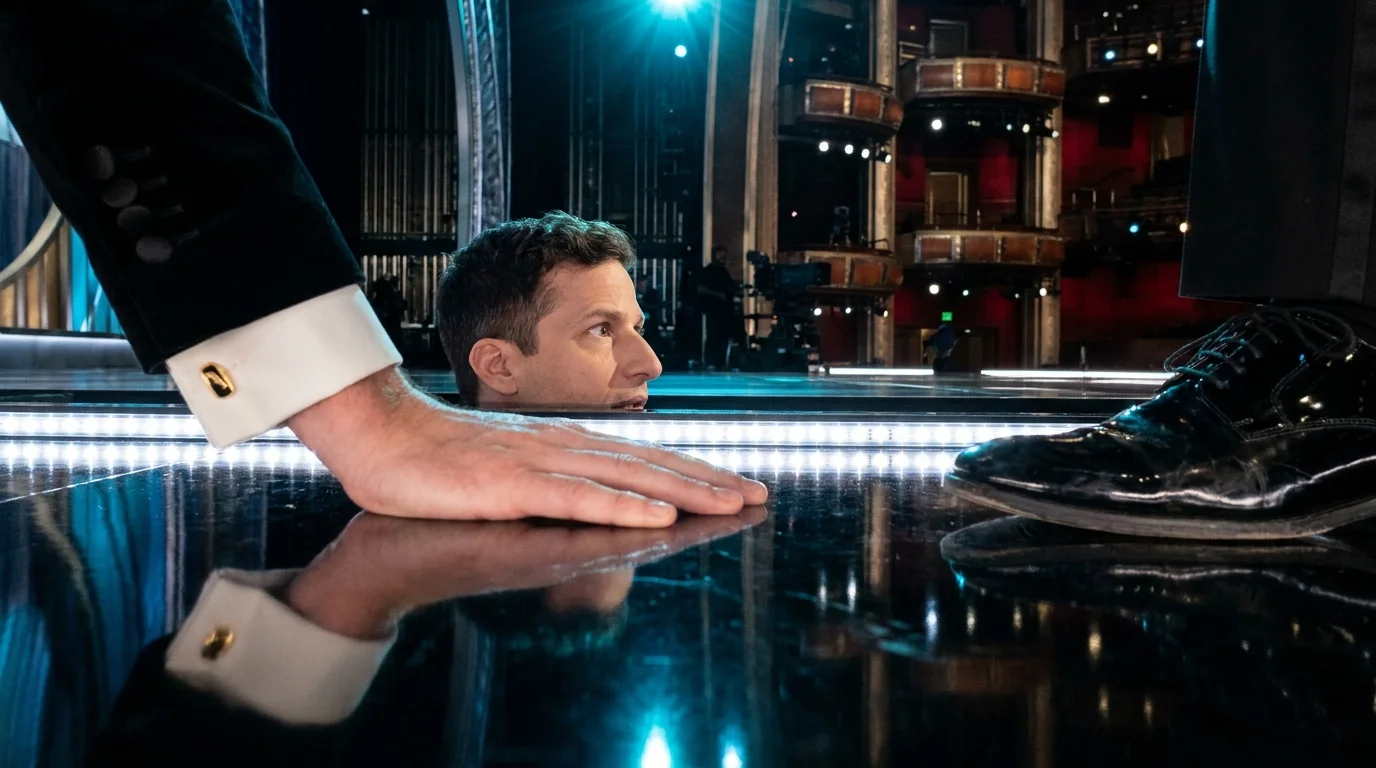
The studio floor at 8:42 PM smells faintly of warm dust, ozone from overheated broadcast rigs, and the damp wool of three hundred tuxedos pressed together under four thousand watts of tungsten. You know the polished calm of a live awards telecast: the seamless cutaway, the rhythmic chuckle of the audience, the effortless slide from commercial break back into the banter of a host whose entire persona is built on manic charm. Everything feels casual because millions of dollars in engineering ensure that spontaneity remains strictly within safety margins.
Then, the glass pane directly below camera three goes pitch black. It does not flicker or stutter; it simply dies into an obsidian mirror reflecting the host’s own startled eyes back at him. In the control booth perched three stories above the soundstage, the steady drone of the technical director’s cadence flatlines into a sharp intake of breath. In that single, unpadded second, the polished machinery of prime-time television evaporates, leaving an empty room holding its breath.
For Andy Samberg, a seasoned performer whose entire career was forged in the frenetic, live-wire crucible of Studio 8H, an unscripted void usually represents home turf. Yet in this specific second, you watch a subtle, physical shift take place behind his eyes: the micro-tightening of the jaw, the deliberate stillness of his hands, and the microscopic pause where instinctive comedic rebellion collides with an invisible wall of corporate broadcast compliance.
The Anatomy of the Uncued Monitor Deadlock
We tend to view live television as a conversation, but it functions far more like a high-speed rail line. The host is not speaking to the room; they are vocalizing a continuous, rolling ribbon of vetted legal text, timed down to the half-beat to protect network clearances, advertiser sensitivities, and broadcast standards. When a teleprompter screen locks up, the illusion of casual banter shatters instantly. You are suddenly forced to confront the actual balance of power between the artist on the floor and the legal apparatus whispering through their earpiece.
When that screen failed, Samberg faced a dilemma familiar to anyone who works in tightly controlled environments: do you fill the silence with the unfiltered chaos that made you famous, or do you stand down and wait for corporate permission? The booth wanted him to buy time without saying anything actionable. He wanted to acknowledge the absurdity of four million people watching a grown man stare at a dead piece of glass. It was a standoff conducted entirely through body language, played out in real time against the ticking clock of a network transmission delay.
- Zoe Saldana cable rig suspension stunts trigger brutal spinal compression strain
- David Fincher rejects biometric test screening data to protect bleak thriller ending
- Kate Winslet blocks digital skin smoothing enforcing brutal macro lens closeups
- Sabrina Carpenter halts stadium performance after piercing monitor feedback spike threatens hearing
- Sally Field resurfaced vintage talk show tape completely reverses Oscar backlash narratives
Veterans of the control room know that dead air is considered worse than a technical blunder, but rogue ad-libbing terrifies executives even more. A single off-color riff or an unvetted political observation can trigger instant fines, advertiser pullbacks, and weeks of damage control. When the screen died, Samberg chose neither panic nor mindless filler; he weaponized the pause, using deadpan theatrical silence as an overt commentary on the very machinery that had just abandoned him.
Elena Vance, a forty-four-year-old live broadcast engineer who spent fifteen years managing cue lines for major network ceremonies, remembers the sheer panic of that evening. “When that scroll cuts out, the director’s track goes wild,” she says. “You have five different voices screaming conflicting protocols into the host’s IFB earpiece. Standards wants him to stick to pre-approved standby cards, while the executive producer screams for him to just say something funny. The host is standing in the crossfire of two opposing corporate survival instincts.”
The Friction Between Spontaneity and Broadcast Liability
To understand why this moment captivated millions of live viewers, you have to dissect the invisible boundaries that govern high-stakes entertainment. The tension did not stem from an actor forgetting a line; it came from the audience watching an artist actively calculate risk on a live stage. Every second of silence felt heavy, electric, and strangely honest in an ecosystem defined by pre-chewed content.
This friction reveals itself across distinct tiers of production, each carrying its own unspoken set of rules:
The Corporate Firewall: Network executives view dead air through the lens of liability. Every unvetted syllable uttered on an open microphone presents an opening for sponsor complaints or regulatory scrutiny. For them, a motionless host staring straight ahead is vastly preferable to an unpredictable performer breaking format to mock the network.
The Performer’s Predicament: A host lives or dies by audience goodwill. To freeze completely looks amateurish, but to ad-lib recklessly risks professional alienation from the studios financing their next multi-million-dollar project. Navigating this narrow boundary requires an almost superhuman calibration of tone, irony, and physical control.
The Audience Instinct: Viewers possess an uncanny ability to detect when the script has evaporated. The sudden posture change, the slight tilt of the head to hear an ear monitor over studio laughter—these micro-signals pull viewers out of passive consumption and drop them directly into the tension of an unscripted human moment.
Handling High-Stakes System Failures with Comedic Restraint
What Samberg demonstrated on that stage offers a masterclass in how to manage catastrophe when your primary support system vanishes. Rather than scrambling to disguise the failure with breathless chatter, he allowed the awkwardness to breathe. He made the silence the joke, holding the audience captive until the technicians upstream could regain their footing.
- Hold your physical baseline: When tools fail, resist the urge to fill the void with frantic motion; grounding your posture signals total command of the room even when you have no idea what comes next.
- Acknowledge the breakdown without blaming the crew: Direct, dry eye contact with the camera communicates the reality of the situation without humiliating the technical operators working behind the scenes.
- Listen past the panic: In high-stress breakdowns, multiple stakeholders will shout conflicting instructions; pick the single most authoritative voice in your feed and mute out the background static.
- Convert dead space into intentional tempo: A prolonged pause reads as incompetence only if you look nervous; if you wear it like an intentional artistic choice, the audience will assume you are orchestrating the tension.
The tactical toolkit in these situations relies on three concrete metrics: a strict ten-second survival buffer to evaluate the scope of the outage, a pre-memorized reset sentence designed to hand control cleanly to a commercial break, and an absolute refusal to let panic alter vocal pitch or breathing cadence.
The Power of the Unvarnished Moment
We spend our daily lives navigating heavily curated narratives, from polished social feeds to corporate meetings that feel rehearsed down to the punctuation. That is precisely why a breakdown of this magnitude resonates far beyond entertainment gossip. When the monitor went dark, the audience was gifted something genuinely rare: an unvarnished glimpse of human presence piercing through the cellophane of network television.
Watching an entertainer calmly hold ground against a wall of institutional panic reminds us of the power of composure. You do not always need to supply the missing script. Sometimes, the most powerful and authentic thing you can do is stand still, look the malfunction directly in the face, and let the silence reveal just how absurd the machine really is.
The sharpest performers never run from dead air; they use the silence to remind the control booth who actually commands the room.
| Key Point | Detail | Added Value for the Reader |
|---|---|---|
| The Prompt Blackout | Monitor signal failed instantly during a high-stakes prime-time segment. | Reveals the extreme technical fragility hidden beneath polished award productions. |
| Control Room Conflict | Legal compliance clashed with the imperative to generate live comedic filler. | Shows how corporate liability limits an artist’s freedom during unscripted crises. |
| Strategic Stillness | The host refused to panic, using deadpan silence instead of frantic ad-libs. | Provides a clear blueprint for maintaining authority when professional tools collapse. |
Frequently Asked Questions
Why do live broadcast teleprompters freeze?
They usually lock up due to software lag, manual scroll-operator disconnects, or signal routing issues between mobile control trucks and floor monitors.Can network hosts say whatever they want if the prompter goes down?
No, hosts are strictly bounded by network standards and practices, with broadcast delays ready to dump audio if guidelines are violated.How do showrunners communicate with hosts during a blackout?
Directors speak directly into the host’s custom-molded in-ear monitors (IFBs), often providing emergency lines or cueing an immediate commercial break.Did the live audience realize the monitor had failed?
The in-house crowd usually senses a disruption within seconds due to abrupt shifts in the host’s cadence and physical posture toward floor managers.What makes a prompter freeze so dangerous for producers?
It invites dead air, which triggers rapid channel flipping, while threatening multi-million-dollar commercial run times scheduled down to the exact second.