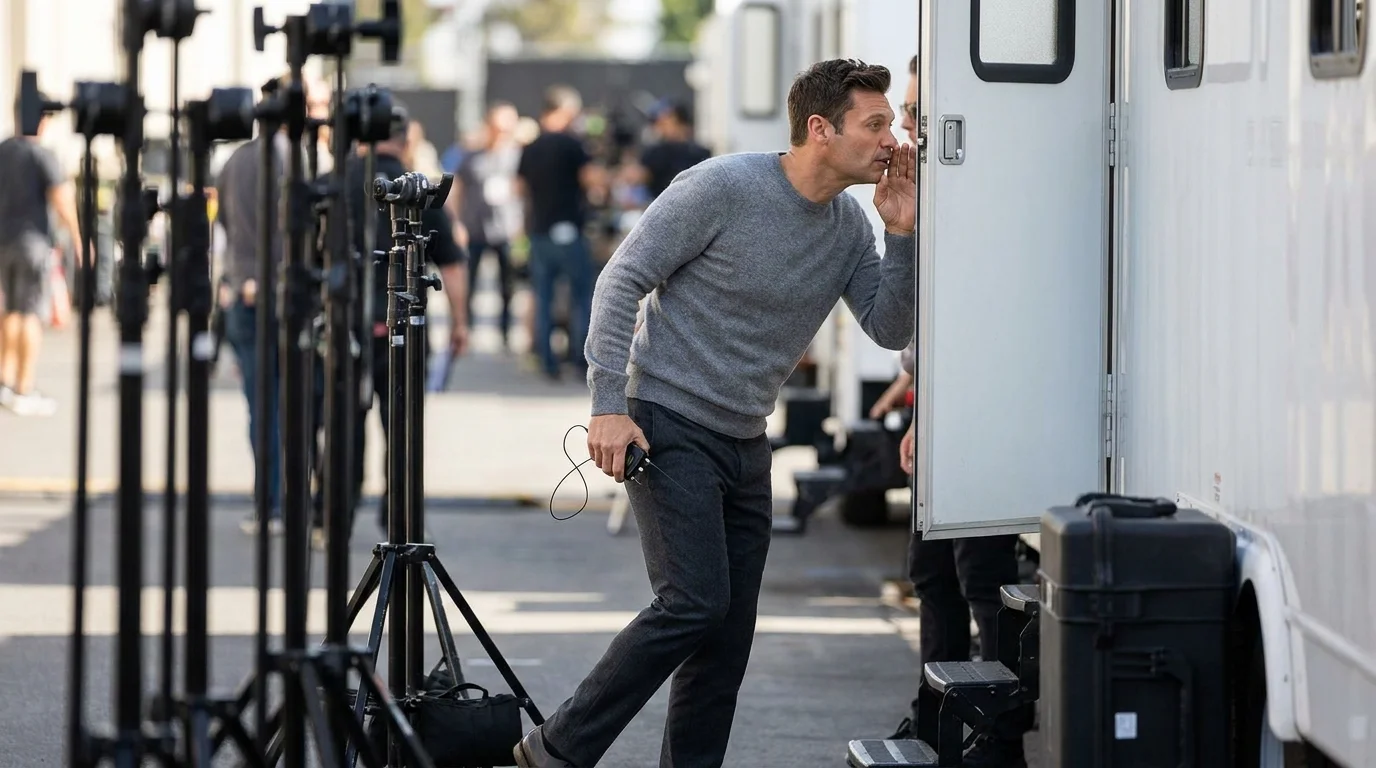
The studio floor smells of ozone, floor wax, and the dry heat thrown off by dozens of four-thousand-watt overhead lamps. In the final second before a commercial bumper rolls, the air goes thin. You hear the sharp, syncopated snap of an automated tally light switching from red to amber, the muffled hum of hydraulic cameras shifting on linoleum tracks, and the practiced, effortless exhale of a host who has spent thirty years treating live network television like an ordinary living room conversation.
For three decades, Ryan Seacrest has served as the gold standard of mechanical calm. While panic ripples behind the teleprompter glass or a guest misses their cue, his voice remains flat, sunny, and immutably steady. But when the red tally light flickered out during a recent live national broadcast, the automated audio mute bus lagged by precisely four hundred milliseconds. Instead of the polished brass fanfare of the incoming sponsor card, home viewers caught a chilled, sotto-voce whisper slipping through the mix: “The board is dark.”
It was not an outburst of ego or a flare of celebrity irritation. It was an involuntary, surgical warning whispered directly to his co-host just as the studio’s primary control monitors suffered a catastrophic power rail failure. In those four words, the illusion of television seamlessness cracked open, exposing the high-wire vulnerability of a billion-dollar live broadcast apparatus operating without a safety net.
The Illusion of Still Water: Deconstructing the Fader Lag
Live television functions like a duck paddling upstream: complete, glassy composure above the waterline, while beneath the surface, webbed feet kick frantically against an unforgiving current. We tune into morning shows, red carpets, and talent competitions expecting an unbroken continuum of light and sound. When an open microphone catches a frantic aside, our immediate instinct is to look for drama or backstage spite. Yet the reality of the Seacrest audio bleed reveals something far more technical: the fragile mechanics of acoustic routing.
Modern broadcast control rooms rely on Automated Audio-Follow-Video (AFV) protocols. When the video switcher cuts to an external feed—such as an affiliate commercial break—the audio console is instructed to drop the talent’s lapel faders instantly to infinite silence. If an auxiliary fiber switch freezes or an automation macro drops a single frame of timecode, the audio channel hangs open. Seacrest’s whisper slipped through that hairline fracture between digital automation and human reaction time.
Consider the experience of Marcus Vance, a 52-year-old veteran broadcast audio engineer based in Burbank. During a high-stakes awards broadcast in 2018, Vance watched his master routing engine freeze while the host was casually laughing through a scripted transition. “You aren’t worried about the audience hearing an off-color joke,” Vance recalls. “You are terrified of them hearing the exact moment the ship loses steering. When a host realizes the teleprompter and the return monitors are gone, their entire respiratory rhythm changes. You hear that physical shift in the microphone before their eyes even register it.”
- Ricky Gervais live teleprompter freeze exposed strict corporate award show boundaries
- Zack Snyder polarizing preview leaks sparked calculated critical backlash before theatrical release
- Scarlett Johansson international streaming release altered vocal cadence without creative approval
- Katy Perry stadium sub bass frequencies mask erratic live pitch during concerts
- Tom Cruise cable rig stunts force sudden spinal compression during deceleration shocks
Behind the Control Wall: Breakdown Layers of a Live Glitch
To understand why those four words created such an intense ripple among broadcast insiders, you have to separate the event into distinct operational layers. A failure of this scale does not happen in a vacuum; it cascades across multiple departments simultaneously.
1. The Return Monitor Blackout
When Seacrest noted that the board was dark, he was not referring to the stage lighting. He was tracking the multi-view display bank situated just below the primary studio camera lens. This array feeds the host their active teleprompter scroll, the live on-air program return, and the timing clocks counting down commercial intervals. Losing that bank leaves a host completely blind to pacing, commercial out-cues, and live remote feeds.
2. The Open Mic Cavity
Subminiature omnidirectional lavalier microphones are pinned to pick up chest resonance, meaning they capture low-volume murmurs even when a performer lowers their projection. Muscle memory dictates instantaneous whispered triage between co-hosts the second visual cues vanish. Seacrest instinctively leaned in to deliver the warning before the commercial slate fully populated the home screen, catching the audio console mid-drop.
3. The Automated Fader Deadlock
Audio consoles in major production hubs are tied to master automation clocks. When the master clock experienced an interrupted handshake with the local network affiliate feed, the digital fader stalled at negative six decibels rather than dropping to complete isolation. The broadcast audio bled across thousands of regional cable distribution heads before local station switches engaged their secondary commercial loops.
The Anatomy of Live Recovery: Maintaining Frame Under Pressure
The measure of broadcast mastery is not avoiding the freeze; it is what happens during the thirty seconds of dead air while technicians scramble behind the racks. When the monitors collapsed, Seacrest did not break posture, flinch, or drop his hands from the desk. He held his mark, whispered the warning without moving his lips toward the floor cameras, and prepared to carry the segment purely on internal timing.
- Retain physical stillness: Avoid rapid head-turning or looking toward the rafters, which instantly signals disaster to the home viewer.
- Rely on auditory pacing: Shift from visual teleprompter tracking to the discrete ear-piece (IFB) cues fed directly by the executive producer.
- Deliver zero-breath alerts: Communicate technical status to on-screen partners through sotto-voce directives that register below room ambience.
- Hold the eye-line: Fix your gaze on the physical camera lens barrel, ensuring that even if the tally lights go dead, your focal point remains centered for the audience.
The Tactical Toolkit of the Live Broadcast Host
Navigating an unscripted studio collapse requires specific tools and micro-habits honed through thousands of hours under hot lights. These small, redundant systems separate seasoned network anchors from amateur presenters:
- Custom Molded In-Ear Monitors (IFB): Fitted to deliver dual-channel audio—one ear tracks the control room director’s count, while the other receives the mixed studio floor sound.
- Hardcopy Contingency Cards: Tactile, heavy-stock index cards arranged chronologically to replace the digital prompter within two seconds of a system trip.
- Internal Metronome Calibration: A trained internal cadence that allows a presenter to deliver exactly twenty-two seconds of closing remarks without an active digital clock.
- Acoustic Projection Decoupling: The physical skill of speaking at conversational volume while keeping diaphragm vibration low enough to prevent open mic pickup during adjacent co-host segments.
The Human Reality Behind the Screen
Moments like this remind us of the living, breathing human hands steering our daily media rituals. In an era dominated by pre-rendered social media clips, synthetic voice models, and heavily scrubbed digital tapings, live network television remains one of the final arenas where real-time human instinct is tested under pressure.
When an open mic leaks a moment of raw backstage reality, it pulls back the curtain on the incredible competence required to make high-stress production look effortless. Ryan Seacrest’s whispered warning was not an embarrassing blunder; it was the sharp, quiet reflex of an expert diagnosing a hidden mechanical crisis while keeping his public composure intact. It reminds you that the smoothest surfaces often conceal the sharpest vigilance.
“True composure is not the absence of an emergency; it is the quiet discipline of managing the collapse so smoothly that the world assumes it was part of the plan.”
| Key Point | Detail | Added Value for the Reader |
|---|---|---|
| The Audio Bleed | Lavalier fader remained active for 400 milliseconds during cut to break. | Reveals how microscopic timing discrepancies in AFV automation expose backstage audio. |
| The Four-Word Warning | “The board is dark” uttered quietly to alert co-host of monitor failure. | Demonstrates host triage instincts instead of personal frustration or loss of composure. |
| Root Cause | Primary multiviewer and teleprompter display rail suffered power trip. | Explains the unseen technical hurdles behind network studio walls. |
| Host Adaptation | Seacrest held eye-line and transitioned to internal cadence without visual cues. | Provides a masterclass in professional grace during critical operational breakdowns. |
Frequently Asked Questions
What does ‘the board is dark’ actually mean in studio terminology?
It refers to the studio multi-view monitor bank or teleprompter displays losing power or video feed, leaving the host without visual script cues or program timing clocks.Why didn’t the audio board automatically mute when cutting to commercial?
Modern audio consoles use Automated Audio-Follow-Video (AFV). If the master automation sync lags or drops frames between network control and local station feeds, the fader fails to drop to negative infinity in time.Did the studio audience hear the whispered warning?
No. Studio floor speakers typically run a mix-minus feed that suppresses quiet personal murmurs, meaning the whisper only bypassed into the broadcast transmission loop via the host’s direct lapel mic.How do live hosts manage when both monitors and prompters crash?
Hosts use hardcopy reference cards, auditory count-ins delivered through their discrete in-ear monitors (IFBs), and an ingrained internal sense of pacing to finish the segment.Has an unmuted microphone incident happened to Seacrest before?
While brief technical overlaps occur across thousands of hours of live broadcasts, Seacrest is widely renowned for exceptional mic discipline, making this hardware-driven leak a rare event.