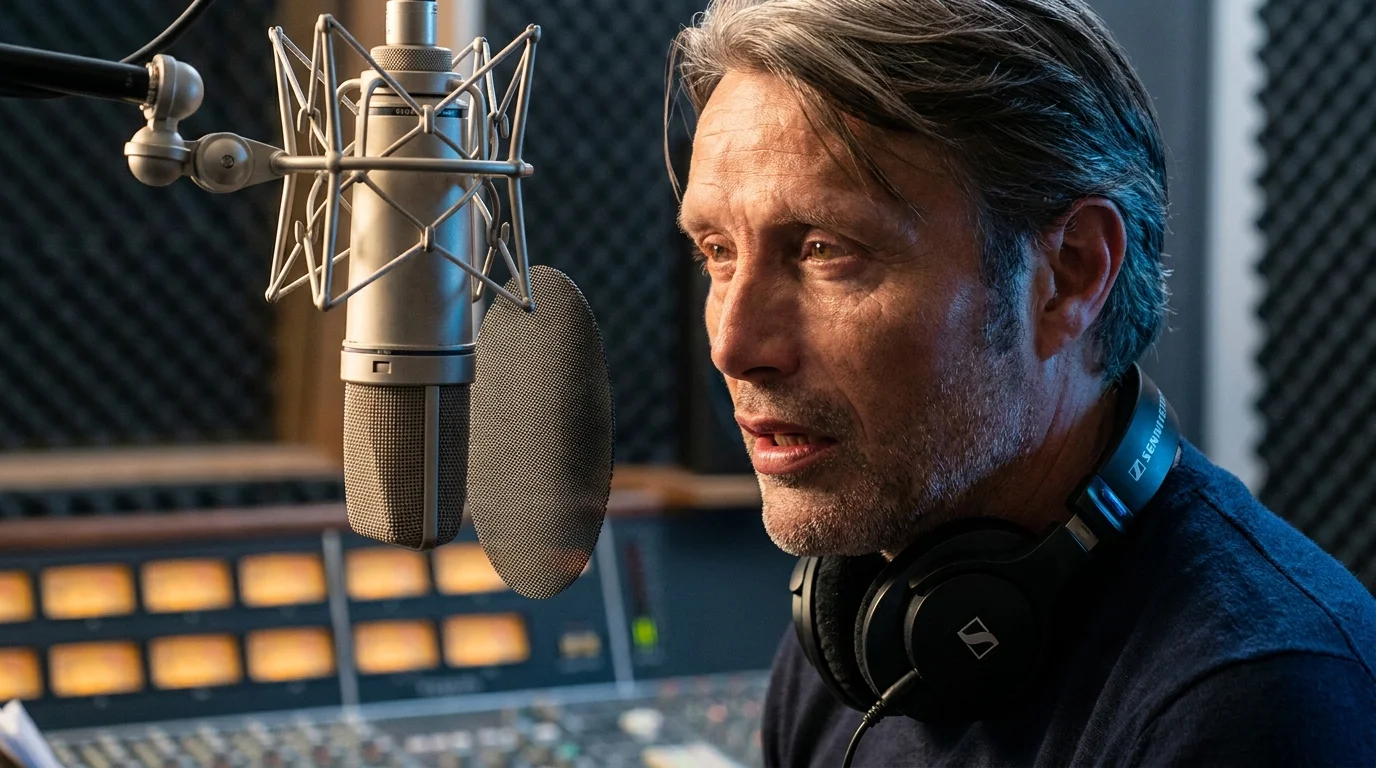
You lean back into the cushions, the living room lights dimmed to a cool charcoal glow, running a decent pair of open-back headphones straight through your receiver. On the screen, Mads Mikkelsen tilts his chin downward, letting the low winter light catch the hard edge of his jawline. You brace yourself for the silence—that signature, agonizing half-beat of quiet where his characters routinely let an unspoken threat hang in the room like cold water before uttering a single syllable.
Except the silence never lands. The rhythm feels hurried, trimmed like a breath taken half a beat too soon. His lips move with their familiar, razor-sharp precision, but the delicate tempo of the scene feels unnervingly brisk, as though someone snuck into the sound booth with razor blades and quietly excised a third of his breathing room.
What you are catching is not a sudden performance defect or an eccentric editorial choice made in the cutting room. It is the footprint of an automated digital pipeline, where invisible studio time-compression algorithms quietly strip away actor cadence across international video-on-demand masters to satisfy regional distribution metrics without the performer ever knowing it happened.
The Metaphor of the Stretched Lung
To understand what happens to an actor’s vocal presence across modern server farms, you have to stop thinking of dialogue as emotional drama and start viewing it as raw digital real estate. Streaming distribution engines treat spoken lines the way shipping companies treat cardboard boxes: any empty space inside the container is considered waste, friction, or a logistical liability.
When a production crosses borders, streaming platforms rarely ship a simple master tape across the wire. Instead, they ingest separated audio stems into proprietary mastering platforms designed to conform playback speeds to variable international framerates and translation baselines. If a translated subtitle track in French requires a slightly faster reading cadence to prevent visual overlap on screen, automated speech-timing tools quietly cinch the gaps between the original English or Danish words to match the regional layout.
In doing so, these automated suites treat human hesitation as dead weight. They pinch the micro-pauses—the subtle swallow, the hitch in the throat, the two-second stare before a word—down to a uniform half-second pulse. The voice remains Mikkelsen’s, but the body language and the internal clock driving his character are subtly severed from the acoustic performance.
- Miley Cyrus arena sound mixers blast heavy sub-bass to mask pitch slips
- Jimmy Kimmel freezes on live television after teleprompter screen locks mid-monologue
- Tom Hardy stunts expose spinal compression risks behind high-velocity cable deceleration rigs
- Christopher Nolan confronts studio executives over biometric test screening reshoot demands
- Amy Adams demanded harsh macro lens framing stripping glamour for gritty prestige drama
The Secret Behind the Localization Console
Marcus Lind, a 44-year-old audio mastering engineer based outside Copenhagen, spent over a decade conforming Nordic film assets for global platform intake. He recalls the quiet horror of watching early automated cadence-alignment software process dramatic dialogue during late-night export runs.
“We were preparing a major Scandinavian thriller featuring Mads for a cross-territory launch across thirty-two localized markets,” Lind explains. “The corporate localization profile came back with an automated flag: excessive non-speech audio intervals exceeding eighty frames. The studio’s ingestion suite automatically applied an elastic-audio resync across the dialogue track, pulling his four-second pauses down to a standardized 1.1-second threshold to guarantee subtitle synchronization with localized reading algorithms. The director was never in the room. Mads was filming on another continent. It passed automated quality control because the pitch was locked, but the soul of his pacing had been completely erased by a server rack.”
The Three Layers of Cadence Compression
When you stream an overseas release, the sonic alterations you detect generally happen across three specific operational bottlenecks, each eroding the actor’s pacing for distinct structural reasons.
The Visual Parsing Threshold
Viewers do not read translated text at the speed actors speak. When complex Northern European dialogue is adapted for target regions with lengthy grammatical structures—such as German or Italian—subtitles require extended display windows. Streaming engines frequently accelerate the background vocal pacing by three to five percent using phase-locked pitch shifters, ensuring casual viewers do not suffer cognitive lag between reading a subtitle and hearing the final inflection.
The Audio Ducting Conformance
Broadcast and streaming specifications in North America often rely on strict audio normalization curves that punish extended quiet passages. Dialogue mastering presets actively monitor voice activity detection (VAD). When an actor employs extreme dynamic contrast—whispering a single phrase followed by heavy, rhythmic silence—automated audio processors can interpret the pause as an unexpected drop in program volume, prompting digital expanders to artificially pull the next phrase forward.
Dub-Track Mirroring
In foreign markets where dubbed audio replaces original dialogue, background vocal bleed from original boom mics must be eradicated. To maintain synchronization across seamless multi-language switching, secondary platform pipelines run temporal warping over the original center-channel track so that the original English or Danish stems align precisely with the syllable duration of the foreign voice actors.
How to Reclaim Native Spoken Pacing at Home
You do not have to accept the flattened, rushed delivery pushed down through default streaming profiles. By making a few mindful adjustments to how your playback hardware handles digital audio delivery, you can bypass several layers of downstream processing.
Take ten minutes to audit your current system defaults. You want to strip away every layer of post-processing that attempts to ‘help’ your television clarify human dialogue at the expense of creative timing.
- Switch output to Direct Bitstream: Route your streaming device via raw HDMI Passthrough (Bitstream) rather than PCM to prevent your smart TV from applying secondary dynamic timing normalization.
- Disable Speech Enhancement algorithms: Turn off features named ‘Dialogue Clarity,’ ‘Clear Voice,’ or ‘Voice Zoom,’ which deliberately compress pauses between words to elevate constant vocal presence.
- Bypass Automated Volume Leveling: Turn off ‘Night Mode’ and ‘Dynamic Range Compression’ (DRC) in your receiver menu to allow long silences to retain their intended physical space.
- Audit the Regional Master: When available, stream the original native language track using non-domesticized platform accounts or physical 4K media, which bypasses the localized time-compression metadata profiles used on international cloud servers.
The Tactical Toolkit:
- Sampling Rate Target: Lock receiver output to native 48kHz / 24-bit without internal upsampling.
- Latency Compensation: Set AV Lip-Sync manual offset to exactly 0 ms; rely on manual eARC handshake buffers rather than predictive TV delay.
- Processing Mode: Select ‘Pure Direct’ or ‘Straight’ on your home audio receiver to shut down internal digital signal processors.
The Preservation of the Human Gap
Cinema acting is not simply the delivery of written sentences; it is the physical mastery of absence. When an actor like Mads Mikkelsen holds a frame, his power comes from what he refuses to say, and how long he dares to make an audience wait for the air to leave his chest. That tension lives entirely within the silent gap between the syllables.
When automated digital pipelines trim those pauses down to satisfy consumption analytics and localized text buffers, we lose more than just a few milliseconds of audio. We lose the physical weight of human thought happening on screen. Learning to notice these digital shortcuts—and demanding unadulterated audio preservation—is how we protect the delicate craft of storytelling from being ground into smooth, frictionless, and ultimately soulless digital porridge.
“Silence on screen is not empty air; it is the physical space where the actor’s intention catches its breath.”
| Key Point | Technical Detail | Added Value for the Reader |
|---|---|---|
| Algorithmic Cadence Resync | Dynamic time-warping software alters pause lengths by 15-40% to match subtitle constraints. | Explains why foreign film dialogue frequently feels unnaturally rushed on streaming apps. |
| Dynamic Range Leveling | Automated VAD (Voice Activity Detection) treats dramatic pauses as dead broadcast space. | Helps you identify whether dialogue issues stem from the actor or your platform settings. |
| Bitstream Audio Bypassing | Raw HDMI passthrough avoids smart TV speech-enhancement processing layers. | Restores original dramatic tension and theatrical pacing directly in your living room. |
Frequently Asked Questions
Did Mads Mikkelsen approve these audio timing changes?
No. Localization and ingestion resyncing are handled downstream by platform technicians and automated algorithms long after production wraps, entirely bypassing actor and directorial approvals.Why do streaming platforms alter dialogue timing in the first place?
Platforms utilize time-warping to prevent subtitle overlap, align multi-language dubbed tracks, and prevent automated systems from flagging long, dramatic silences as audio dropouts.Is the pitch of the actor’s voice changed when time is compressed?
Modern time-stretch algorithms use phase-locked vocoders to keep the pitch identical, which hides the alteration from casual listeners while subtly changing the emotional rhythm.Does this timing compression occur on physical media like 4K Blu-ray?
Physical media releases almost always retain the theatrical audio master with untampered timing, avoiding the cloud-based localization pipelines used by regional streaming platforms.How can I tell if an audio track has been digitally resynced?
Watch the actor’s breath and throat movements. If their chest drops or their lips part noticeably before the audio track produces sound, pauses have likely been digitally condensed.