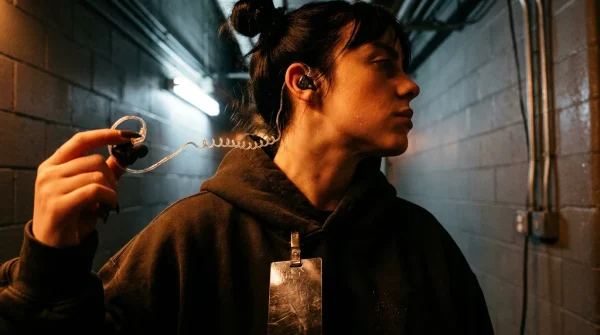
The air inside a packed sixty-thousand-seat arena carries its own weather system. It is a humid mixture of theatrical haze, spilled seltzer, and the electric warmth generated by thousands of bodies moving in unison. When Dua Lipa hit the soaring crest of her third-act chorus, the sensory engine seemed indestructible. Bass pulses vibrated through the steel risers beneath the floorboards, lasers carved violet corridors through the rafters, and the performance felt as steady as a luxury locomotive on a straight track.
Then, the invisible architecture snapped. A piercing, parasitic shriek ripped through the artist mix at an ear-shattering 118 decibels, turning the internal audio feed into a weapon. Without missing a step of momentum, she reached up with a sharp, instinctive flick of her fingers, sending a molded translucent resin in-ear monitor dangling against a sweat-glistening collarbone. The house band sputtered into a muted vamp as she waved both arms in a wide, unmistakable cross overhead, forcing the entire runaway production to an immediate, dead stop.
You could hear the collective intake of breath across the stadium floor. For a heartbeat, the silence was heavier than the kick drum had been. The moment stripped away the glittering illusion that modern pop spectacles run on untouchable autopilot, leaving only a performer standing on a platform, managing bodily survival in front of thousands of expectant eyes.
The Fragile Wire Behind the Stadium Machine
Pop tours at this altitude often trick you into believing they are digital music boxes. You see seamless transitions, perfect syncopation, and laser cues timed down to the millisecond, assuming that once the computer rolls, human error cannot enter the equation. But the reality backstage is more akin to keeping a high-voltage current inside an aging garden hose. The artist does not hear the room you hear; they hear an isolated, hyper-controlled sonic capsule piped straight into their auditory canal.
When an acoustic feedback loop or radio-frequency spike compromises that canal, the custom acrylic seal turns from a protective cocoon into a trap. Standard stage speakers allow an artist to step away from a blaring horn, but in-ear monitors physically occlude the ear drum. If a rogue signal breaks past the analog brickwall limiter, there is nowhere for the sound wave to dissipate except directly into fragile biological tissue.
The sudden stoppage is not a prima donna gesture; it is an occupational survival reflex. The human brain cannot sing on pitch while an uncontrolled squeal scrambles its acoustic equilibrium, nor should any singer sacrifice permanent hearing to keep a pop illusion spinning for four more bars.
- Sydney Sweeney smudged mascara exhaustion video blocks an impending contract exposé weeks early
- Disney The Black Cauldron deliberate studio suppression forced a tax write-down exit
- Goldie Hawn wholesome throwback clips resurface across algorithmic feeds silencing old studio disputes
- Forest Whitaker intense method immersion on set alienates crew members during dictator role
- Heath Ledger derails rigid Batman script triggering an unscripted mocking applause outburst
The Four-Millisecond Panic at Monitor World
Tucked into the shadowed cavern directly beneath stage left sits Marcus Vance, a 46-year-old touring monitor engineer who has spent twenty-four years babysitting high-stakes radio frequencies for world-touring headliners. He watches a wall of spectral analyzers that resemble green radar screens scanning for hostile aircraft. In Vance’s world, an unexpected jump above the preset safety ceiling is an immediate red code.
“People forget that an arena is an open electronic battlefield,” Vance explains while adjusting an antenna distribution rack. “You have sixty thousand fans in the seats, all carrying pocket computers hunting for 5G and Wi-Fi handshakes, plus local emergency frequencies and local television broadcast signals bleeding through the roof. If an RF dropout introduces digital packet noise, or if a dynamic mic sweeps across a rogue acoustic reflection, a deadly spike happens in milliseconds. My thumb lives over an analog killswitch every night. If I miss that spike by half a second, the artist’s hearing is permanently compromised.”
The Three Breaking Points of Live Arena Audio
Understanding why a modern arena show can freeze in an instant requires looking at the invisible layers that separate a perfect set from total acoustic failure.
1. Radio Frequency Congestion
Modern stadium tours run dozen of simultaneous wireless channels across vocals, instruments, talkback systems, and automation tracking. In major metropolitan centers, the available UHF spectrum between 470 and 608 MHz is suffocatingly dense. When two signals cross paths even for a microsecond, the receiver can spit out a burst of white noise or high-frequency oscillation that bypasses digital DSP smoothing.
2. The Pitfalls of Custom Acrylic Isolation
Custom-molded earpieces offer roughly 26 decibels of ambient noise reduction, creating a sterile bubble so the singer can hear their own vocal nuances above an arena crowd. However, this tight seal eliminates the natural air cushion that cushions acoustic shocks. When an audio burst enters that sealed chamber, the acoustic pressure spikes exponentially, giving the performer no escape route other than tearing the unit from their ear.
3. Choreography and Physical Stress
High-tempo stadium routines demand aggressive physical exertion. As an artist sweats, moisture can migrate down the transducer bore of the monitor, creating micro-shorts in the tiny balanced armature drivers. This internal resistance drop can instantly translate into a screeching harmonic distortion that mimics external feedback.
Handling the Silent Shock: The Recovery Protocol
Watching a professional navigate an acoustic equipment crash offers a clear blueprint for maintaining poise when your own high-stakes systems fail. When everything stops, clear physical signals take precedence over panicked verbal explanation.
- Sever the input immediately: Physical removal beats software diagnosis. Lipa yanked the earpiece out rather than waiting for front-of-house to correct the line, neutralizing the physical threat in one second flat.
- Command the room visually: A double-arm overhead cross tells the musical director, drummer, and stage manager to cut the timecode track before the backing tracks trainwreck into the quiet.
- Allow the ear canal to breathe: A sudden acoustic trauma triggers the stapedius reflex—the ear’s built-in muscle clamp against loud sounds. Jumping straight back into performance without sixty seconds of ambient adjustment leads to vocal pitch drifting.
The technical team relies on a rapid-response toolkit during these exact incidents to reset the stage without clearing the arena:
- Emergency Killswitch Response: Shure Axient hard-mute triggered within 30 milliseconds of an unmapped frequency climb.
- Safety Clamping Ceiling: Secondary hardware limiters calibrated not to exceed 105 dBA under any burst scenario.
- Backup Frequency Hopping: Automated real-time reassignment to pre-cleared spare spectrum blocks within 15 seconds.
- Canal Recovery Window: A 90-second minimum ambient rest period before reseating monitors to let the performer’s acoustic perception stabilize.
The Human Element Beneath the Spectacle
There is an odd, quiet relief when a mega-tour stumbles on its own technical shoelaces. We spend so much of our cultural energy consuming polished, edited, algorithmic pop products that we begin to mistake human performers for infallible machines. When an in-ear monitor fails and an artist stops the music to protect their body, the machine shatters, and something genuine takes its place.
In that suspended silence, the contract between the audience and the stage resets. You are reminded that beneath the dynamic lighting, the designer costuming, and the bass drops shaking your ribcage, there is real physical vulnerability. When the feedback dies, the laughter breaks through the crowd, the monitors get swapped out, and the count-in starts fresh, the music sounds better than it did before—simply because you saw the humans who make it.
“You cannot automate the human ear, and the moment a live show pretends biology doesn’t matter is the moment somebody gets hurt.”
| Key Point | Detail | Added Value for the Reader |
|---|---|---|
| Decibel Spike Threshold | Spike hit roughly 118 dBA before the side-stage killswitch cleared the feed. | Explains why physical removal is an urgent medical precaution, not an artistic overreaction. |
| RF Spectrum Congestion | Crowded arena environments crowd out the 470–608 MHz operational band. | Demystifies why stadium tech fails even when teams rehearse for six months straight. |
| Stage Protocol Action | Non-verbal overhead cross signal used to freeze the pre-programmed timecode sequence. | Shows how clear, universal physical cues override digital chaos during critical failures. |
Frequently Asked Questions
Why do singers take out one or both in-ear monitors during a show?
Artists often pull one monitor out to gauge the natural energy of the stadium crowd, or pull both when a dangerous audio glitch occurs. Doing so breaks the sealed isolation chamber, protecting their hearing from feedback while allowing them to pitch against the house sound.How loud does an in-ear monitor glitch actually get?
Unregulated feedback loops or RF digital bursts can easily exceed 115 to 120 decibels inside the sealed ear canal. That is equivalent to the sound of an emergency siren inches away, capable of causing instant acoustic shock or permanent tinnitus without rapid intervention.Why can’t the audience hear the screech that the singer hears?
The artist’s in-ear mix is an entirely independent audio feed sent only to their personal beltpack receiver. While the arena sound system might sound clear and balanced, the artist’s internal line can be overloaded with rogue radio interference or dedicated talkback issues.Do modern audio teams have safeguards against these feedback loops?
Yes, systems utilize brickwall peak limiters and automated spectrum managers to squash spikes. However, extreme analog line spikes or physical hardware shorts can occasionally outrun digital limiters by several milliseconds, creating a brief but dangerous sonic burst.Does stopping a stadium show throw off the entire night’s schedule?
A stoppage causes minor friction with strict venue curfew cutoffs, but modern touring production computers can pause, locate the nearest song marker, and re-sync lighting and video rigs within a few minutes once the artist confirms their ears are safe.