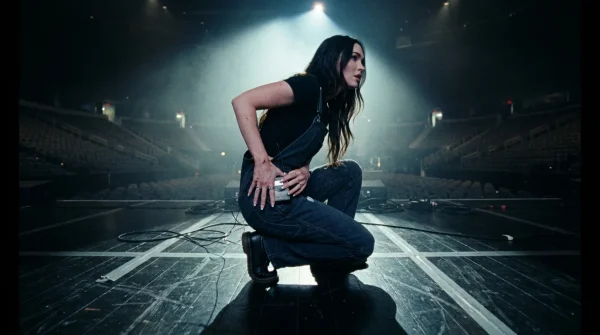
The concrete floor beneath your sneakers hums before you even hear the pitch. Inside an eighteen-thousand-seat arena, the air hangs heavy with theatrical fog, stale popcorn oil, and the faint, sweet scorch of pyrotechnic charge. When the lights cut to black and the opening chords rattle your ribcage, you believe you are hearing pure, unrestrained human spirit roaring through a wireless handheld microphone.
You lean forward as the vocal climbs into a strained register. In that exact fraction of a second, an invisible physical pressure slams straight into your sternum, making your shirt flutter and your ears tighten against the sudden burst of low-end force. What registers as arena euphoria is actually an acoustic shield deployed with clinical precision from an aluminum soundboard sitting two hundred feet back in the lower bowl.
Live touring at this scale is an endurance sport played against the unforgiving laws of biology. When you watch Miley Cyrus tear through a two-hour set of raspy country-rock belting, you are witnessing an artist pushing vocal cords against sheer physical exhaustion. To keep that show moving without exposing every pitch slip, cracked note, or wavering vibrato to fifty thousand cell phone microphones, the production relies on an old psychoacoustic secret: drowning vocal micro-flaws beneath towering walls of sub-bass frequencies.
The human ear operates on a fragile hierarchy of attention, and when forced to choose between a wavering pitch in the midrange and a 40-hertz pressure wave displacing the air in your lungs, your nervous system surrenders to the physical thump every single time.
The Auditory Masking Threshold: Why the Body Forgives What the Ear Misses
To grasp what happens at the front-of-house mixing console, you have to abandon the idea that a concert mix is meant to mirror an album track. An arena is not a studio; it is a hostile cavern of reflective concrete, structural steel, and ambient crowd scream. When an artist tackles sustained belts night after night, vocal fatigue is not a moral failing—it is an anatomical certainty. The sound engineer’s job is not just clarity; it is strategic acoustic deflection.
This reliance on low frequencies exploits a phenomenon known as psychoacoustic auditory masking. Think of it like trying to spot a candle flickering across an empty lot while a tractor-trailer rumbles past with its high beams blazing. The candle does not vanish, but your sensory processing completely collapses under the weight of the larger stimulus. When sub-bass cabinets mounted under the stage dump immense energy between 35 Hz and 80 Hz, your brain’s auditory cortex becomes overwhelmed by tactile sensation.
- Jimmy Kimmel freezes on live television after teleprompter screen locks mid-monologue
- Tom Hardy stunts expose spinal compression risks behind high-velocity cable deceleration rigs
- Christopher Nolan confronts studio executives over biometric test screening reshoot demands
- Amy Adams demanded harsh macro lens framing stripping glamour for gritty prestige drama
- Bruce Springsteen halts stadium encore after deafening monitor feedback shatters stage audio
When a singer slightly undershoots a high G or their pitch wobbles under breath fatigue, the mixer does not reach for real-time robotic auto-tune, which sounds synthetic and obvious on a raspy rock voice. Instead, they lean on dynamic automation. They dial the sub-bass channels up three to six decibels precisely on the vocal transition, forcing the room’s air pressure to spike so violently that your brain never catches the half-step pitch drift happening right above it.
The ear’s sensitivity to pitch accuracy lives almost entirely in the critical band between 1 kHz and 4 kHz, a delicate acoustic territory where consonants and vocal warmth reside. By contrast, deep sub-bass frequencies bypass the eardrum’s delicate analytical faculties entirely, rattling the temporal bones of your skull and the fluid in your inner ear. You leave the venue convinced you heard a pitch-perfect masterclass, when what you actually experienced was tactile sonic hypnosis designed to hide human vocal wear.
Behind the Front-of-House Glass: The 48-Year-Old Fader Master
Consider Marcus Vance, 48, a veteran touring front-of-house engineer who has spent twenty-four years sitting behind multi-million-dollar digital desks for major pop and rock headliners. Standing over a DiGiCo console in the center of an echoing basketball arena during 3:00 PM soundcheck, Marcus does not listen to the band the way an audience member does. He listens for the subtle acoustic seams where human anatomy begins to fray. “A singer like Miley has incredible natural power, but touring seven days a week strips the moisture right out of the vocal folds,” Marcus explains while tapping a spectrum analyzer display. “Around song nine, the throat dries out, and micro-flatting creeps in on sustained vowels. If I leave the mix open and dry, every TikTok camera picks up that flat note. But if I duck the upper mids by a hair and let the auxiliary sub-woofers hit the room on the downbeat, the audience only remembers the punch in their chest. It keeps the artist safe, and it keeps the illusion intact.”
Anatomy of the Illusion: Three Layers of Arena Sound Sculpting
The practice of masking pitch fatigue is not a blunt, sledgehammer maneuver. It requires a tiered arrangement of sound channels working in concert, adjusting to the precise acoustic acoustics of each concrete room.
- The Infrasonic Foundation (30 Hz to 60 Hz): This zone does not carry musical pitch; it carries atmospheric weight. Handled by massive dual-18-inch subwoofers arrayed beneath the front stage lip, these waves travel along the venue floor. When the mixer senses vocal strain during an extended chorus, these faders bump upward, engaging your physical body and masking room reflections that would otherwise bounce flat vocal overtones off the back wall.
- The Sidechain Compression Pocket (150 Hz to 300 Hz): This is the danger zone where vocal mud lives. Skilled engineers sidechain the bass guitar and low synth elements to the lead vocal channel. When the vocalist projects cleanly, the bass tucks neatly underneath. When the vocal begins to waver or lose stamina, the ducking releases, allowing the low-mid instrument weight to swell forward and wrap around the dry vocal tone like a warm blanket.
- The Harmonic Overtone Shield (2 kHz to 5 kHz): While the subs rattle the arena floor, sound teams often saturate the upper midrange of the vocal line with subtle tape distortion or harmonic exciters. This creates an artificial brightness that cuts through the bass wall, giving you the impression of crystalline articulation while the fundamental pitch remains safely masked by the low-end churn underneath.
By splitting the soundboard into these responsive zones, the acoustic team protects both the singer’s reputation and the crowd’s emotional investment without resorting to blatant lip-syncing or robotic pitch correction.
How to Read an Arena Mix with Your Own Senses
The next time you stand in a packed amphitheater or stadium, you can bypass the sensory distraction and analyze what the front-of-house engineers are actually doing to balance vocal fatigue against sonic grandeur.
- Feel the chest kick on sustained high notes: Notice if the bass drum or synth pad suddenly feels noticeably heavier during the final chorus than it did in the first verse. If the floor begins shaking harder during an artist’s most demanding vocal run, you are experiencing active masking.
- Watch the singer’s mic distance: When an artist pulls the microphone back more than four inches while belting, their acoustic volume drops dramatically. If the perceived vocal level in the room remains completely unchanged while the low-end swells, the mixing desk is driving the illusion through automated gain and sub-weight.
- Step out from under the balcony overhang: Arena balconies create acoustic shadows that trap midrange frequencies while muting low-end rumble. If you move from the open floor to just beneath a concrete tier, the sub-bass drops out, instantly revealing the dry, naked pitch of the vocals above.
Recognizing these production maneuvers does not ruin the show; it reframes arena touring as a complex collaborative magic trick where human limits meet engineering brilliance to deliver an unforgettable night.
The Reassurance of Imperfection
In an era where recorded music has been polished into uncanny digital perfection, the raw chaos of live performance is the last authentic frontier. We want our pop stars to be superhuman, yet we simultaneously crave the honest gravel of vocal cords pushed to the absolute edge. Arena sound masking is not a deceit; it is an act of preservation. It allows an artist to give everything they have physically on stage without being permanently crucified online for a momentary human slip.
Understanding that heavy sub-bass exists to catch a falling note shifts your perspective from passive consumer to perceptive listener. The next time the low-end thumps so hard your vision blurs during a climactic chorus, smile at the console operators working in the shadows. They are holding up the sky so the star can shine, reminding us that live art is always a high-wire dance between biological fragility and sonic engineering.
“Arena mixing isn’t about playing a sterile record loud; it is about building an acoustic safety net strong enough to let a human voice risk failure without crashing.”
| Key Point | Detail | Added Value for the Reader |
|---|---|---|
| Auditory Masking | Using 35–80 Hz low-frequency sound waves to dominate sensory perception. | Explains why physical vibration prevents your brain from detecting micro-pitch slips. |
| Dynamic Sidechaining | Automating instrument thickness to swell when vocal power dips. | Reveals how mixing boards disguise vocal fatigue without synthetic auto-tune artifacts. |
| Balcony Acoustic Shadow | Evaluating vocal tone from underneath concrete architectural overhangs. | Gives you an actionable method to hear the raw, unmasked vocal at your next concert. |
Frequently Asked Questions
Is Miley Cyrus lip-syncing when sub-bass levels spike?
No. Sub-bass masking is used specifically to support real, raw singing. Rather than replacing live vocals with a pre-recorded track, sound engineers use low frequencies to buffer pitch instability caused by physical exhaustion, keeping the performance authentic.Why don’t sound engineers just use heavy auto-tune on arena vocals?
Heavy digital pitch correction produces a recognizable robotic sheen that clashes directly with rock-influenced, raspy vocal textures. Dynamic frequency masking allows the singer’s natural, gritty tone to remain intact while masking tonal dips underneath physical sound pressure.Does sub-bass masking damage hearing more than normal concert volume?
High sound pressure levels at low frequencies (below 100 Hz) are felt physically and carry less risk of acute inner-ear hair cell damage than harsh high-mid frequencies (2 kHz to 5 kHz), but overall exposure over 100 decibels still requires high-fidelity hearing protection.Can front-of-house engineers predict when an artist will miss a note?
Touring engineers follow the setlist closely and know exactly which songs, choruses, and key changes push an artist’s vocal stamina. They automate console snapshots to engage heavier low-frequency support during historically challenging sections of the night.How can I hear the difference between a natural belt and an acoustically supported note?
Focus your attention on the low-end thump in your chest during a sustained high note. If the bass suddenly hits harder the moment the singer reaches for their highest register, the sound crew is actively reinforcing the acoustic space around the vocal line.